• The move to the new server is done. There are some software and database maintenance updates in process. This has us passing the hat around to help out. We appreciate any donations. Seriously, even a dollar helps. The payment page may be found here - https://www.audiokarma.org/support.html

Dynaco A50 rehab (modded w/ passives)

onanysunday

chasing realism
Subscriber
Hello,

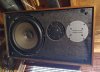
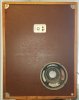
I'm picking up a pair of older, vintage speakers today that look to be quite interesting and unusual. They appear to be in pretty good shape and are reported to sound quite good and can be demo'd. The grills are also in excellent shape. I noticed a passive radiator on back of one of them is missing. I am trying to ID this speaker and its corresponding passive radiator to determine whether they're worth picking up, or whether finding a suitable passive radiator replacement will be impossible to find. Seller doesn't know what speakers they are, but my interest is piqued, as they appear to be Dynaco A50, but this model does not have passives on back. They do not "appear" to be modified by an end-user, but rather it seems like they came from the factory this way with passives on back (but I could be wrong). Perhaps these are another Dynaco model- does anyone know? I always wanted to hear/own the A25, or even the A35, but am wondering if these are even better? They have shallow cabs like the A50. So they are either the A50, or an upgraded version of them. What was one step above an A50 in the Dynaco product lineup when that model was in-production?


mystery speaker 1.png mystery speaker 2.png mystery speaker 3.png
 
Last edited:
Register to hide this ad
They do look like A50. Maybe modded by someone trying to get more bass. If so, it would certainly change the aperiodic function. Even at 120, I'd be cautious. Or maybe there was a different iteration of the A50.

I had A35 years ago, now have a pair of A25s. Always lusted after A50s but never see them in these parts.
 
Grille also looks different than A50 original, maybe indicates someone did indeed mod those. Maybe you can remove a speaker and confirm if the cabinet has an angled chamber separator. From HiFi Engine...

"The internal cabinet structure is unique. Two separate chambers provide dual spectrum damping - a combination of ideal damping in the range of cone resonance, plus the benefits of a larger sealed enclosure in maintaining linearity in the lowest bass region. The two woofers are mounted in one chamber, which is vented through an acoustic impedance system into the second sealed chamber. This variable volume action of the aperiodic design lowers the Q of the system, and preserves an even more linear impedance characteristic than is achieved in the A-25. The result is notably superior transient response (articulation) in the bass range."

If original (albeit modified) A50, then you might choose to restore back to original.
 
My first good system had A50s. Wish I still had them. I currently have A10s, A25s, A35s, and Sennheiser SE-2s (close cousin).

AFAIK there was no variant with a passive. The passives are mounted in the aperiodic section, not the woofer section, so they would not function as passives ordinarily do. It would be more of a "compound aperiodic", if the original internal baffle and damped vent are still intact.

The drivers look pretty hammered. The tweeters were the same in all models of that series (Seas H087). The woofers looked identical to the smaller models, but they were 16 ohm each, in parallel.

Might be a lot of work to get them up to speed.


Edit: the orange-ish color of the tweeter domes makes we wonder if they are not original, maybe Heppner or something else. Unless that's just an artifact of the pic.
 
Hammered? No, just dusty. I play tested them in the seller's garage and they sounded pretty good. All the drivers work properly, channels sound balanced with equal output, and all settings on both pots work without static or voice coil rubbing on the woofers. Of course the electrolytics need to be replaced and I need to match the back of the one speaker to the other. Other than that, maybe upgrade the cement power resistors (if it has any) sand and oil the cabs and call it a day.

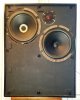
They're definitely A-50 that were modded by someone. There's rope caulk on the upper woofers where the cones meet the dust caps perhaps to dampen, add mass, or integrate with the added driver on back of the speaker which is just below this woofer. Grey felt woofer trim sections were also added at some point. I think they're outstanding. I'm glad I got them.
 
Hammered? No, just dusty. I play tested them in the seller's garage and they sounded pretty good. All the drivers work properly, channels sound balanced with equal output, and all settings on both pots work without static or voice coil rubbing on the woofers. Of course the electrolytics need to be replaced and I need to match the back of the one speaker to the other. Other than that, maybe upgrade the cement power resistors (if it has any) sand and oil the cabs and call it a day.

They're definitely A-50 that were modded by someone. There's rope caulk on the upper woofers where the cones meet the dust caps perhaps to dampen, add mass, or integrate with the added driver on back of the speaker which is just below this woofer. Grey felt woofer trim sections were also added at some point. I think they're outstanding. I'm glad I got them.
Good on you, you have a great pair of uncommon speakers there. Enjoy and keep us posted!
 
Hammered? No, just dusty. I play tested them in the seller's garage and they sounded pretty good. All the drivers work properly, channels sound balanced with equal output, and all settings on both pots work without static or voice coil rubbing on the woofers. Of course the electrolytics need to be replaced and I need to match the back of the one speaker to the other. Other than that, maybe upgrade the cement power resistors (if it has any) sand and oil the cabs and call it a day.

They're definitely A-50 that were modded by someone. There's rope caulk on the upper woofers where the cones meet the dust caps perhaps to dampen, add mass, or integrate with the added driver on back of the speaker which is just below this woofer. Grey felt woofer trim sections were also added at some point. I think they're outstanding. I'm glad I got them.
Yeah, "hammered" is too strong a word. It would be interesting to know the design approach on the mods. Adding mass to one woofer would lower the sensitivity and resonance slightly. The effect of the passive depends on several factors but it would probably not alter the sound a lot. Looks fun.
 
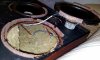
I really wish I knew the intent behind it and what they were trying to achieve. I know that the bass was claimed to be the biggest and most impactful of all the “A-XX” models with good “articulation” according to literature at the time with perhaps a slightly lower “Q-Factor” compared to some of the other models? Would this mod raise or lower the “Q” do you think? What do you think it would do to frequency response on the bottom-end? Raise it, lower it, or have no effect? Also, these appear to be transmission line speakers and the extra driver is in the lower, sealed enclosure. See photo below.

Has anyone heard of modding Dynaco speakers? Was it ever a “thing” -maybe there was an article in an audio or hobbyist magazine in the seventies or something that talked about adding an additional driver or something.. Maybe this was just random guy taking matters into his own hands? It will be hard to give them a full sonic assessment on their true potential before I recap them.

68D45D8B-F3F5-4A6C-97EF-8806E9860279.jpeg
 
Last edited:
I modded my A35s, but on the high end. (They are, coincidentally, playing now in the work room.) I added Infinity EMIT tweeters. I did not alter anything feeding the existing domes. I set up the EMITS to add a bit of top end where the domes roll off. I can turn them off with L-pads if I feel like hearing stock sound.

IMG_20220731_114943_1.jpg

All the Axx speakers used aperiodic woofer loading, which uses a damped vent. On the 10 and 25, the vent is exposed on the baffle. On the 25, 35, 40, 50, it feeds into a second interior space thru an internal partition.

Aperiodic loading reduces system Q slightly. The bass tendency to peak is reduced. It does not lower the cutoff frequency. I have messed around with lightly stuffing vents in an attempt to get aperiodic response. This works, but the amount and density of stuffing is critical. You must tune empirically, meaning measure as you go with a tool like the Dayton Audio DATS. Too much stuffing and you get a sealed system. Too little and it keeps the original vented properties.

If your A50s have the original partition, vent, and vent dampening material intact, adding a passive radiator on the far side of the partition might have little or no effect. Measurements of Q would be needed, preferably with varying amounts of mass added to the passive. It would be fun to play with. If you just go with what you've got, you'd probably be fine.
 
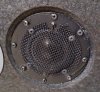
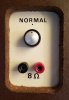
After creating air spacing between the domed, metal tweeter grill and the two exposed voice coil leads (on the front of both tweeters) the resistance of these tweeters went way down (if I recall as it was several weeks ago) from around 4-6 ohms down to about 0.5 or 1 ohm which does not sound right at all but they sounded pretty good before and their resistance measured closer to what I'd expect with the metal domes touching the voice coil leads. Also, at some point the tweeter wiring was cut in half/ re-attached using loosely fitting wire nuts only. These exposed metal strands were heavily oxidized and loosely fitting in the wire nuts. I re-attached the tweeter wiring using thicker, fresh OFC stranded wire and soldered this connection instead of wire-nutting it. Now, the volume level of the tweeters is down compared to the level they had before when their metal domes were touching the voice coil leads with increased resistance and their oxidized wiring connection was only loosely attached with wire nuts. I have ordered the upgraded SEAS tweeters which should arrive any day now. The crossovers still need a recap. Also, I found the internal wooden cabinet partitions still intact and lined with insulation (see photo).

https://www.madisoundspeakerstore.c...s-prestige-27tffc-h0881-textile-dome-tweeter/

h881.jpg dynaco partition.jpg
 
Last edited:
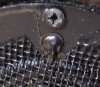
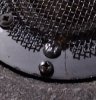
If anyone else is running (any) Dynacos with the SEAS tweeters and domed metal grills, I would be curious to know whether your domed metal tweeter grills are/were also touching the two exposed voice coil leads on the front of the tweeters? This increases the resistance of the tweeter compared to the lowered resistance of the tweeter with the metal grill removed or re-installed with air spacing between the metal-to-metal contact point they had before. Apparently, my domed tweeter grills were either smooshed in at some point or they came that way from the factory. Either way, the tweeters actually sounded better with the increased resistance of the metal domes touching their voice coil leads. I thought (everything else being equal) less resistance = more gain? i.e. 4 ohm speakers are "louder" compared to 8 ohm speakers when driven by the same amp at the same volume level. I can't imagine increasing the gauge/ quality of the tweeter wiring would lower the gain? Now I have to increase the tweeter pot to its max setting to achieve a similar amount of detail and gain as I was getting before. I am getting new (naked) tweeters anyway (without grills) and still need to recap so I am not overly concerned at this point- but it is a bit odd. Go figure.
 
Last edited:
I have 6 of these tweeters in use now, and I think a couple spares. It looks to me like the leads passing under the gratings are insulated or coated with standard "Dynaco black gunk". They definitely need to be insulated or not touching the grating. I don't think these are touching but they are close.

IMG_20221012_202957_1.jpg

IMG_20221012_203020_1.jpg

IMG_20221012_203028_1.jpg

Those look like very good tweeters you chose.
 
The grid is not supposed to make contact with the lead-out wires. The "goop" is there both to insulate the wire and reduce vibrations. The original grid has large openings for both wires, so make sure it has been installed in the correct orientation, and not 90 degrees off.

If there is electrical contact between the lead-out wires and the grid (or the front plate), the signal is partly shorted. I would expect less total resistance, because the short is effectively parallel to the voice coil. The tweeter output would be reduced, since part of the signal now bypasses the voice coil.

- H -
 
Last edited:
Sounds strange, but if the tweeter still has this problem (0-1 Ohms is definitely not normal for a working driver, and not good for your amp), it doesn't have to be the grille. The tweeter front plate is made from aluminium, so check that the terminals have no electrical connection to it.

That being said, one of your pictured tweeters certainly has been tampered with to some degree, so getting new ones would perhaps be wise.

The speakers look like A50s to me, but judging by your images and descriptions, they've had a hard life. Note that at least two of the front woofers are non-original.

- H -
 
Last edited:
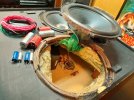
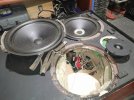
All drivers (including woofers) are SEAS with the exception of the new passives I purchased and installed through Dayton. 2/4 woofers just have a different looking dustcap with rope caulk for added dampening that was added/ installed on them at some point with the addition of that rubbery black paint on the paper cones for rigidity. It's also obvious someone has removed and then re-installed the drivers multiple times (probably while "tuning") as several of the driver mounting holes were stripped out- allowing air to escape. There were several areas around the driver mounting holes where you could feel the air pumping out with each bass note. These will all be sealed back up to make the cabs airtight once again.

passive1.jpg passive.jpg seas.jpg terminals.jpg a50 front.jpg
 
Last edited:
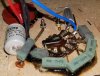
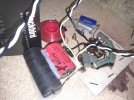
I received the tweeters today and had a look at the crossovers. Dead simple and a blessing in disguise with less parts to consider, upgrade, go bad, or effect the signal path in a negative way. For the most part, it seems all drivers are pretty much running wide open for this two-way design to give full frequency response. There’s just one inductor, one pot with resistors and one low-voltage 25uF and a 5uF. I may/ may not upgrade the wiring.

I will be upgrading both bi-polar electrolytics with some polypropylenes I have lying around which I’ve cobbled together to equal the same capacitance as the originals. 20uF + 4.7uF gets me to 25 (Icel and Jantzen Standard-Z) for the woofer section and 2uF + 3uF (Electrocube 935b and Component Research paper-in-oil) for the tweeter section. I’m really excited to hear the 935b and PIO with the new, upgraded SEAS tweeter.

Also looking forward to how much I may be able to tighten up bass response with new crossover components as well as sealing off any cabinet leaks. The speakers already have more than enough bass response as-is, they just need to tighten up at this point. I could be wrong, but adding some rigidity to the paper woofer cones by coating them with a rubbery paint and adding mass / dampening to the upper woofers with rope caulk would appear to “tighten” up bass response, slow them down or make them more controlled- similar to the effect of increasing the damping factor on an amplifier, while adding a passive on back may help compliment the woofers or fill-in lower frequencies or increase the perceived soundfield. I have no measurements to back that up. I’m just trying to get into the mind of the person that modified these speakers and what could (possibly) come out of such a design. Either way, I’m not concerned this bass modification has made these speakers sound “bad”. That is not really the concern at this point. These speakers have gobs of bass response and articulation that just needs to be tightened up and dialed-in a bit. I could be wrong, but the felt pads appear to serve the purpose of spacers/ shims to position the woofers in a specific, fixed position to help keep them solidly in position for mounting or visual purposes as the baffle cutouts for these is of a larger diameter than the circumference of the woofers themselves.

Honestly, the hardest part (at this point) is to re-establish clean, flat, airtight, driver mounting surfaces. These drivers have all been removed and re-installed so many times that several of the driver mounting holes have gone all the way through causing air leaks. Also, the fiber wood used for the baffle is chipped and uneven in many areas. At least three different types of “goop” was used at different times to keep the drivers sealed and in place. I may have to scrape and fill-in all the uneven mounting surfaces and holes to get these cabs as tight as a drum. The mounting screws used were too long and going all the way through the cabs creating holes (and potential air leaks) in them all over. These will all be filled. I found some wood screws with a shorter reach I will then use that won’t go all the way through the baffle.

Stay tuned. I don’t have a lot of time these days but was at least able to make some progress on them this weekend.

A50 woofer.jpg A50 crossover.jpg A50 caps2.jpg
 

Attachments

  • A50 woofer.jpg
    A50 woofer.jpg
    114.8 KB · Views: 7
  • A50 crossover.jpg
    A50 crossover.jpg
    127.2 KB · Views: 9
  • A50 caps2.jpg
    A50 caps2.jpg
    120.1 KB · Views: 7
Last edited:
Two years later an update. Crossover before and after. Yes, I could've replaced the resistors and inductors too, but I may as well re-invent the wheel at that point. I grew weary after cleaning the pots, recapping the crossovers with last minute mkp revisions bypassed with PIO, upgrading all internal wiring to mil-spec solid copper in ptfe, sealing the cabs to make them completely airtight, and adding even more cabinet insulation to re-tune them to tighten up the bass with the extras passives that had been added to the back at one point. I had to re-adjust the fill about 6 times until I was happy that I had tightened them up adequately and optimized their bass response. These are some very solid, respectable sounding speakers with enough bass in corner room placement that a sub is completely unnecessary. They cast a big and meaty natural stereo image with airy highs and a very full midrange with a textured, satisfying body on the lower registers. Would I have added the passives myself to an original pair of A50? No, but I love the way they sound with them. It just took some careful cabinet tuning for them to arrive at their best sound. I can't imagine I'd ever want to sell them. They're unusual and sound unlike anything else I've ever heard- in a good way.
 

Attachments

  • Dynaco A50 recap.jpg
    Dynaco A50 recap.jpg
    151.2 KB · Views: 16
  • 20231213_134735.jpg
    20231213_134735.jpg
    136 KB · Views: 17
  • 20231213_134756.jpg
    20231213_134756.jpg
    142.7 KB · Views: 18
Last edited:
Congrads for making it to the completion of your project! It sounds like they turned out in an unexpected and good way, and they are
a unique keeper!
I love DIY stuff, and the creating and modifying and learning along the way is the best of the best in my book. :)
 
Back
Top Bottom