• The move to the new server is done. There are some software and database maintenance updates in process. This has us passing the hat around to help out. We appreciate any donations. Seriously, even a dollar helps. The payment page may be found here - https://www.audiokarma.org/support.html

Dynaco st-70 identification

Carbsandcaps

Super Member
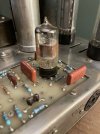
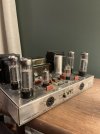
Just picked up this dynaco st-70 from a guy who got a bunch of dynaco stuff from an estate sale. It’s obviously a mk1 but it uses 6gh8a driver tubes. I’m sure the driver board has been replaced since it looks newer and definitely has new caps and resistors. Any info would be appreciated. image.jpg
 
Register to hide this ad
They’re soldered in. That’s not to say the sockets weren’t replaced. The original owner seemed to know what he was doing and all 3 of the st-70’s had different drive pcb’s. image.jpg
 
replaced the bias rectifier too. Looks like it was done a while ago based on the browning of the tape flags. I think I'd have to remove those, it makes it look sloppy.
 
I know there was a change at some point as to how the bottom cover was attached, but I'm not aware of any "Mark I" versus an implied Mark II version of the ST-70 as manufactured and sold by Dynaco. There was always just the ST-70 within the original Dynaco product line. Later, I think Stereo Cost Cutters issued their own version of the ST-70 -- which used a 6GH8A driver tube on their board -- and to distinguish the difference, I think they called their version the Mark II -- but that was not an original Dynaco product. I'm not trying to make an issue out of a tissue, but simply emphasizing what the distinction is between a Dynaco ST-70, and a Stereo Cost Cutter ST-70 Mark II.

From the looks of your unit, it appears to me to be an original Dynaco ST-70, that has had the Stereo Cost Cutter ST-70 driver board installed so as to be able to use the more available and economical 6GH8A driver tubes in the original circuit.

Dave
 
Can you explain "Stereo Cost Cutter"? Is that a joke or not. The Dynaco ST-70 Series II was developed by Panor Corporation, which owned the Dynaco brand at the time of the Series II's release. Doesn't it say something that the owner decided to use a series II board to improve upon the original and take advantage of better tubes than the 7199? This updated version of the classic ST-70 tube amplifier was designed to modernize the original while maintaining its legendary sonic character. The Series II includes updated components and design improvements to adapt to the advancements in audio technology, aiming to appeal to both long-time fans of the original and new generations of audiophiles. Panor Corporation's initiative in creating the ST-70 Series II was part of a broader effort to revive and sustain the legacy of Dynaco's high-quality, affordable hi-fi equipment.
 
@albusark , @Carbsandcaps
From Wikipedia:
"Dynaco was acquired by ESS Labs, LLC in 1979; the Dynaco division was closed in 1980 and its assets acquired by Stereo Cost Cutters (later called Sound Values and Sound Valves).

In 1991 the Pan Orient Corporation (later Panor Corporation) acquired the Dynaco trademark, and in 1993 began marketing electronic audio components with the Dynaco brand. Panor introduced some new products, such as the Stereo 70 II."

Vintage Electronics LLC (EBay) has Stereo Cost Cutters/Sound Values/Sound Valves inventory:
(No affiliation).
We purchased the remaining inventory of the Sound Values/Stereo Cost Cutters operation and have been selling just the bare board for a while (Sound Values branded their audio tube line as "Sound Valves"); however do to customer requests, we have now sourced all the components required to complete the board and can now offer the stuffed version for the hobbyist who doesn't want to spend the time building their own. These boards use the plentiful (and affordable) 6GH8A tubes versus the original 7199 tubes. Similar to our own assembled/stuffed Vintage Electron PC-3B 6GH8A driver board (listed in our eBay store) but uses a slightly different circuit. We include a copy of the original Sound Valves installation manual.
1712493609361.jpeg
 
Last edited:
Back
Top Bottom