• The move to the new server is done. There are some software and database maintenance updates in process. This has us passing the hat around to help out. We appreciate any donations. Seriously, even a dollar helps. The payment page may be found here - https://www.audiokarma.org/support.html

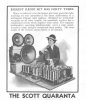
E.H. Scott Tubes. What a photo!!!!!!

Register to hide this ad
Not sure if this one is a bi-amp or tri-amp setup, but they made both. At one point tube count was the major bragging right, so manufacturers used a lot of them. These were mostly single element tubes too, so if you needed two triodes to get a job done, that was two tubes.

Two of the more impressive things with this one, the chassis chrome is in good shape, and its in a cabinet. Along the way a lot of the cabinets have gone away, and the chrome wasn't super amazing quality so when these got abandoned in a basement or whatever it bubbled and pitted really badly. This one is a real gem.
 
I think the Philharmonic is parallel push-pull output, not biamped.
While tube count was bragging rights, Scott had the high count from function features engineering to have the best set sold.
 
For comparison, a working class person could pick up the same stations on their AA5
That's called an AA5 because the tube count is 5.
So the scott has 8x as many tubes as a average household radio of the time.

Just to put that number in perspective.
 
For comparison, a working class person could pick up the same stations on their AA5
That's called an AA5 because the tube count is 5.
So the scott has 8x as many tubes as a average household radio of the time.

Just to put that number in perspective.
Specialty tubes made a reduction of tube count and cost for a real superheterodyne receiver possible, the AA5 is really a very efficient topology used worldwide for decades.
It could receive the same local and "skip" distant AM BCB stations as the Scott, but not difficult distant and foreign broadcasts, nor could it deal with noise and static interference like the Scott, and definitely not with the sound quality. Like the Model T Ford for automobiles. the AA5 brought decent affordable AM radio reception to most folks in a reliable easy to maintain form, it delivers a lot with a little, in console form can be impressive as a full sounding multi-band international receiver.
 
Last edited:
You are right. It is chrome. Why did I say stainless steel? :crazy: :rolleyes:
Dunno either, in the 1920s it would have been nickel plated. Hard chrome plating is a 1930s thing. Stainless steel sheet was notoriously hard on dies to punch and form, Ford briefly used it on Model A Ford trim, then dropped it on later models.
 
Last edited:
My dream set as a tech head 1950s kid was a Hammarlund Super Pro 210X, finally acquired one as a BC-1004-C military general coverage commo receiver. A classic very high grade 1930s type16 tube allwave receiver topologically similar to the Scotts, without the bells and whistles features but with better parts, being Hammarlund OEM and MilSpec.
 
Last edited:
In "everyman" trim, the AA6 is the better set. AA5 with an RF amp stage, and in better implementations its a tuned RF amp stage. Variations of that existed with shortwave tuners too. By the mid-late 30s you could have a competent international receiver with good performance with 7 or 8 tubes. That would get you an RF amp and push-pull audio output.
 
In "everyman" trim, the AA6 is the better set. AA5 with an RF amp stage, and in better implementations its a tuned RF amp stage. Variations of that existed with shortwave tuners too. By the mid-late 30s you could have a competent international receiver with good performance with 7 or 8 tubes. That would get you an RF amp and push-pull audio output.
Definitely, then comes the point of diminishing returns for the average user. Some might consider a single ended console with a well chosen speaker would be have better SQ in an average domestic setting then the more powerful P-P "upgrade" with a larger speaker.
 
yeah, massive tube count tabletops are sort of pointless at some level because of the small speaker. There are consoles that are just big boxes with the same weenie electronics and speakers inside though, and those aren't awesome either.
 
yeah, massive tube count tabletops are sort of pointless at some level because of the small speaker. There are consoles that are just big boxes with the same weenie electronics and speakers inside though, and those aren't awesome either.
A 6-8 inch speaker on a baffle is an excellent vocal reproducer ime. German table sets use variations, usually oval and are renoun for SQ with typically an SE EL84 on an AA5 config, and do well mid-bass-to-mid-treble.
 
Last edited:
Back
Top Bottom