• The move to the new server is done. There are some software and database maintenance updates in process. This has us passing the hat around to help out. We appreciate any donations. Seriously, even a dollar helps. The payment page may be found here - https://www.audiokarma.org/support.html

Eico ST40 problems

mdc701

Active Member
Hello guys,

I’m new to the Eico world. I recently got an ST40. When I hooked it up, I noticed that one channel was softer than the other. The balance knob would have to be at around 3 o clock in order for both channels to be more or less the same. I have since cleaned all the contacts and still the problem persists. I really like how the amp sounds, i hope there’s an easy fix to this problem. On top of that, one channel has a hum, as if it was grounded. Any help will be greatly appreciated. Thanks!
 
Register to hide this ad
Check to make sure the volume pot resistance are the same on both channels. If those are close check the balance, in centre position you should have same resistance in both halves.If any of these is way off then that's your issue.If these all check out then you need a sig generator and scope to work through the stages to see where you are losing the signal. The hum is not good as noted in one channel. Check also the voltages across the cathode resistor for each set of power tubes. Go through and make sure all grounds are nice and tight and clean.
 
When the amp is powered down, swap all the tubes between the 2 channels and see if the imbalance is the same, i.e. same channel louder than the other one. If there is no difference, then it's something in the amplifier itself. If different, then a tube is causing the imbalance.
 
When the amp is powered down, swap all the tubes between the 2 channels and see if the imbalance is the same, i.e. same channel louder than the other one. If there is no difference, then it's something in the amplifier itself. If different, then a tube is causing the imbalance.

So I sprayed all the contacts/pots with deoxit. I also sprayed the tube sockets and swapped the different tubes from their original positions. When i tried it out, the hum was gone and the output on both channels were pretty much the same! I listened for about 10 mins and noticed one channel (not the original problematic one) was having brief dropouts. I switched the amp off for a while. After a few mins I switched it on and the intermittent channel was now dead. I noticed one of the tubes (Eico 7951) had this smoky patch (it wasn’t there earlier). Is it safe to assume that this is a problematic tube and has been causing the weak/intermittent signal? I’m gonna switch the tubes again later to see if the dead channel transfers to the other speaker.
 
If one power tube has died don't power it back up...I think you need to do more troubleshooting...did you measure across the cathode resisitor for each pair of power tubes as I indicated?
 
If one power tube has died don't power it back up...I think you need to do more troubleshooting...did you measure across the cathode resisitor for each pair of power tubes as I indicated?

Not yet, mainly because I’m not really knowledgeable when it comes to electrical stuff. Will have to take it to a reliable tech on the weekend so he could take a look. On a side note, I tested the amp again a while ago ( before i read your message) and both channels were working perfectly again. So I guess it’s not a tube problem after all? Anyhow, I’m gonna stop meddling with it til my tech checks the unit out. Thanks again for your help.
 
Just to update, I sprayed some deoxit on the weird power switch (the treble control) which i neglected the first time around. I also swapped the 4 12dw7 tubes around. I’m now on my second record and enjoying the EICO immensely! Hopefully the problem has been solved.

One more question, if I want to use the EICO’s phono input, where does the ground wire from the turntable go?
 
Last edited:
There isn't a dedicated ground terminal. Just pick a screw at the back and loosen it slightly to attach a ground wire. It just needs to make a connection with the metal chassis.

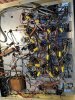
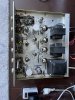
By the way, if you want to post a couple of pics of your amplifier, one from top and another from below with the bottom plate removed, we can tell if anything needs to be serviced.
 
Just to update, I sprayed some deoxit on the weird power switch (the treble control) which i neglected the first time around. I also swapped the 4 12dw7 tubes around. I’m now on my second record and enjoying the EICO immensely! Hopefully the problem has been solved.

One more question, if I want to use the EICO’s phono input, where does the ground wire from the turntable go?

So last night I played the Eico for 2.5 hours straight, much to my enjoyment. This morning, both channels had no sound. All the tubes light up, and the speaker wires and rca jacks are in place. What could be the problem? I don’t think it’s in the tubes as they all tested strong on my friend’s tube tester. Could it be a dead capacitor? I will attach pics of the amp’s underside as suggested by the previous poster. Looking forward to your opinions as i troubleshoot this amp.
 

I think your problem is mechanical and not a bad electrical component.
The signal coming in to the amp needs to pass thru all of the slider switches and the selector switches for source and mode.
They are a source of frustration for anyone bringing one of these amps back to life and are prime suspects when problems like you're experiencing arise.
Even if you gave them an initial cleaning, my experience is that it takes several attempts to get rid of the dirt/oxidation that may be present on the contact surfaces.
You also could have the tape monitor switch in the wrong position.
If you have it in the "on" position you will only get a signal to the amp if you are using the input jack for Tape .

For cleaning purposes on the slide switches, Function and Mode controls I suggest using Deoxit DS5-6S aerosol.
It's made for cleaning metal to metal contacts.
The mode and function switches can be gently scrubbed using a cotton swab along with Deoxit D5 on the contact surfaces visible from the backside of control panel.
Be careful not to bend any of the fragile contact parts.

For cleaning Tone, Volume and Balance controls I have found Dexoit F5 fader lube to be effective.
It's made for cleaning the carbon track potentiometers used at these locations.


Take a few minutes to watch the video, and you'll be able to get a better feel for what you're doing.
 
The switches and sockets of this amp can be confusing too. Have you downloaded the Instruction Manual? There is a free PDF on the web, just search for it.
 
I think your problem is mechanical and not a bad electrical component.
The signal coming in to the amp needs to pass thru all of the slider switches and the selector switches for source and mode.
They are a source of frustration for anyone bringing one of these amps back to life and are prime suspects when problems like you're experiencing arise.
Even if you gave them an initial cleaning, my experience is that it takes several attempts to get rid of the dirt/oxidation that may be present on the contact surfaces.
You also could have the tape monitor switch in the wrong position.
If you have it in the "on" position you will only get a signal to the amp if you are using the input jack for Tape .

For cleaning purposes on the slide switches, Function and Mode controls I suggest using Deoxit DS5-6S aerosol.
It's made for cleaning metal to metal contacts.
The mode and function switches can be gently scrubbed using a cotton swab along with Deoxit D5 on the contact surfaces visible from the backside of control panel.
Be careful not to bend any of the fragile contact parts.

For cleaning Tone, Volume and Balance controls I have found Dexoit F5 fader lube to be effective.
It's made for cleaning the carbon track potentiometers used at these locations.


Take a few minutes to watch the video, and you'll be able to get a better feel for what you're doing.

Thanks for this! I’ll definitely try this and report back.
 
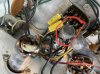
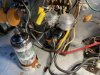
So as I was cleaning the switches with deoxit, I noticed that one capacitor had melted, probably due to the tubes not having those aluminum tube shields? It’s situated directly in front of one tube. Could this be the cause of the problem as well? The value of the cap reads 9000F, 630V. I’ve been googling for “9000F” capacitors to no avail. I hope someone can point me to a store where I can order them. Also, is it advisable to get those aluminum tube shields to prevent this from happening again? Pics below:
 
So as I was cleaning the switches with deoxit, I noticed that one capacitor had melted, probably due to the tubes not having those aluminum tube shields? It’s situated directly in front of one tube. Could this be the cause of the problem as well? The value of the cap reads 9000F, 630V. I’ve been googling for “9000F” capacitors to no avail. I hope someone can point me to a store where I can order them. Also, is it advisable to get those aluminum tube shields to prevent this from happening again? Pics below:

That looks like its a 9000 picofarad (aka 9000uuf) capacitor that is part of your Low Filter circuit.
There are two of them, one for each channel - Part numbers C29 and C30 on the schematic.

The tube shields are to keep stray RF interference out of your audio circuit, not to protect from heat.
It looks like someone has replaced the original ceramic disc capacitors with some sort of polystyrene caps and accidently touched a soldering iron to the outside of the cap.
If its a problem it will only effect one channel not both since there are individual caps for each channel, and will only be audible when the low filter is switched
on.
I'm guessing that it's ugly but not a functional problem.
Mouser or Digi Key should have them if you want eliminate the eyesore.

I would install the tube shields for good measure against RF interference.
I think you can find them inexpensively at Tubedepot or Antique Electronic Supply.
 
Back
Top Bottom