• The move to the new server is done. There are some software and database maintenance updates in process. This has us passing the hat around to help out. We appreciate any donations. Seriously, even a dollar helps. The payment page may be found here - https://www.audiokarma.org/support.html

Electrovoice Interface: What's the design philosophy? And what's with the equalizer?

Ohighway

Wannabe Minimalist
Electrovoice Interface Speakers.

What's the design philosophy behind them?

Why did they choose to use a dedicated equalizer?

Can they be successfully used without the equalizer? I'd like to use these with an all tube system and don't want to place that solid state equalizer in the signal path.
 
Register to hide this ad
The woofer's voice coil is longer than standard practice which lowers distortion but also increases low frequecy rolloff. Other companies like McIntosh and Thiel have done the same thing and also made an external EQ availble. EV unlike the others also used a passive driver to add bass. A lot of people did use them with out the EQ.
 
The equalizer is primarily to extend the bass response - I believe that it extends it on the Interface A from 38 Hz to 32 Hz, then rolls it off steeply after that. I'm restoring a pair of Interface A's this week so I'l see how it works pretty soon. My guess is you'd have no issue running them without the equalizer.
 
Mine are the Interface C speakers. Big bass reflex cabinets (no passives) , 10" woofer, vented midrange and dome tweeter.

Thanks for the input thusfar, I've had these for years but was always curious as to the what and why....
 
I would think you would like the C's.

I have a pair of D's that I bought in 1978. I've used them without the equalizer and I've also used my LaScalas WITH the equalizer (Receiver had A / B speakers and the EV equalizer was in the pre-in/main-out jacks so it affected everything)

I never noticed any detrimental effects from it. I'd say give it a try with the Eq....not only can you always take it out but you would at least be starting with a 'correct' setup and can then decide if you like the EV starting point or the sound of them with the EQ removed.
 
Do a search here on the word 'interface'. I think you'll find a post somewhere with scans of old EV brochures about the Interface series. They should explain the design philosophy.
 
I've collected and saved Stereo Review and High Fidelity Magazines since 1970. I've attached a review of the of EV Inteface A.
 

Attachments

  • EV INterface A_1 001.jpg
    EV INterface A_1 001.jpg
    145 KB · Views: 282
  • EV INterface A_2 001.jpg
    EV INterface A_2 001.jpg
    123.3 KB · Views: 221
Electrovoice Interface Speakers.

What's the design philosophy behind them?

Why did they choose to use a dedicated equalizer?

Can they be successfully used without the equalizer? I'd like to use these with an all tube system and don't want to place that solid state equalizer in the signal path.

I don't know if it's like the McIntosh eq, but if it is, then the speakers will not perform to their fullest w/o the eq. Further, any transitors that would be used are not generating a huge amount of gain, so I doubt you'd notice any difference between solid state and tube.
 
Here you are.


InterfaceApage1.jpg


InterfaceApage2.jpg


InterfaceApage3.jpg


InterfaceApage4.jpg
 
Using Thiele-Small simulation software, a sealed box is a "second order network," a ported box is a "forth order network" and the EV speakers are "6th order networks" with four of the poles in the box and two of the poles in the equilizer (I'm talking about pole/zero analysis of networks). A 6th order response pushes the F3 lower but the output falls at 18 dB/oct after F3. A sealed box is 6 dB/oct and a ported box is 12 dB/oct. The proper output is dependent on the equilizer box. I cannot tell you how the response changes without the equilizer. It's been too long ago to remember.
 
Great post SG.

I remember that brochure and it was very informative. As I recall EV at the time was in the forefront using Thiele-Small methods to design vented boxes and Ray Newman wrote articles about the methods for the audio press.
 
Old thread but thought I'd add some info. EV made many series of the Interface A. Mine are 1985 model A series 4. EV integrated the eq box within the speaker starting with the series 4 model, so that may be why some sets do not have eq box included. Also, EV dropped the rear firing tweeter in the early eighties when they started using the Super-dome 1.5 inch tweeter.
 

Attachments

  • EV Interface A series 4.jpg
    EV Interface A series 4.jpg
    45.5 KB · Views: 48
Using Thiele-Small simulation software, a sealed box is a "second order network," a ported box is a "forth order network" and the EV speakers are "6th order networks" with four of the poles in the box and two of the poles in the equilizer (I'm talking about pole/zero analysis of networks). A 6th order response pushes the F3 lower but the output falls at 18 dB/oct after F3. A sealed box is 6 dB/oct and a ported box is 12 dB/oct. The proper output is dependent on the equilizer box. I cannot tell you how the response changes without the equilizer. It's been too long ago to remember.

yeah old thread but there is a mistake. sealed boxes like AS roll off at a 2nd order of 12db/oct. BR roll off at a 4th order of 24db/oct. the Interface A was 6th order and had a third order (18db/oct) rolloff that became a fourth order at the EQ cutoff point
 
So the EQ is essentially a quasi-active crossover of sorts? And the sonic ramifications of playing my Interface C II's (BR) without the EQ ('cause I don't have one) would be ??????
 
Last edited:
So the EQ is essentially a quasi-active crossover of sorts? And the sonic ramifications of playing my Interface C II's (BR) without the EQ ('cause I don't have one) would be ??????

Not absolutely certain but as I understood EV's application the electronic filter was strictly equalization with a very low bass filter to keep excursion from getting out of hand. In effect they were compensating for small enclosure (as to the system A, anyway) and need for tweeters able to handle power with the low xover point used. The trade off with such drivers was rolled off top end.

Without the EQ in place the low end response (and high) would be less than compared to the response with the EQ. There may be some benefit in lower group delay and better transient response without the EQ.
 
^^^

I find my Interface C's to have very fast transient response and plenty of high-end extension. The LF extension is not so impressive and when I had them in rotation I was using a 31-band EQ boosted below 60Hz. Could've been my room as my acoustic treatment scenario at the time was not as extensive as it is now.
 
FYI In the case of the EV Sentry III the use of the box is optional

dependent on if one of the ports was open or blocked off. With the EQ in use

the result was a 6db boost applied, 3db loss of efficiency and the

response lowered to 28 hz from 39 or 40 hz.
 
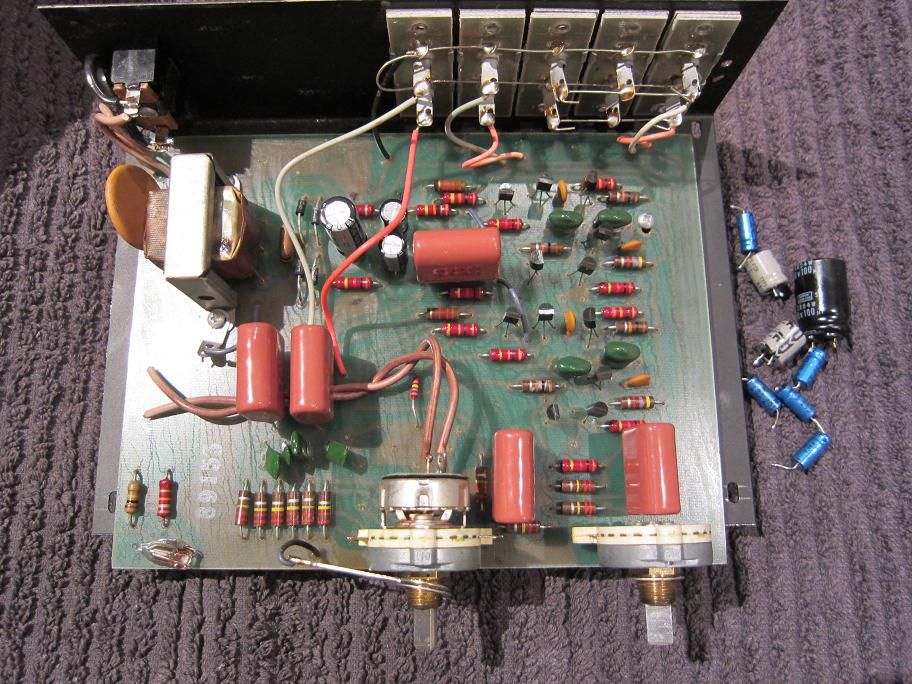
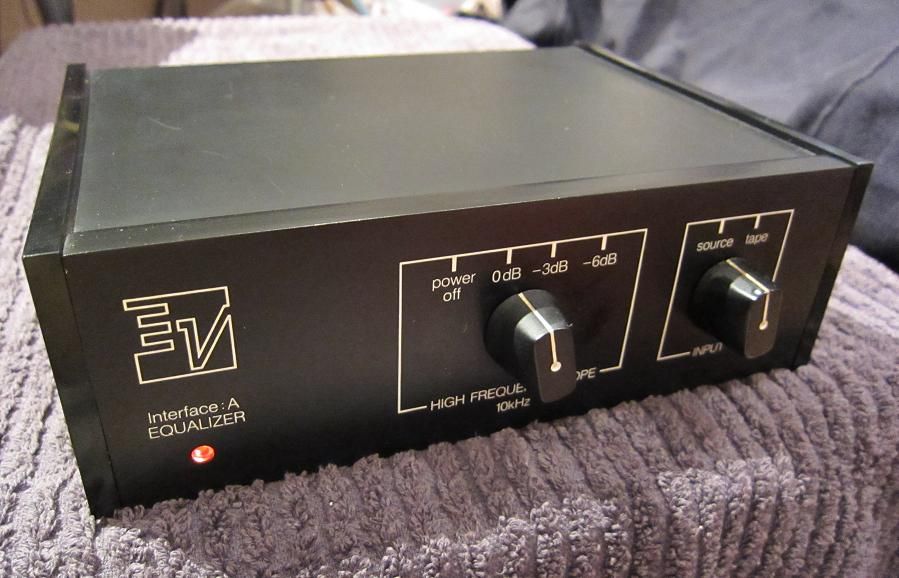
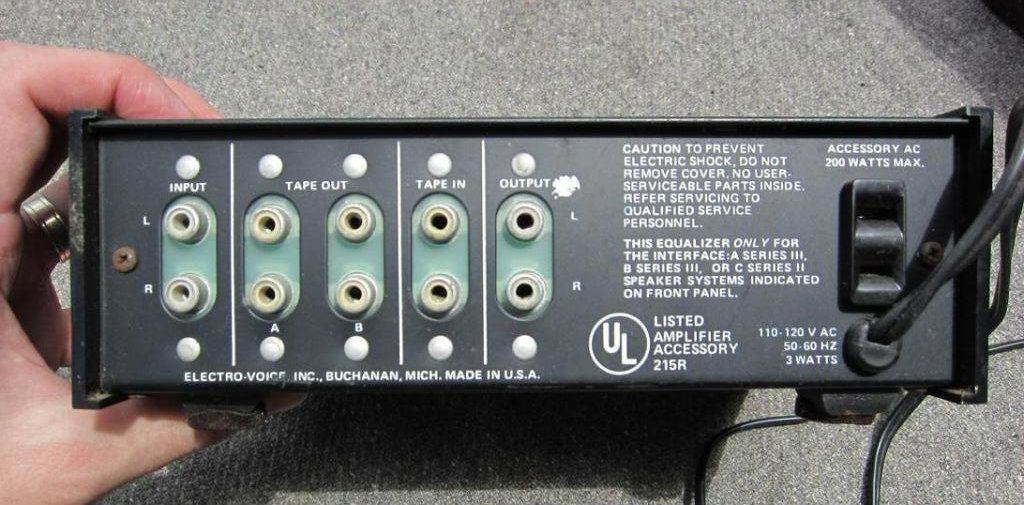
Here are some pics of the Interface A Series III EQ:

eveq2_zpsafb51e68.jpg


evEQ3_zps96dc559a.jpg


eveq4_zps3e5ef1fb.jpg


It has writing on the rear panel as follows:

"THIS EQUALIZER ONLY FOR THE INTERFACE:A SERIES III, B SERIES III, OR C SERIES II SPEAKER SYSTEMS INDICATED ON FRONT PANEL"


evA10_zps9daef1c9.jpg


I've typed up some information from the Interface B Series III owner's manual as found here:

http://www.electrovoice.com/downloadfile.php?i=971391

This information is in the section which relates to running different types of interface speakers from the same amplifier, and therefore advises on which speakers can be used with which EQs. It highlights the subtle differences between the various series of speaker and the accompanying EQ:


"Interface B series III and Inferface C Series II use the same equaliser. Therefore, in a system set up for Interface B Series III, Interface C series IIs may be added to the same amplifier and will receive the proper frequency contouring.

Not unexpectedly, the capabilities of other equalised Interface models are best realised by using the equaliser specifically designed for each system. The deviation from ideal depends on the particular model.

The Interface A Series III is not endangered by the Interface B Series III equaliser as long as very low bass (around 30hz) at the highest listening level is avoided. Frequency response from the 40-80hz range will be depressed about 3/4dB and approximately twice normal power will be fed to the woofer below about 32hz.

Interface D is not endangered by the Interface B Series III equaliser. However, response below about 28hz will be depressed about 3dB and response in the 40hz to 80hz range wil be emphasised by about 3/4dB."

 
I recently did a bunch of research into these. Some of the big brains over at Techtalk posted technical documents that clarify the design.

As I recall, the idea was that EV used the woofer's thiel-small parameters to tune the box lower than the optimal tuning for the woofer, which extends the bass response of the system but decreases efficiency. Then they used the eq to boost the signal to offset the efficiency loss. So the net result is a lower freq extension than was possible without the eq.

If I had a set of these, I'd definitely run the appropriate eq for the speakers. I have an Interface A eq on my JBL L150As right now, and it gives a nice boost to the low end. I got the eq because I was planning to try to build some Interface D workalikes, and I was gonna mod the eq to I-D specs. But then I figured I might as well try it on my L150As, and I've lost interest in the I-D project.

The second post in this thread has all the technical docs. Post #19 is very technical but actually explains the idea very well if you can decipher it.

BTW, the point of this sixth order crossover design is extended bass in a "too small" enclosure. As I understand it, Bose took these ideas and based their Acoustimass subs off it.
 
Last edited:
Specs and explanations aside ,I've had these since 1998 and they continue to please me.
 
Last edited:
Back
Top Bottom