• The move to the new server is done. There are some software and database maintenance updates in process. This has us passing the hat around to help out. We appreciate any donations. Seriously, even a dollar helps. The payment page may be found here - https://www.audiokarma.org/support.html

Eliminate Crosstalk between AUX/PHONO

arcorob

Addicted Member
So i have had this happen on a few vintage receivers I have restores. Cross talk from AUX if I switch to phono. Its very low and doesnt get louder if you turn the volume up. If an album plays you 100% dont hear it but bewteen vinyl tracks or silence you do.

I am sure folks have run into this. Is there some resistor or capacitor, something on the inputs to keep aux from bleedking over ? DOes not happen with FM or AM, only if source AUX is playing and it comes through.

Suggestions ? This particular one is a Marantz 2220B
 
Register to hide this ad
I don't have an answer for you. It's odd that it doesn't get louder with the volume setting, which implies that it's not the phono pre-preamp that's picking up the crosstalk, but the preamp itself, after the volume control, or possibly the power amp section. It's likely that the tuner doesn't cause it because the tuner is turned off when it's not in use.

Some amps short out unselected inputs; obviously yours don't. If you plug your AUX device into the tape input, does it still happen?
 
Ummm...thats not a fix. Thats a band-aid :)
Don't know about you, but when I spin vinyl, I don't have the DAC and endpoint powered up sending signal simultaneously to the preamp. And vice versa. While my ARC preamp doesn't exhibit crosstalk under those conditions, my question is "why"? Are you comparing same content across different sources and want instant switching?

Mine is a cost effective solution for modest gear. You would likely need to replace both volume and balance pots along with some other tweaks to fully address the issue.
 
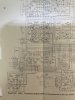
Crosstalk is NOT supposed to happen..it does and it has to have a cause. Yes, these amps short ground when siwtching inputs. WHat I find strange (look at the schematic) is 1) Both AUX and Phono seem like they share a path and 2) BOTH have a .01uF 50V capacitor to ground (C001 and C002). Why a capcitor to ground ?

20230119_000549445_iOS.jpg
 
Signal bleed does happen and it is because of induction in the circuits that are next to each other. There is not something wrong with the unit, nor is it something that can, or should be, fixed. Marantz units do this. Mine does, and there's nothing wrong with it.

In the words of one designer, shut the bloody tuner off, then. Or, whatever source is bothering you. To prove this out, many receivers either cut power or muted the tuner when on another source to prevent this from happening.

They, however, did not do it to the other sources because, when these were designed, every other source can be turned off. Unless you have record selector knobs, your receiver or preamp should only be getting one noise at a time.
 
Signal bleed does happen and it is because of induction in the circuits that are next to each other. There is not something wrong with the unit, nor is it something that can, or should be, fixed. Marantz units do this. Mine does, and there's nothing wrong with it.

In the words of one designer, shut the bloody tuner off, then. Or, whatever source is bothering you. To prove this out, many receivers either cut power or muted the tuner when on another source to prevent this from happening.

They, however, did not do it to the other sources because, when these were designed, every other source can be turned off. Unless you have record selector knobs, your receiver or preamp should only be getting one noise at a time.
Makes sense and yes, the other occurances were on Marantz...LOL. Its just a nit and I thought perhaps it was some known "here is how you fix it by adding a 200Kohm flux capacitor to the J782 lead and setting the warp drive to 9" :-)
 
Its a normal problem with older tube stuff. Some older Mcintosh pieces when you selected a particular source the other inputs were shorted to ground, no cross talk that way. So you couldn't drive two or more pre-amps or integrated units from a single source. So I would install a series resistor to allow other pieces to sample the source. Like the man said turn off the source causing the cross talk. It will extend the life of that unit. Its SOP.
 
I've ran across selector switches that are supposed to ground unused inputs when not in use that have had issues ( dirty contacts, wiper actually spinning slightly off line on rivet.)
I'm not saying that's your issue but a possibility. I still agree it's good practice to have other sources off.
 
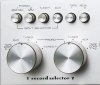
The only thing I have seen that's crazy enough to maybe circumvent this is the Marantz 3650 and similar that has "record select" knobs. These are features that are an additional setting in tape out recording.

On a unit without these, you select your input, push record on your tape unit, and you hear either what the input is playing, or what the tape is getting if you hit tape monitor. If you want to copy from one tape to another, there are tape 2>1 and tape 1>2 copy buttons, and you either hear what the source player is playing, or the record player is getting, based on if you hit tape monitor (and have a 3 head unit.)

On a unit with these "record select knobs", in the "direct" position, they work like the above. If you set one to "tape copy from the other" it will listen to the other tape in. If you set it to aux or tuner, it hears those. I seem to remember it only hears one of the two phonos. But, and my point is, you can set these knobs to have one listening to the phono and recording, one listening to the tuner, and recording, and you can be listening to the aux on the speakers. You can also use tape monitors like normal.

This unit is designed to have multiple signals going through, and I have not played with signal bleed enough on mine to see if the record selects ground out the source playing that is not selected on input when you turn it off of "direct."

1.jpg
 
Last edited:
+1 dirt in/on the switch. Rotaries are especially bad for this if some sort of cleaner that leaves a residue behind is used. The residue always ends up in the phenolic wafer where it plus dust ends up forming a leakage path. Sometimes you can fix it by hosing it down with a non-residue cleaner.

other things its just physical proximity of all the wiring or traces and it won't go away. They capacitively couple so the highs bleed across. Thats why better switch designs ground the un-used inputs.
 
Having to turn off a tuner, or other source, can be inconvenient for those of us who sometimes have two or three active inputs. I'd think this shouldn't be a problem with a good preamp.
 
Back
Top Bottom