


Oval drivers are tarred by association with car speakers, but the shape makes sense -- it has most of the rigidity of standard cone speakers, but the cone resonances are spread out so less audible. They also have better dispersion in one plane than the other, which can be useful, and in the plane of greater dispersion (perpendicular to the long axis) they have greater dispersion than a round cone with the equivalent area.
KEF's B 139, the styrofoam/foil racetrack shaped woofer bears some resemblance, and the ELAC driver ithe stiffening ribs that IMF and TDL used subsequently is even closer to elliptical. I used to have a pair of unknown maker German speakers with a big elliptical and there were quite a few small ones used in consoles (Grundigs, Nordmendes and the like) and TV sets etc.
But the EMI is superior to the simple cone ones because of its composite construction with paper outer cone/aluminum inner which gives better control and deep bass, and unlike the (excellent for their application) KEF and ELAC, they go fairly far up the frequency scale so can be used in two ways effectively (and yes I know KEF sold a B139 two way, and its kind of proof of my point -- very odd polar pattern and difficulty with integration of the drivers.)
KEF's B 139, the styrofoam/foil racetrack shaped woofer bears some resemblance, and the ELAC driver ithe stiffening ribs that IMF and TDL used subsequently is even closer to elliptical. I used to have a pair of unknown maker German speakers with a big elliptical and there were quite a few small ones used in consoles (Grundigs, Nordmendes and the like) and TV sets etc.
But the EMI is superior to the simple cone ones because of its composite construction with paper outer cone/aluminum inner which gives better control and deep bass, and unlike the (excellent for their application) KEF and ELAC, they go fairly far up the frequency scale so can be used in two ways effectively (and yes I know KEF sold a B139 two way, and its kind of proof of my point -- very odd polar pattern and difficulty with integration of the drivers.)

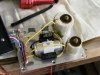
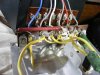
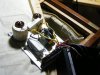


 What are the cap and resistor values you used?