• The move to the new server is done. There are some software and database maintenance updates in process. This has us passing the hat around to help out. We appreciate any donations. Seriously, even a dollar helps. The payment page may be found here - https://www.audiokarma.org/support.html

Empire strikes back!

orgelbau

New Member
I have searched the threads, but am seeking for the specifications of an Empire 9000t Improved. Where does this fit into the hierarchy of the Empire? Is it a later clone of an earlier classic cartridge? I am curious about this one, specifically because I can't find any specific information about it. I know the 7000 III is a direct descendant of the 66 lineage, but can't find anything on the "interwebs" about the 9000, except information on replacement styli. I found one installed on a thrift store TT, and for $15 it may be a real gem of a cart.
 
Register to hide this ad
Almost! It's a clone of the low-inductance 2000X, which just happens to use the innards of the quad 4000D series. So you could say it's a clone of both. We covered the 9000T Improved in the Big Empire Thread. Not a huge difference from the 66 series-- you could get away with using one of the 66 styli with very little high-treble error.
1.jpg
 
Last edited:
Cartridge with a free turntable? I like those deals. The 9000T Improved/2000X is a very capable and good-sounding cartridge-- the only trouble now is finding the original-genuine S917E styli, or, for that matter, the S4000D, S440D or S912E styli.
 
I have searched the threads, but am seeking for the specifications of an Empire 9000t Improved. Where does this fit into the hierarchy of the Empire? Is it a later clone of an earlier classic cartridge? I am curious about this one, specifically because I can't find any specific information about it. I know the 7000 III is a direct descendant of the 66 lineage, but can't find anything on the "interwebs" about the 9000, except information on replacement styli. I found one installed on a thrift store TT, and for $15 it may be a real gem of a cart.
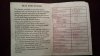
I was seeking specs and didn't realize that under the display in the velvet box it came in, is the spec sheet. When I get home, I'll take a pic and attach here.
I remember LOVING that cartridge and am anxious to connect it up again and see why. As I remember, I think it had a good, strong output....High mV @ 1K Hz?
 
I have an Empire 2010 that has the same metallic red stylus with gold print. It's killer! What amazes me, is how quiet in the groove it is. Clicks and pops that other carts pick up just seem to disappear with it. It also has about the least amount of IGD I've heard from an elliptical. Empire must've gotten something right with their tip profiles, back in the day. It's only minor weakness is that it's a little more prone to sibilance than some, but not drastically so.

WD-40 helps 'em when they sag, too.
 
gavel01: Thanks for the photos!

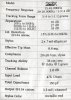
Now if you were thinking the 9000T Imp had higher output than the 2000X, you need to look at the velocity the specs writers cited for the output figure. You'll see that both the 2000X and 9000T Imp put out what was average at the time: 1.0mV output per cm/sec groove velocity.

Why they'd cite 3.54 cm/sec one time and 5.0 cm/sec another, for two identical cartridges, I don't know. Possibly to "differentiate" the models, and Empire isn't alone in this. The difference is what you'd get if one groove were stereo and the other mono (look for that magic 0.707 ratio).
Upshot: anytime you're looking at output figures, they have to be referenced to a velocity; otherwise the spec tells you nothing.
 
gavel01: Thanks for the photos!

Now if you were thinking the 9000T Imp had higher output than the 2000X, you need to look at the velocity the specs writers cited for the output figure. You'll see that both the 2000X and 9000T Imp put out what was average at the time: 1.0mV output per cm/sec groove velocity.

Why they'd cite 3.54 cm/sec one time and 5.0 cm/sec another, for two identical cartridges, I don't know. Possibly to "differentiate" the models, and Empire isn't alone in this. The difference is what you'd get if one groove were stereo and the other mono (look for that magic 0.707 ratio).
Upshot: anytime you're looking at output figures, they have to be referenced to a velocity; otherwise the spec tells you nothing.
I just noticed that! 3.5 mV @ 3.54 cm/sec versus 5.0 mV @ 0.5 cm/sec. Apples vs oranges.
 
Back
Top Bottom