• The move to the new server is done. There are some software and database maintenance updates in process. This has us passing the hat around to help out. We appreciate any donations. Seriously, even a dollar helps. The payment page may be found here - https://www.audiokarma.org/support.html

EPA-110 Loose

mrdavec

New Member
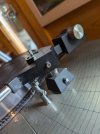
I inherited a Panasonic SL-1100 with the stock EPA-110 tone arm. It plays well most of the time but there's definitely a problem with the pivot which appears to be loose. See video. I've tried to unscrew the pivot screws but they seem very tight. They look like a small screw inside a larger one. Can anyone tell me whether I should unscrew the inner one first? I don't want to break it!


PXL_20240726_125714888.jpg
 
Register to hide this ad
Be aware that adjusting bearings is a delicate job. Obviously you want to tighten the bearings a bit, but be careful, since you can brinnel (mash) the bearing surfaces if you apply too much force. The standard advice (that I know of) is to loosen the outer lock ring and then screw in the pivot pin gently until it makes contact (wiggle the arm a bit to see that the pin is seated). Back of an eighth of a turn, and then tighten the lock screw without tightening the pivot screw - a bit of a problem sometimes,
You need a bit of slop in bearings because nothing is infinitely perfect - ball bearings and ball races have slight variations and if you tighten up enough to eliminate slop, the bearings will quite possibly bind.
Also - and very important - make sure the slop you are trying to eliminate is actually that of the vertical bearings, not that of the horizontal pillar bearings. This is a bit overstated, but essentially correct) the horizontal bearings rely on gravity to keep them tight - the upper race is the one that matters, and the lower race is just there to keep the upper race ball bearings from falling out - and gravity keeps the mass of the arm tight on that upper race. So if you torque the arm checking for loose bearings, if you find slop, make sure it is not the entire arm in the pillar bearings. The slop of the whole arm in the pillar is integral to the low friction of the arm - you want the arm rolling along the top race, with no dragging from the bottom race.
So check by pressing down gently at the pivot point of the arm, and see if the slop is in the vertical bearings before you do any surgery. It may not be necessary.

 
I inherited a Panasonic SL-1100 with the stock EPA-110 tone arm. It plays well most of the time but there's definitely a problem with the pivot which appears to be loose. See video. I've tried to unscrew the pivot screws but they seem very tight. They look like a small screw inside a larger one. Can anyone tell me whether I should unscrew the inner one first? I don't want to break it!


View attachment 3260439
The EPA 100 had ruby ball in the bearing which many broke and need replacing with silicone nitride balls, I don't know what bearing the EPA 100 had, but so much play to me indicates damaged bearings.
You need heat to open them as they are secured with lock tight. I hold a screw driver against the screw whilst heating the blade with a mini blow torch, this,way you heat only the screw not the arm.
I keep stopping and seeing if the outer has become loose, if not continue with more heat, eventually it will come loose, repeat for the inner.
You can mod a screwdriver with a dremel for the outer screw.
With so much play I would be carefully lifting the arm off the bearing to examine the beating but take care not to pull the arm wires.
Chris
 
Thank you for the useful advice. I've managed to undo the lock nuts so I've separated the arm from the bearing. My problem now is that the pivot pin and lock nut seem to be stuck together. If I hold the lock nut in a pair of pliers and try to turn the pivot pin it won't budge. I've tried some penetrating oil but no joy. I've broken two precision screwdrivers trying to turn it! Would heat help?
 
Thank you for the useful advice. I've managed to undo the lock nuts so I've separated the arm from the bearing. My problem now is that the pivot pin and lock nut seem to be stuck together. If I hold the lock nut in a pair of pliers and try to turn the pivot pin it won't budge. I've tried some penetrating oil but no joy. I've broken two precision screwdrivers trying to turn it! Would heat help?
If you have removed the pin and lock nut heat again, it is thread lock holding them together. When heated the lock will melt and thry will easily unscrew.
Chris
 
All of the EPA arm had very strong thread lock, trying to undo without heat will chee up the screws, heat is the only way.
Chris
 
A little heat did the trick. I've re-seated the bearing pins with a tiny bit of play as suggested. Sounds great. Thank you all! I
 
That is very very loose though something in the bearing is very wrong, maybe a bent ir dislodged pin as happens in sl1200mk2 arms.
Chris
When I found the turntable in the attic, it had a big pile of records on top, so it was definitely dislodged. It actually played like this surprisingly well, but occasionally it would skip and other times you could see that the stylus looked to be more compressed than it should be. It's good to have it 100% now.
 
I wouldn't advise using a mini torch on items like this for heat. Use your heat gun that is for heating your heat shrink would be much safer, and you won't risk damaging your painted parts of cause discoloration of metal parts.
 
Most heat guns have much too wide a heated area and only some actually have enough heat to get the section you want really hot quickly enough not to also heat up everything in the vicinity, potentially melting plastic and charring any wood decor.
A very high heat in a small area is safer in my view - of course in this case, the parts were no longer in the tone arm so any heating source could be used.
 
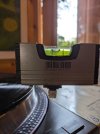
It looks like my problems aren't over! Looks like the piece of metal housing the bearings is actually bent. Looking at the front of the stylus it looks like the right side is slightly lower. Using a spirit level confirms this. Any advice how I might straighten it without doing more damage?

PXL_20240729_155051469.MP.jpg
 
Most heat guns have much too wide a heated area and only some actually have enough heat to get the section you want really hot quickly enough not to also heat up everything in the vicinity, potentially melting plastic and charring any wood decor.
A very high heat in a small area is safer in my view - of course in this case, the parts were no longer in the tone arm so any heating source could be used.
I actually used a mini blow torch for exactly this reason. If I had a hot air soldering station I would have used that, but a normal hot air gun would be difficult to use. With the mini blowtorch I could set the flame down low, stand it on the bench so I didn't need to hold it, hold the part in a pair of pliers and apply heat with good control. I could even turn the screw while it was in or above the flame so I knew exactly when to stop heating.
 
I have a number of hot air guns including tips that focus the hot air in a very narrow area. The cordless Milwaukee heat gun has an attachment for focusing the heat in a small area. Using a cooling blanket to protect the areas you don't want heated is a practice we often use.


One also has to be careful when using gas torches to heat up metals, as some metals are not tolerant to the higher heat that gas torches put out. I was a BMW tech for the K100 motorcycles, and they were very adamant of not using gas torches to heat the cases because of the type of metals they used. They only allowed electric heat guns to heat up parts. Just saying it is your table.
 
Last edited:
I have a number of hot air guns including tips that focus the hot air in a very narrow area. The cordless Milwaukee heat gun has an attachment for focusing the heat in a small area. Using a cooling blanket to protect the areas you don't want heated is a practice we often use.


One also has to be careful when using gas torches to heat up metals, as some metals are not tolerant to the higher heat that gas torches put out. I was a BMW tech for the K100 motorcycles, and they were very adamant of not using gas torches to heat the cases because of the type of metals they used. They only allowed electric heat guns to heat up parts. Just saying it is your table.
That sounds like something for my Christmas list!
 
How did you go with this?
I wouldn't advise using a mini torch on items like this for heat. Use your heat gun that is for heating your heat shrink would be much safer, and you won't risk damaging your painted parts of cause discoloration of metal parts.
His pin was,siezed to the lock nut so removed from the arm.
Chris
 
Back
Top Bottom