• The move to the new server is done. There are some software and database maintenance updates in process. This has us passing the hat around to help out. We appreciate any donations. Seriously, even a dollar helps. The payment page may be found here - https://www.audiokarma.org/support.html

EPI 100 mods

Jailtime

Standin' on a corner
I hit the AK search on this topic, not much there. So, EPI fans, what are some tricks and tips to improve the EPI 100? I have an early walnut veneered pair. The woofers are already refoamed, and I know that the 10uF cap is the first thing to replace. Anything else, like rewiring, acoustic stuffing, etc. that makes the EPI 100 a better speaker?
 
Register to hide this ad
Interesting timing on this inquiry.

I was considering spicing up a pair of Epicure 11 speakers. Beyond the requisite capacitor change I was MOST CERTAINLY going to ditch the stupid speaker connectors on the back and replace with some good binding posts!! Possibly even bypass the 3 position tweeter switch. Another mod I had planned was to reinforce the inside of the cabinet near where the woofer mounts. There's a pair of speakers that Huw Powell rebuilt shown on his site (http://www.humanspeakers.com) and he placed 2x4 braces front to back near the woofer mounting. I have a pair of tweeters Huw rebuilt using inverted -aluminum- domes I was gonna' try out..... just to see if they sound nicer than the originals.

How about you, did you have any other plans for yours ? Methinks there's probably not a lot to be done. The early EPI/Epicure were quality speakers to start with, and are likely hard to improve upon.
 
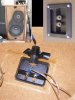
EPI M-100s, swapped out the old spring-clip connectors with tweeter knob for banana plug posts and replaced the 10uF cap.

If I wanted to go further, I would replace the wires from the woofer and tweeter instead of connecting them to the crossover circuit via twist-crimps.
 

Attachments

  • epi_mod.jpg
    epi_mod.jpg
    120.9 KB · Views: 298
I used the Dayton 1% polypropylene caps, and added a .1uf Dayton Film & Foil bypass cap. Also, I broke out most of the masonite in the back, and used the bit that was left to glue in a plug, made of mdf, where the speaker terminals used to be. That gave me a solid mounting surface for a pair of binding posts from PE. I had some 16 ga OFC wire that I used to replace the old hook-up wire that was inside.
 
The batts can be re-arranged to make a better cavity. Turn the center bat 90 degrees to hold the L&R batts near the cab walls. Add a 1x1 front-back brace at the top of the woofer cut out. Use a good glob of hot melt to hold the cap to the back wall or the brace to stop it from rattling. Tweeter wire OK, change woofer wire. Change input connectors if you want. Add a loose fill of Acoust-i-stuff in the channel formed by the re-arranged batts if you want a bit more bass. Make absolutely sure you have an air tight seal on all remounted divers and connectors. Any air leaks will degrade the sound.
 
I hit the AK search on this topic, not much there. So, EPI fans, what are some tricks and tips to improve the EPI 100? I have an early walnut veneered pair. The woofers are already refoamed, and I know that the 10uF cap is the first thing to replace. Anything else, like rewiring, acoustic stuffing, etc. that makes the EPI 100 a better speaker?

If you have an early pair of the 100's, they should have the masonite flange inverted dome tweeters with the linen dome. IMHO, these sound better than the later phenolic domes that came on the newer EPI tweeters. The older ones are probably more efficient due to the much larger magnet structure (higher flux density). Strangely, Genesis Physics used the same tweeter but with the phenolic dome and the larger magnets into the early 90's...

If by chance you have the newer plastic flange tweeters, try a pair of the older ones. They are often found on ebay (selling for too much of course.) The highs may get more pronounced, which I found desirable in my pair of vintage 1979 100's which came with the plastic flange types.

It's going to be hard to improve on the crossover topology, but replacing the aging 10uF electrolytic with a plastic cap is a standard mod. What isn't standard is whether you might want to add some series resistance to the plastic cap to simulate the ESR of the original cap. Mr. Burhoe was a pretty smart guy, and he probably considered the ESR when he specified the original electrolytic.
 
Timely post here as well. I recently picked up a pair of 90s (the same drivers at the 100s but with vinyl-clad cabinets). I am working on new cabinets with a 1.6 ft3 volume to maximize bass (as per the Human Speakers site and some software runs). I spent some time on the baffles today: flush driver mounting, mirror imaged tweeters, and rounded edges (will post pics when done). In the meantime, I pulled the drivers from the original cabinets, installed a new cap on the tweeter, used 16 gauge wire for the connections, and tossed the old fiberglass batts and replaced them with polyfill. The woofers had been refoamed by the fella who owned them before me. Wow - they sound great! I was listening to Pink Floyd's Echos and The Digital Fox last night. I am amazed at the bass that these things put out and how good the 35+ year old tweeters are. I can't wait to see how they sound in the new cabinets.
 
I just have a question. Beyond bringing the EPIs up to spec, why would you want to mod the speaker? If you want a modern speaker, sell the EPIs and get something else. If you are happy with the sound of the EPI, just leave them alone.
 
Like any other mass marketed product the EPI speakers were built to a cost. Most if not all of what I see above is aimed at correcting/improving some of the marginal links in the chain, and not trying to "reinvent" the speaker.
 
The EPIs are great little speakers for what they are and how they are made. I don't see how much can be improved on them besides a recap, etc., to bring them back to stock. Enjoy them, and don't sweat the rest. :)
 
Like any other mass marketed product the EPI speakers were built to a cost. Most if not all of what I see above is aimed at correcting/improving some of the marginal links in the chain, and not trying to "reinvent" the speaker.

Exactly my point. I owned the 100s for over 15 years. I never considered them a platform for a super high end speaker. If that is what people are saying, maybe I made a mistake selling my EPIs...
 
Exactly my point. I owned the 100s for over 15 years. I never considered them a platform for a super high end speaker. If that is what people are saying, maybe I made a mistake selling my EPIs...

That wasn't your point and that is not what people are saying.

There is absolutely nothing wrong with squeezing out the last bit of performance from a great little speaker...no reason to just leave it alone.

Nobody claimed the 100 was the pinnacle of audiophile design but there sure is alot of fun to be had for $25-$50. :yes:

Sure, many may move on up the ladder in the speaker world but it is in the spirit of AK to restore and squeeze out every bit of performance from these old vintage speakers.

It's fun!

and cheap!!!
 
Yes, my 100's have the inverted dome masonite flange tweeter. I don't want to totally mod the speaker, just slight improvements to be made. And that's exactly what all these great AKers provided. Thanks guys! :thmbsp: I'll probably make all these little changes, they're all reversible anyway.
 
Yes, my 100's have the inverted dome masonite flange tweeter. I don't want to totally mod the speaker, just slight improvements to be made. And that's exactly what all these great AKers provided. Thanks guys! :thmbsp: I'll probably make all these little changes, they're all reversible anyway.

Keep us posted on your progress!
 
It would be interesting to lay out all the different version tweeters that EPI/Epicure/Genesis used to compare them.
 
There are pictures of most of the tweeters on the http://www.humanspeakers.com website.

Click on all the part numbers for pictures:
https://secure1.thebook.com/cgi-bin/humanspeakers/parts.pl?brand=e

There's a lot of variations on the basic 1" inverted dome, and then they started changing the product in the mid-1980s, and had some horns and some variations on their original tweeter.

Humanspeakers.com doesn't mention that there are some other differences between the early tweeters and the last generation which includes the Genesis Physics tweeters with the square plastic flange.

Physically, the most obvious difference is the dome material. Less obvious is the voice coil resistance. My round plastic flange EPI tweeters and Genesis tweeters all have resistances almost 1-ohm higher than the older masonite variety. This is in addition to magnet size....

Probably functionally the same though.
 
I refoamed and recapped (Dayton 1% caps) a pair of Genesis Model 10s last year and was unhappy with their sound. As Luvvinvinyl suggests, bypass caps made all the difference in the world. I used Thetas though.

I also replaced the binding posts with Dayton 5 ways.

They sound fantastic with tubes IMO.
 
Hmmm...I didn't mention that I'll be driving them with a Fisher 800C. That should be a really nice combo. Are the 100s an easy load for tubes? I've read that some speakers are hard on tubes (low impedance dips, etc.)
 
ditto....

better caps, wire and stuffing. About the only thing better than a 100, would be two of them put together..lol
 

Attachments

  • IMG_2340.jpg
    IMG_2340.jpg
    40.5 KB · Views: 108
Back
Top Bottom