bob412
Active Member
I posted a question about capacitor quality a few months ago inquiring if cap quality makes a difference to loudspeaker sound . I'm the type that whenever I purchased a new vintage speaker the first thing I would do was to replace all the capacitors with new , cheap electrolytics . I was a happy camper and didn't know what quality film capacitors could do . Anyway I have a pair of EPI-100 based on the Audio Note An-J's( sealed box ) , they call them clones . What follows is my experience with quality capacitors used in speaker crossover networks .
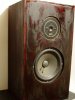
These two inch sausage size Audyn capacitors (10uf,400v) made a huge difference in my EPI Audio Note clone cabinets . The original EPI-100's are great speakers and will benefit from a quality film capacitor instead of an electrolytic . I went with a pair of German made audiophile film capacitors made by Audyn (10uf,400v) . My Epi-100 speaker are remakes using thin walled birch plywood (1/2 inch) . They're bigger than the 100v's mine measure exactly 23hx13wx10d , they're more full range than the 100v's with strong in room bass down to 30hz,easily heard and felt with a 70 watt amp I use with test tones . I like birch because it is light but super strong , very easy to move around . It might be thin but it's a hell of a lot stronger than the original particle board cabinets . The birch cabinets create a very lively , open sound and those cheap electrolytic caps I was using brought out the absolute worst in them , the treble mainly suffered as it was always bright and edgy but very detailed at the same time , for some reason it was never harsh . The only thing that removed the edge was my pentode tube amp or the tripath amp I own .The particle board cabinets are good but in a veiled sort of way and not as lively as the birch cabinets , especially in the midrange( birch is very open and clear) . The birch cabinets with those terrific Audyn film caps (10uf,400v) allows the speakers to sing like a speaker system that cost at least $3000 , I kid you not ! The speakers have a wall to wall type spaciousness and deep clear imaging , the bass is nice and tuneful and deep . I have the speakers exacly 7 feet apart and 5 inches in front of the back wall . When I use very good recordings the speakers now extract room echoes very easily , and that's with a solid state amp . I didn't hear this before , my guess is the Audyn caps has something to do with this detail I'm now hearing ?? My tube amp recreates this spaciousness by a magnitude of two but I don't like the heat associated with tubes this time of year . Room sounds such as echos that exist in recordings wasn't easily heard before I upgraded the caps . Those boutique caps took all the grain and edge off of the treble . It's like there's an openness and spaciousness to the sound without the hi fi edge it had before . Don't get me wrong , if you use a crappy recording it will sound bad but not like it did with those electolytic caps , but it's never harsh . It's like music , natural music , very lively and full of life , especially in the midrange , piano music is incredible . Some people will doubt this and that's fine . All I know is what I'm hearing now and its better by magnitudes . My speakers sound as good as they do simply because of the new boutique caps and the high quality birch cabinets . I copied these ideas from several individuals with websites and their experiences with plywood cabinets , plus a lot of reading BBC monitor reports . Cabinet material makes a huge difference . I went with Audyn because they're used in German speakers that cost anywhere from $4000 to 10k per pair . Those BBC engineers know what they're talking about . If you're looking to take your EPI speakers to the next level of performance I encourage you to experiment with high quality birch plywood . I love the lively open sound these cabinets provide . Like I said before my speakers aren't embarrassed at all by far more expensive modern speakers . It's like EPI drivers have the soul of a reference quality studio monitor in them waiting to be coaxed out . I've alway been impressed with the sound of Fritz loudspeakers but I prefer the sound of my EPI clones to certain Fritz models . And I'm not finished tweaking them . These speakers are incredible, No bull ! All you have to do is experiment like I did .
If you decide to build a pair of birch plywood( marine or Russian) cabinets for your EPI drivers don't finish the cabinets with any polyurethanes at all . It will absolutely kill the tone and the type sound I've just described . You'll find that the tone will be dull ,grey and kinda lifeless . Use a natural finish that allows wood to breath and won't seal the wood . I learned this the hard way by not listening to the guys at the 'mother of tone website' . Or just simply avoid any kind of finish . Quality birch plywood (marine) is completely void free and looks great naked . No bracing is necessary except for pine battens glued to each corner of the inner cabinet walls . Plywood is super strong in comparison to mdf and particle board . If you want a more solid bass just double up on the baffle size to 1 inch instead of 1/2 inch . A thicker baffle will also improve detail retrieval .
These two inch sausage size Audyn capacitors (10uf,400v) made a huge difference in my EPI Audio Note clone cabinets . The original EPI-100's are great speakers and will benefit from a quality film capacitor instead of an electrolytic . I went with a pair of German made audiophile film capacitors made by Audyn (10uf,400v) . My Epi-100 speaker are remakes using thin walled birch plywood (1/2 inch) . They're bigger than the 100v's mine measure exactly 23hx13wx10d , they're more full range than the 100v's with strong in room bass down to 30hz,easily heard and felt with a 70 watt amp I use with test tones . I like birch because it is light but super strong , very easy to move around . It might be thin but it's a hell of a lot stronger than the original particle board cabinets . The birch cabinets create a very lively , open sound and those cheap electrolytic caps I was using brought out the absolute worst in them , the treble mainly suffered as it was always bright and edgy but very detailed at the same time , for some reason it was never harsh . The only thing that removed the edge was my pentode tube amp or the tripath amp I own .The particle board cabinets are good but in a veiled sort of way and not as lively as the birch cabinets , especially in the midrange( birch is very open and clear) . The birch cabinets with those terrific Audyn film caps (10uf,400v) allows the speakers to sing like a speaker system that cost at least $3000 , I kid you not ! The speakers have a wall to wall type spaciousness and deep clear imaging , the bass is nice and tuneful and deep . I have the speakers exacly 7 feet apart and 5 inches in front of the back wall . When I use very good recordings the speakers now extract room echoes very easily , and that's with a solid state amp . I didn't hear this before , my guess is the Audyn caps has something to do with this detail I'm now hearing ?? My tube amp recreates this spaciousness by a magnitude of two but I don't like the heat associated with tubes this time of year . Room sounds such as echos that exist in recordings wasn't easily heard before I upgraded the caps . Those boutique caps took all the grain and edge off of the treble . It's like there's an openness and spaciousness to the sound without the hi fi edge it had before . Don't get me wrong , if you use a crappy recording it will sound bad but not like it did with those electolytic caps , but it's never harsh . It's like music , natural music , very lively and full of life , especially in the midrange , piano music is incredible . Some people will doubt this and that's fine . All I know is what I'm hearing now and its better by magnitudes . My speakers sound as good as they do simply because of the new boutique caps and the high quality birch cabinets . I copied these ideas from several individuals with websites and their experiences with plywood cabinets , plus a lot of reading BBC monitor reports . Cabinet material makes a huge difference . I went with Audyn because they're used in German speakers that cost anywhere from $4000 to 10k per pair . Those BBC engineers know what they're talking about . If you're looking to take your EPI speakers to the next level of performance I encourage you to experiment with high quality birch plywood . I love the lively open sound these cabinets provide . Like I said before my speakers aren't embarrassed at all by far more expensive modern speakers . It's like EPI drivers have the soul of a reference quality studio monitor in them waiting to be coaxed out . I've alway been impressed with the sound of Fritz loudspeakers but I prefer the sound of my EPI clones to certain Fritz models . And I'm not finished tweaking them . These speakers are incredible, No bull ! All you have to do is experiment like I did .
If you decide to build a pair of birch plywood( marine or Russian) cabinets for your EPI drivers don't finish the cabinets with any polyurethanes at all . It will absolutely kill the tone and the type sound I've just described . You'll find that the tone will be dull ,grey and kinda lifeless . Use a natural finish that allows wood to breath and won't seal the wood . I learned this the hard way by not listening to the guys at the 'mother of tone website' . Or just simply avoid any kind of finish . Quality birch plywood (marine) is completely void free and looks great naked . No bracing is necessary except for pine battens glued to each corner of the inner cabinet walls . Plywood is super strong in comparison to mdf and particle board . If you want a more solid bass just double up on the baffle size to 1 inch instead of 1/2 inch . A thicker baffle will also improve detail retrieval .
Last edited: