• The move to the new server is done. There are some software and database maintenance updates in process. This has us passing the hat around to help out. We appreciate any donations. Seriously, even a dollar helps. The payment page may be found here - https://www.audiokarma.org/support.html

EPI Microtower II Crossovers

turnitup

No, the stereo won’t break the crystal...Oh CRAP!
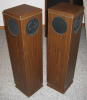
Picked up a pair of these at a garage sale today. Figured out how to remove the grills to check the drivers (in great shape), but cannot figure out how to get to the crossover, or find out where it actually is, in the enclosure. It wasn’t behind the drivers (as far as I could see). I’m wanting to swap out the capacitors...

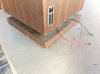
Anybody have experience with these little towers? They have a base on them, but can’t figure out how to get it off...guessing this where the crossover might be? There’s an open port on the bottom...

Funky little speakers, can’t wait to try them out.
DCE505C4-EBCE-4556-B870-606D61B2785D.png
 
Register to hide this ad
The crossovers are almost definitely just one capacitor per tweeter. Remove the tweeter and see if it's soldered directly to it.
 
Check out the crossover circuit at the Human Speakers page:
http://www.humanspeakers.com/e/epi-mt2.htm

Generally, the crossovers on EPI/Epicure speakers is at the speaker input terminals inside the cabinet. The Microtowers have a funky construction to them. I looked into buying some earlier this year during a road trip. I choose not to because I filled up my car with other speakers. :p I have seen rebuild instructions on the web, so you may want to up your Google skills.
 
I just looked at the crossover diagram at Human Speakers. Since there is only one for the tweeters, I would look and see if it was glued to the where the terminal posts are. It may be somewhat far away from where the drivers are.
 
The crossovers are almost definitely just one capacitor per tweeter. Remove the tweeter and see if it's soldered directly to it.

Wouldn’t this dictate that both the woofer and tweeter have caps upstream? Pulled the woofer and no cap. I’m a little reluctant to remove the tweeter unless I have to. It looks brittle...

CC849677-2504-452C-AA92-5D05EEB417A1.gif
 
Wouldn’t this dictate that both the woofer and tweeter have caps upstream? Pulled the woofer and no cap. I’m a little reluctant to remove the tweeter unless I have to. It looks brittle...

View attachment 1624074

There is one cap in series with the tweeter and one cap in parallel with the woofer terminals.

You are part way there. With one of the woofers removed, put on some rubber gloves and a long sleeve shirt. Pull out the fiberglass and stuff it into a plastic trash bag so you can put it back later. Then shine a flashlight into the woofer opening. Follow the wires and you will see the crossover components.
 
There is one cap in series with the tweeter and one cap in parallel with the woofer terminals.

You are part way there. With one of the woofers removed, put on some rubber gloves and a long sleeve shirt. Pull out the fiberglass and stuff it into a plastic trash bag so you can put it back later. Then shine a flashlight into the woofer opening. Follow the wires and you will see the crossover components.

You’re my worst nightmare, but know that you’ve got to be right. Hate dealing with fiberglass!

Thanks for letting me know, I appreciate it
 
There is one cap in series with the tweeter and one cap in parallel with the woofer terminals.

You are part way there. With one of the woofers removed, put on some rubber gloves and a long sleeve shirt. Pull out the fiberglass and stuff it into a plastic trash bag so you can put it back later. Then shine a flashlight into the woofer opening. Follow the wires and you will see the crossover components.

Do you know if the crossover is attached to anything, or just free-floating? Hoping for the latter!
 
Expect to find the parts hot-glued to the back of the terminal plate. If you go to Human Speakers, you can see samples of various models, but not yours, and his replacements.
 
Two each, 10uf and 20uf poly caps? No terminal plates on these things. They’re interesting...
 
Last edited:
Ok, since there is very little information on recapping my little EPI Microtower 2’s, I thought I’d document my effort. Again, this is only MY effort, but I think it is a sound approach...

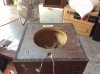
1) Gently pry off the bottom platform at the bottom of the speakers. They are stapled, and hot glued, which is good because the hot glue simply peals off, and the staples slide out with slow/steady leverage applied (I used a ply bar to prevent damage).

26BA28E6-77A8-476D-8D12-B7AAFB2EFA37.jpeg

7EDD7BB4-247E-43B0-886A-05DC065DA1C5.jpeg

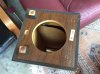
2). Suit up...time to remove fiberglass. Always my favorite part... With gloves and a long sleeve shirt, pull the fiberglass bat out, through the bottom of the speaker (now exposed with the bottom now off).

9CA678EE-C2CA-4B43-9DD9-583EED8BEECB.jpeg B0448A3B-5D17-4380-858C-13C0BB197E87.jpeg

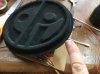
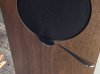
3) GENTLY remove all of the speaker covers. They are held in by a flexible outward facing “lip” on each of the covers. I used a large metal kitchen spoon to pry the covers off. Work back and forth in the same general spot to get one side started, then just work the cover off all around in a circular motion until it comes off.

A443900B-FAF2-4A08-BDAE-BADFFDA6901A.jpeg

9D1D1202-10AD-4D83-B540-EA599BFD7356.jpeg

4) Remove all 4 speakers, Mark the back of the speaker terminal with the color of the wire that you removed. Take a picture!

DEF7949F-6FAE-4710-9BA0-80089711A528.jpeg

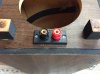
5) With all 4 speakers removed, the crossover is accessible now through a speaker port, and the bottom. It is hot glued into place, so leveraging it loose wasn’t too difficult.

ABBBE09B-388C-4460-95C0-1DA325ED3BC3.jpeg
I just used a large flat head screwdriver, and gently pried it loose. Now the crossover and cabling are removed from the bottom.

8D0C138F-AEF3-43DA-967D-261D176C8777.jpeg

6) Ordering caps, and soldering time...more to come!
 
Last edited:
Ok, I’m a little stumped...

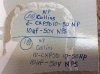
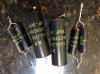
All three of the caps in this picture seem to have the same 50v 10uf rating. Why is the standalone cap, 4x the size of the other 2 wired in parallel?

6099A9BF-03B2-41D3-BA19-60CA38F7E2C9.jpeg

Here is what is printed on each cap:

79DAE994-F39D-4E9F-8CF2-7C134680B2E2.jpeg

The only difference is that the smaller 2 caps are marked with a “6-cxpsd 10-50 NP”, where the larger cap is a “10-cxpsd...”, but I’m not familiar with this level of cap detail. Do I just need to order decent quality 10uf and 20uf non-polarized poly caps for replacements? The size ratio of the 3 “same value” caps is what is really confusing me!

Somebody’s got to know this one, answers???
 
Last edited:
The consensus that I found on the cap size differentiation post (above) was that essentially, ignore the size thing, and just replace the caps with the same crossover cap uf rating. Pretty much what I already knew, but was hoping to find a purposeful reason for the difference. I didn’t...

So I just moved on with the replacement project.

Originals:

4FA7C4A9-F48B-41CD-BD5A-2999E98CFC34.jpeg

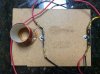
Naked board (oh the shame):

3730ED3C-4C06-4DC9-9593-A72BA858DDD5.jpeg


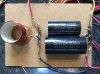
New Dayton caps, nothing special, but commensurate with the speakers. Still a likely huge upgrade over the originals, even when they were new...

6C8B42C0-6FB8-4F19-B25A-D26BEBEE3EE1.jpeg

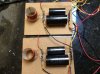
Right, left...check...

0268813F-D1CA-4BFC-A62A-53D40256EC81.jpeg

Yesterday’s news...

086BBC45-3EC3-491D-9365-209F425C5F47.jpeg

Still more work to do, but coming along...
 
Hooked up everything in test mode, and got an “all clear” - all drivers are firing! Have to say that I like what I’m hearing. Those tweeters are pretty awesome in terms of clarity of output. Quite impressive for a 45 year old set of strangely designed speakers.

Bass is a little light (mostly expected), and am curious about how these might do if I installed a passive radiator onto the ported opening on the bottom of these. To my knowledge (and I could DEFINITELY be wrong on this) passive radiators weren’t around in the mid 70’s. The woofers are open to the open port construction on the bottom, but the tweeters are sealed off, so it shouldn’t have any adverse impact on the high end. Just wondering if I could boost the low end a bit without degrading anything else?

I think that these will go into my rotation as front end speakers on a 4 speaker setup. I like them a lot more than I expected I would!

C12F8F40-DA68-4F53-9D42-1D4478BB0EEA.jpeg

3961ED1A-E7CD-435E-BEB7-294469AB1CC0.jpeg
 
I was really hoping someone could explain this size discrepancy.

Nice project, very good documentation, thx.

Thanks, it was kind of frustrating that I couldn’t find hardly any documentation on these weird little guys, so thought I’d document and post everything for future reference, as I went through the project. I’ve sure benefitted from others who have done this on other projects in the past, so that was my motivation.
 
I do not believe that a passive radiator would improve the Microtowers. More likely the reverse.
Positioning can make a big difference in how they sound, but you will never get super deep loud base from them. Instead you will get lively, room filling, engaging sound. If you desperately need deep bass, a subwoofer is a better idea.
They are column speakers, functioning as quarter wave resonators. They depend on the interaction of the length of the pipe and resonant frequency of the woofer. The open end is part of the design.
I believe passive radiators are designed with the volume/mass of air in the enclosure, rather than its length, and the volume there doesn't look encouraging. I'm sure with some math and some luck you could get something that would work, but I doubt that it would be as lively, and quite possibly it would not go as deep or as loud. And you'd still have the column resonances, but now without any benefit.
I'm no expert, so I could be wrong, but I think that what I have suggested is pretty standard speaker theory.
I'd enjoy them for what they are, but if the lightness continues to bother you, it is possible that the new caps have a lower ESR (equivalent series resistance) and that a small value resistor in line might balance the sound better.
 
Sound advice Nat, I’m not one to really want to alter original designs. I’m a novice, the thought of a passive driver was more of a curiosity than anything. My thought is of running them with another set of speakers that generate a larger bass presence, and using them as more front-end speakers. Their strength is their crisp high end. That’s what I want to accentuate. I’ll rely on the secondary pair to drive the lower end. Thanks for the input.
 
Back
Top Bottom