• The move to the new server is done. There are some software and database maintenance updates in process. This has us passing the hat around to help out. We appreciate any donations. Seriously, even a dollar helps. The payment page may be found here - https://www.audiokarma.org/support.html

EPS Speakers (not EPI or Epos) anyone heard of these ?

laidbacklark

Active Member
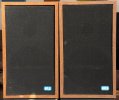
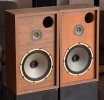
Need your help for details on this speaker maker/brand - the grill sports a ‘EPS’ label (not sure if I am reading it right - between the P and S is a speaker symbol, don’t know if that’s to be treated as a letter)

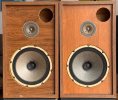
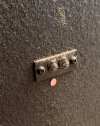
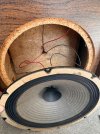
Came by these vintage couple days ago for $35, seller said was purchased in the 80’s. No hits with the logo on the grill, no label at the sealed back either with a model number. AI search gives you some generic garbage info. Cab veneer in fairly good condition, Grill nailed into cab. Has two drivers - not anything special but do come alive when pushed with ‘loudness’ and tone controls on a vintage amp. When hearing at ear height, you can feel a semblance of tight bass and acceptable AQ. Don’t know if the top right is missing a driver or if it’s just a port. There’s no heft to them but not lightweight either. Speaker connections are screw terminals. Speaker dimensions are: 23”x13”x8”.

What is the history of the EPS brand ? Thanks in advance.
 

Attachments

  • IMG_4630.jpeg
    IMG_4630.jpeg
    328.7 KB · Views: 48
  • IMG_4629.jpeg
    IMG_4629.jpeg
    324.7 KB · Views: 46
  • IMG_4632.jpeg
    IMG_4632.jpeg
    327.9 KB · Views: 44
  • IMG_4633.jpeg
    IMG_4633.jpeg
    361 KB · Views: 45
  • IMG_4641.jpeg
    IMG_4641.jpeg
    257.5 KB · Views: 44
  • IMG_4625.jpeg
    IMG_4625.jpeg
    334.9 KB · Views: 48
Register to hide this ad
I'd pull those drivers and see what mfr code is on the back of them. I'd wager they're some CTS or similar made drivers, and probably not all that bad. The cabinets seem to be pretty solidly made, at least on par with other big brands of the time. That being said, it looks like the cabinet is pretty much empty, and without any real engineering going into that port so I think you could improve them pretty easily, either with some polyfill and a cardboard port tube (and some math), or with entirely new components if the originals seem subpar.
 
I'd pull those drivers and see what mfr code is on the back of them. I'd wager they're some CTS or similar made drivers, and probably not all that bad. The cabinets seem to be pretty solidly made, at least on par with other big brands of the time. That being said, it looks like the cabinet is pretty much empty, and without any real engineering going into that port so I think you could improve them pretty easily, either with some polyfill and a cardboard port tube (and some math), or with entirely new components if the originals seem subpar.
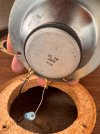
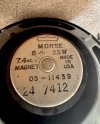
Thank you. Yeah, the cab’s pretty empty as you can get a peek inside thru that ‘port’. It’s about 3/4” mdf. There’s some insulation material stuck to three sides of the speaker. Pulled the components out - no crossover, just a single cap to the tweeter. Woofer code is 247412 indicating ‘EIA manufacturer's code for National Union Radio Corporation, a US-based manufacturer primarily known for vacuum tubes and some electronic components’. Made in Q1 1974.
 

Attachments

  • IMG_4642.jpeg
    IMG_4642.jpeg
    261.8 KB · Views: 26
  • IMG_4644.jpeg
    IMG_4644.jpeg
    335.4 KB · Views: 26
  • IMG_4645.jpeg
    IMG_4645.jpeg
    205.9 KB · Views: 26
No screw holes so I don't think there used to be a driver in there. Odd that they are just vents and not ports. Also strange that the baffle boards have two different wood patterns. I don't think those whizzer cone drivers are from the 1980s.
 
No screw holes so I don't think there used to be a driver in there. Odd that they are just vents and not ports. Also strange that the baffle boards have two different wood patterns. I don't think those whizzer cone drivers are from the 1980s.
As vinylkid58 said above, these may have been bought used by the seller. Yeah, the different baffle patterns are baffling . Will play around with different amps. Does anyone think adding a two way crossover (the tons available on Amazon) could help with AQ ? No science there, just playing around
 
If these were house brand speakers- they were probably built to a tight price point. Part of that, may have been not caring what wood finish was on the baffle- as it would likely be covered by a grill, anyway. That may have allowed them to cut a buck or two out of the cabinet construction cost- which, could make the difference between getting or not getting a contract to build them, from a retail store chain that probably put out bids to quite a few OEM manufacturers.

Mind you, that doesn't mean they would or wouldn't sound good. That's more on the acoustic engineering, than the cosmetic design... and some of those engineers at those OEM manufacturing companies were pretty good, at squeezing surprising performance out of very low cost...

Regards,
Gordon.
 
Seems like both the woofer and tweeter were made for Morse Electrophonic which was more or less a big box store/ console manufacturer. They also almost always put whizzer cones on their drivers so that checked out.

Personally, I'd replace the blue capacitor with a modern one, and go from there. To me, the woofer looks more promising than the tweeter, so that would be the next thing to look at.
 
Seems like both the woofer and tweeter were made for Morse Electrophonic which was more or less a big box store/ console manufacturer. They also almost always put whizzer cones on their drivers so that checked out.

Personally, I'd replace the blue capacitor with a modern one, and go from there. To me, the woofer looks more promising than the tweeter, so that would be the next thing to look at.

Actually, after looking at the back of that woofer again- I think that Morse was likely the OEM manufacturer of the cabinets, and most likely did the assembly as well- but that Becker actually built the woofers. The "24" on the back of the magnet, was the EIA code that Becker used.

Regards,
Gordon.
 
Seems like both the woofer and tweeter were made for Morse Electrophonic which was more or less a big box store/ console manufacturer. They also almost always put whizzer cones on their drivers so that checked out.

Personally, I'd replace the blue capacitor with a modern one, and go from there. To me, the woofer looks more promising than the tweeter, so that would be the next thing to look at.
Thank you. What would you recommend for the cap replacement ? This would be my first go at doing this
 
Thank you. What would you recommend for the cap replacement ? This would be my first go at doing this
I doubt you'll ever get any decent sound out of these, no matter what you do. All Morse speakers were mediocre at best, and most were worse than that. I probably wouldn't bother wasting any more time or money on them.

Morse's full name was "Morse Electro Products" and they marketed most of their audio under the name "Morse Electrophonic" or sometimes just "Morse" for their slightly-better-than-mediocre electronics (again, no speakers in that category). Possibly EPS stands for Electro Products Speakers.
 
Thank you. What would you recommend for the cap replacement ? This would be my first go at doing this

There should be numbers on the side of the cap. A value, and a voltage rating. Values would be something like "2.2u" or "3.3u" or something like that. Voltage will usually be something like 25, 50, 63, 100 or something like that.

You want the same value, and the same or higher voltage rating, in a replacement.

Regards,
Gordon.
 
There should be numbers on the side of the cap. A value, and a voltage rating. Values would be something like "2.2u" or "3.3u" or something like that. Voltage will usually be something like 25, 50, 63, 100 or something like that.

You want the same value, and the same or higher voltage rating, in a replacement.

Regards,
Gordon.
Sorry I should have been clearer in my ask. What cap type should I consider for replacement ?
 
Sorry I should have been clearer in my ask. What cap type should I consider for replacement ?

Probably an inexpensive film cap. Like a basic Audyn "red cap", or an Audiophiler cap, from Parts Express, or something of that ilk. We're not as worried about keeping the original type, in a very basic speaker like this- a film cap probably will improve things a tad.

Regards,
Gordon.
 
I doubt you'll ever get any decent sound out of these, no matter what you do. All Morse speakers were mediocre at best, and most were worse than that. I probably wouldn't bother wasting any more time or money on them.

Morse's full name was "Morse Electro Products" and they marketed most of their audio under the name "Morse Electrophonic" or sometimes just "Morse" for their slightly-better-than-mediocre electronics (again, no speakers in that category). Possibly EPS stands for Electro Products Speakers.
Thank you. I am treating this as an inexpensive experimental project for learning. If the re-cap doesn’t cut it, can always reuse the cap for another project - got several vintage speaker sets that need fixing up
 
Orion blue book lists two speakers under EPS by Quadraflex the 110 and 120. Both the same price one early 70s one later 70s. No info on driver compliment to verify these. But it seems likely.
 
Orion blue book lists two speakers under EPS by Quadraflex the 110 and 120. Both the same price one early 70s one later 70s. No info on driver compliment to verify these. But it seems likely.

I am not sure. Quadraflex speakers tended to use different driver complements than that. I don't remember a whizzer cone driver in any Quadraflex speaker I've seen...

Regards,
Gordon.
 
That’s why I didn’t say for sure, but the brand name is straight from the Orion and we know they make mistakes. The limited number of listings and the price point of $110 I think, not near the book right now, a whizzer cone can make a cheaper speaker than the Quadraflex. Maybe someone will drop in some time in the future with the sales flyer for the EPS line to clear things up.
 
At this point, I think it's safe to say that either:
  • These are speakers manufactured by Morse Electro Products in the early 70s, or
  • These are speaker cabinets manufactured by some other company that somebody stuck some Morse drivers in
No other manufacturer would have used Morse-branded drivers.
 
Back
Top Bottom