If you prefer the sound quality that you achieve when using an equalizer, that is fine, it is your choice.
"Is the eq fooling us because the sound volume is boosted?"
Yes...
This question requires a two part answer.
If you use a control on an equalizer to boost a certain frequency or range of frequencies, you do in fact increase the power (power from the amplifier and the acoustic output of the speakers) for the frequency frequencies that you have selected.
This will cause those frequencies to be louder in absolute measurable terms and in relationship to the other frequencies in the music.
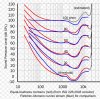
The second answer has to do with the basic function of the human auditory system. Our hearing is not equally sensitive to all frequencies when it is presented with frequencies having the same acoustic power. This is commonly called the Fletcher-Munson equal loudness hearing curve, although it has be revised and changed over the years.
The point is, the actual frequency response of the human auditory system changes with the intensity of the sounds (music), that we hear.
So, not only does boosting certain frequencies increase the actual measurable power in those frequencies (making the music sound different), one must also take into account the change in the frequency response of our ears as the loudness of the frequencies boosted in increased.
To be clear, equalizers do not shift frequencies, they change the amplitude of the frequencies selected and of course an EQ can be used to boost or attenuate the selected frequencies.
Of course each persons perception of changes in sound quality may be different and the contribution to these changes may be less for change in the frequency response of the ear due to changes in the absolute acoustic power at any given frequency than the actual increase in the absolute acoustic power at any given frequency. And as can be seen from the picture below, it is frequency dependent.
And BTW NJguy, this is a good and very perceptive question.
Yes you can use an equalizer when using a turntable, but it must still be used for line level signals, not phono cartridge level signals, that also require a specific type of EQ that is provided by the phono stage called the RIAA EQ curve.





 i feel deceived.

