• The move to the new server is done. There are some software and database maintenance updates in process. This has us passing the hat around to help out. We appreciate any donations. Seriously, even a dollar helps. The payment page may be found here - https://www.audiokarma.org/support.html

External FM antenna for multiple receivers

Justin Kohl

New Member
Hello,

I currently have a Fisher 400 tube (FM only), Marantz 2230, Marantz 2270, and a 1963 Nordmende Mikado-Stereo Ch=4/675 console with AM/FM/and Shortwave. My question is this, is there an external antenna that I can purchase that all of the above could run off of, if so, does anyone have any recommendations?

Thanks in Advance!
 
Register to hide this ad
Some general information.

It depends on the amount of signal that is available to the antenna from each station and that will vary depending on a number of factors such as how far away the stations are, how much power they have, how high their and your antennas are, do you have a clear line of sight to the stations (no hills, buildings or other obstructions) and so on. Each situation will be different.

A 4 way splitter will reduce the signal to each receiver by at least 7 dB plus the loss in the coaxial cable. This is a fair amount of loss and may have a negative impact on signal quality.

Are all of your stations of interest the same direction from your house? If not an omni-directional (receives stations from all directions) may work, although this type of antenna is not the most sensitive type of antenna and may not provide enough signal to be split 4 ways.

A directional antenna is a more sensitive type of antenna and will provide a larger amount of signal (possibly enough to overcome the loss of the 4 way splitter), but that does guarantee that it will supply enough signal. If your stations of interest are in different directions, you may need an antenna rotator to aim the antenna at you station(s) of interest.

Depending on you local conditions a quality low noise figure RF amplifier or an amplified 4 way splitter may be appropriate.

A 4 way switch will have much lower loss than a 4 way splitter, but you can only use one receiver at a time and it is less convenient.

The short answer is, it can be trial and error.

Without more exact information regarding your exact location, local conditions and your stations of interest and their directions and so on, it is difficult to give any kind of meaningful recommendations.

 
The local oscillator in most FM tuners operates 10.7Mhz displaced in frequency from the 'tuned' dial position. This can cause interference problems between the other receivers connected to the same antenna, or in some cases, even close to each other.

Tom
 
Some general information.

It depends on the amount of signal that is available to the antenna from each station and that will vary depending on a number of factors such as how far away the stations are, how much power they have, how high their and your antennas are, do you have a clear line of sight to the stations (no hills, buildings or other obstructions) and so on. Each situation will be different.

A 4 way splitter will reduce the signal to each receiver by at least 7 dB plus the loss in the coaxial cable. This is a fair amount of loss and may have a negative impact on signal quality.

Are all of your stations of interest the same direction from your house? If not an omni-directional (receives stations from all directions) may work, although this type of antenna is not the most sensitive type of antenna and may not provide enough signal to be split 4 ways.

A directional antenna is a more sensitive type of antenna and will provide a larger amount of signal (possibly enough to overcome the loss of the 4 way splitter), but that does guarantee that it will supply enough signal. If your stations of interest are in different directions, you may need an antenna rotator to aim the antenna at you station(s) of interest.

Depending on you local conditions a quality low noise figure RF amplifier or an amplified 4 way splitter may be appropriate.

A 4 way switch will have much lower loss than a 4 way splitter, but you can only use one receiver at a time and it is less convenient.

The short answer is, it can be trial and error.

Without more exact information regarding your exact location, local conditions and your stations of interest and their directions and so on, it is difficult to give any kind of meaningful recommendations.

Thank you for the information! One last question, and it is probably going to be a dumb one, I have the antennas that all of the receivers came with, if I put another antenna in my attic that isn't directly connected to the receivers will it boost the reception at all to the antennas connected?
 
Thank you for the information! One last question, and it is probably going to be a dumb one, I have the antennas that all of the receivers came with, if I put another antenna in my attic that isn't directly connected to the receivers will it boost the reception at all to the antennas connected?
Could you clarify what you're asking here? To do any good, an antenna must be connected to the receiver((s)
 
Could you clarify what you're asking here? To do any good, an antenna must be connected to the receiver((s)

Haha sorry, I feel like a complete idiot when it comes to this topic. For example, each receiver has the T-antenna that it originally came with. Is there an external antenna that I could put in my attic that simply just pulls a better signal to my house in general that will just give the T-antenna a better signal. I think my disconnect is my brain is thinking in what is probably today's wireless technologies that probably doesn't work for vintage stuff.
 
If you want to split the signal at the tuner end of the co-ax, get a mast-head preamp. That will make up for the losses of the splitter.
You can also stack Yagi antennas side by side, or on top of each other, to get more signal without the noise factor of a pre-amp. 4 stacked Yagis is a BIG antenna though.

FM and AM require very different antenna systems - and tuners almost always have different sockets for the two systems.

As for putting an 'unconnected' antenna near a connected antenna, it is most likely to have a detrimental effect, rather than a beneficial one, if any effect at all. They need to be quite close to affect each other.
 
The typical output port to output port isolation for a reasonable quality 4 way passive splitter is about 25 dB plus connector and coaxial cable loss. That means that it will reduce any local oscillator leak through by 25 dB, a fair amount.

FM by its nature has a feature or operating parameter called capture ratio. An FM tuner will respond to the stronger of two signals on the same frequency and ignore the weaker signal. Typical capture ratios are in the 1 dB to 2dB range. That is if the stronger signal is only 1 dB or 2 dB stronger the FM tuner/receiver will ignore the weaker signal.

If the station of interest in 1 dB to 2dB stronger than any local oscillator leak through and remember the splitter is reducing any leak through by about 25 dB, the local oscillator leak through is likely not to be a major issue all though it is possible. And as mentioned the 2 stations would have to be 10.7 MHz apart in frequency.

Even if the local oscillator leak through is enough to cause an issue, it will only happen as previously mentioned, if the 2 stations of interest (tuned in at the same time) are 10.7 MHz apart in frequency. While it can cause a issue, the odds are that it is more likely not to be an issue than to be an issue.
 
Depending on you local conditions a quality low noise figure RF amplifier or an amplified 4 way splitter may be appropriate.
A distribution amplifier is an RF amplifier and some splitters together in one box. The noise penalty is about 2 dB. Similar to but somewhat cleaner than having an amp and separate splitters.

See for example, https://www.channelmaster.com/Antenna_Cable_TV_Amplifier_p/cm-3414.htm

(Note: not making a recommendation for this particular unit.)
 
A distribution amplifier is an RF amplifier and some splitters together in one box. The noise penalty is about 2 dB. Similar to but somewhat cleaner than having an amp and separate splitters.

See for example, https://www.channelmaster.com/Antenna_Cable_TV_Amplifier_p/cm-3414.htm

(Note: not making a recommendation for this particular unit.)

The unit above unit is of reasonable quality.

In terms of noise figure, 2 dB is likely better than the average FM tuner/receiver. As long as it is lower (smaller) than the tuner/receiver it will not be an issue or penalty. Of course not all tuners/receivers are not created equal, but it is likely that an RF amplifier/splitter with a 2 dB noise factor may improve the RF performance of a tuner/receiver.

To be clear just because an amplified splitter has a noise figure of 2 dB, that does not automatically mean that it is a penalty. Overall noise figure and noise penalty are not necessarily the same thing.

As an example.

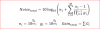
Using the above unit with a noise figure of 2 dB with 8 dB of gain per port and a typical tuner/receiver with a typical noise noise figure of 3 dB.

Per the math below the overall noise figure will be reduced to about 2.4 dB, about a 0.4 dB improvement. The lower the noise figure the better.

upload_2018-4-3_19-46-21.png

Any number of the commonly available amplified splitters have much worse noise figures than the unit above. If the noise figure of an RF amplifier or amplified splitter is higher than the tuner/receiver it can have a negative impact on signal quality.
 
Last edited:
Using the above unit with a noise figure of 2 dB with 8 dB of gain per port
I had interpreted their spec as +8dB raw gain from the amplifier but I think you're right, its +15 dB for the amp and then -7 dB for the splitter to make 8 dB the net gain per port.

At what point does one have to worry about amplified noise and out-of-band signals (like TV) affecting the front end of the receiver?
 
At what point does one have to worry about amplified noise and out-of-band signals (like TV) affecting the front end of the receiver?

When the available signal is large enough to overload the RF amplifier/splitter (input and or output) and or the tuner/receiver. This is not limited to out of band signals. A strong local FM station can cause problems.

Not all tuners/receivers are created equal when it comes to RF performance in terms of strong signals in band or out of band.

One of the things that is not totally uncommon on AK is the recommendation of very high gain RF amplifiers/splitters on the order of 35 dB or more because if a little is good, more is better and this is not necessarily always the case. This is often without regard to the other parameters of the device such as maximum input/output levels and noise figure.

Quality devices will give gain, maximum input/output levels along with noise figure.

For FM broadcast band use, I prefer purpose built FM only amplifiers/amplified splitters. That is not to say that other devices will not work okay depending on the situation, device, tuner/receiver and local conditions.
 
Back
Top Bottom