• The move to the new server is done. There are some software and database maintenance updates in process. This has us passing the hat around to help out. We appreciate any donations. Seriously, even a dollar helps. The payment page may be found here - https://www.audiokarma.org/support.html

Failed Crossovers?

Dsk19

New Member
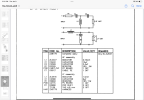
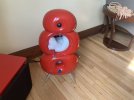
I have a pair of B&W Housepods speakers circa 1995. I am getting an extremely faint audio beyond 7KHz from both speakers(I am using a signal generator app using sine wave). Since the woofer/ mid-range are not behind a screen, I unscrewed them and disconnected them from the crossovers and ran the same test and got no audio at all at any frequency. The two-way crossovers use a simple RLC network that have two 10MFD caps in series. Is it possible that one or more of these caps on both crossovers could be open at the same time? Due to the loss of audio from the tweeters all the music seems dull and most times garbled, lacking definition.

Has anyone had a similar issue? Thanks.
 
Register to hide this ad
I have a pair of B&W Housepods speakers circa 1995. I am getting an extremely faint audio beyond 7KHz from both speakers(I am using a signal generator app using sine wave). Since the woofer/ mid-range are not behind a screen, I unscrewed them and disconnected them from the crossovers and ran the same test and got no audio at all at any frequency. The two-way crossovers use a simple RLC network that have two 10MFD caps in series. Is it possible that one or more of these caps on both crossovers could be open at the same time? Due to the loss of audio from the tweeters all the music seems dull and most times garbled, lacking definition.

Has anyone had a similar issue? Thanks.

Where are the resistors in the circuit? If the resistors are in series with the tweeters and open, that could explain your problem.
 
Both caps failing seems unlikely, but I suppose it's possible. Have you tested the tweeter voice coil for continuity?

Did the tweeters have ferrofluid in them?
 
Can you post pictures of the crossovers? Also have you tested all the speaker drivers themselves? Using a digital multimeter you can set it to ohms and see if you get a resistance reading. Maybe some coils in the speakers are open?
 
Can you post pictures of the crossovers? Also have you tested all the speaker drivers themselves? Using a digital multimeter you can set it to ohms and see if you get a resistance reading. Maybe some coils in the speakers are open?

An excellent point. I agree, check the voice coils.
 
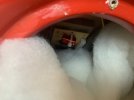
Thanks folks. I have attached the crossover circuit diagram. There is a 1ohm @5watts resistor in series with the tweeter. It appears to be ceramic, not wirewound- see attached pic. The pc board is attached to the back of the fiberglass body of the speaker with plastic rivets and somewhat difficult to remove. One other test I should mention is that for some teenagers I played the same tracks they usually listen and after a few moments they thought the music sounded garbled.

The tweeter coils check out for continuity, and just to be sure I had an extra voice coil I bought several years ago, that too does not work.
IMG_0533.pngIMG_0534.jpeg
 

Attachments

  • IMG_0535.jpeg
    IMG_0535.jpeg
    85.5 KB · Views: 17
Those ceramic resistors ARE wirewound resistors. Most likely 5 to 10% tolerance. I can only see a part of the crossover, but it looks like they are film capacitors from the little I can see If they are film caps, they probably don't need replacing. With a very few exceptions they tend to last forever.
So no need to replace them in almost all cases.
I'm guessing you have problems with the drivers.
One other thing came to mind, have you tried a different pair of speakers connected to your integrated amp, power amp, or receiver, which ever you have? The problem could be with your equipment, not the speakers. :dunno:
 
The tweeter voice coils are 5 ohms and 4.9 ohms. I do not have another speaker pair but I do have another amp as well as a DAC I use for streaming from Spotify and other tracks on my hard drives. Will test with other equipment and post.

Thanks all.
 
The tweeter voice coils are 5 ohms and 4.9 ohms. I do not have another speaker pair but I do have another amp as well as a DAC I use for streaming from Spotify and other tracks on my hard drives. Will test with other equipment and post.

Thanks all.
hi do you have a picture of the back of the tweeters taken out from the enclosure? Also I did like a copy of the repair manual for the housepods if you don’t mind sharing it? I’ve been trying to find a copy of the repair manual.
Thanks
Nick
 
img_0533-png.3396605

After a few moments they thought the music sounded garbled.
When you test the resistance across R1, does tapping it cause the meter to jump?

Do the solder points look good? Tap them and see if the DVM jumps (set to resistance).

:idea:
 
Back
Top Bottom