• The move to the new server is done. There are some software and database maintenance updates in process. This has us passing the hat around to help out. We appreciate any donations. Seriously, even a dollar helps. The payment page may be found here - https://www.audiokarma.org/support.html

field coil???

bobbyonions

AK Member
Hi folks. I rescued an old Capehart panamuse console from the trash last week. The cabinet is trashed. The faceplate to the radio is trashed. The power cord is gone.
I thought It would at least part out what was usable before it gets buried.

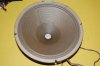
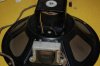
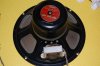
There is this Jensen 12" speaker with opt attached that I think is field coil. See pictures.

How do you test a field coil speaker? The cone is beautiful and moves freely without any rubbing. I tried to take some resistance readings from various terminals, but was getting unfamiliar values, like .5 and .3 ohms. There are the normal voice coil wires, and then the field coil wires, then the transformer making it extra confusing.
Anyone know how to help me out here? Thanks.
 

Attachments
  • DSC_1299.jpg
    DSC_1299.jpg
    64.6 KB · Views: 52
  • DSC_1298.jpg
    DSC_1298.jpg
    65.8 KB · Views: 34
  • DSC_1300.jpg
    DSC_1300.jpg
    51 KB · Views: 62
Last edited:
Register to hide this ad
That is a field coil speaker.

The transformer that is mounted on the frame is most likely the amplifier output transformer. It was not unusual for them to be mounted on the speaker frame.

The field coil is the coil that is under the cap that you removed.

Field coils were used for two purposes. One to provide the magnetic energy for the voice coil to react to and to act as a filter choke for the B+ power supply.
 
That is a field coil speaker.

The transformer that is mounted on the frame is most likely the amplifier output transformer. It was not unusual for them to be mounted on the speaker frame.

The field coil is the coil that is under the cap that you removed.

Field coils were used for two purposes. One to provide the magnetic energy for the voice coil to react to and to act as a filter choke for the B+ power supply.

Thanks. How do you go about testing one of these? I'm guessing it's not a good idea to try to remove that output transformer. Will this only work with amps that were originally designed to work with a field coil speaker? Is it best to not tamper with this at all and move it along to someone that is restoring a capehart panamuse or similar 30's or 40's unit?
 
You will need some DC current flowing in the field coil to make the speaker work. Measure its resistance, then apply enough voltage to make it dissipate a couple of watts at most. And watch out for inductive kick. Crank that DC voltage up and back down without breaking the circuit, to avoid sparks and possible damage to your power supply.
 
Sorry, thread jack. I've wondered for a few years now: Is it possible to drive a field coil with AC out of an amp, only wired out-of-phase? How many amps would it take to work?
 
Maybe help simplify a few things. Surely this speaker was originally driven by a tube amp. Most modern tube amps have the output matching transformer on the chassis, while your's in on the speaker itself. Best removing it and and wiring directly to the voice coil with a modern day amp. As mentioned, you'll need DC voltage/current to the electro-magnet, but who knows how much. Pay attention to the coil voltage give back, as you're not wanting to be holding onto these wires when removing the power supply. While maybe some fun to play with, can't see any practicle real world use for this speaker.
 
Field coils were used for two purposes. One to provide the magnetic energy for the voice coil to react to and to act as a filter choke for the B+ power supply.

Right. And once permanent magnet speakers came into being, the field coil speaker disappeared. The field coil was no longer needed to create the magnetic field.
 
I read somewhere that most Jensen field coils were rated for 14 watts nominal power. So you measure your field coil resistance and, using ohms law, figure out what voltage you need to power the coils off that.

Use this formula: (R * 14)sqrt = volts
 
OK you guys have scared me away from messing with this. It's way over my head. I think it's best to offer this to someone who knows how it works for a resto project. It doesn't sound like it has any other use really.
 
Sorry, thread jack. I've wondered for a few years now: Is it possible to drive a field coil with AC out of an amp, only wired out-of-phase? How many amps would it take to work?

In principle, it should work. As a practical matter, I think the inductance of a typical field coil is way too high. As someone else noted, they double as power supply filter chokes in most real-world applications.
 
Back
Top Bottom