• The move to the new server is done. There are some software and database maintenance updates in process. This has us passing the hat around to help out. We appreciate any donations. Seriously, even a dollar helps. The payment page may be found here - https://www.audiokarma.org/support.html

Film capacitors options

Oneoff

Active Member
I’m restoring my Musical Fidelity A5 and already bought some Nichicon muse to replace some 10uf bi-polar capacitors in the preamp section, but I’m now considering to find some 10uF MKP or polyester film capacitors instead. There are 10 10uF NP capacitors total.
My options are limited as well as the foot print on the PCB.
I’m considering :
1- Panasonic ECQ-metalized film capacitors at 5% tolerance (large!)
2- AID MKP 10% made in Taiwan - axial polypropylene. capacitors, off eBay (big but can be worked with)
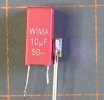
3- Wima MKP4 5% polypropylene film capacitors
(huge, needs leads extension, x2 the price of the others).
What do you think? Worth the trouble? Stay with the electrolytics? TIA!
 
Register to hide this ad
Nichicon ues is good may as well go with 47uf for even lower corner frequency, better bass see vcap corner frequency calculator.
Any film is better as lower dielectric constant more space air blacker blacks etc, well worth fitting if there's space, thing is I doubt they need to be 10uf that was probably just a rounding up for average bass and as electrolytics benefit from being bigger for lower distortion than smaller electrolytics.
3.3uf or 4.7 will probably be ample if film.
Jantzen do a compact mkt which is very easy to fit end up, and the leads aren't too thick.
But a mkp will be even better. The risk is their size and wire stiffness breaks the pads so it's important to glue them down and maybe add stranded leads something a production line wouldn't do.
Obviously make sure they're coupling cap positions.
One day hopefully film caps will be manufactured with stranded leads.
If you film they could easily take a month to run in.
Can you go eliminate some, 5 stages of coupling cap is a lot, the Pioneer a400 just has one. Normally there's pre input, pre out, power in, so 3.
Good luck, hope you keep us updated.
 
Last edited:
Nichicon ues is good may as well go with 47uf for even lower corner frequency, better bass see vcap corner frequency calculator.
Any film is better as lower dielectric constant more space air blacker blacks etc, well worth fitting if there's space, thing is I doubt they need to be 10uf that was probably just a rounding up for average bass and as electrolytics benefit from being bigger for lower distortion than smaller electrolytics.
3.3uf or 4.7 will probably be ample if film.
Jantzen do a compact mkt which is very easy to fit end up, and the leads aren't too thick.
But a mkp will be even better. The risk is their size and wire stiffness breaks the pads so it's important to glue them down and maybe add stranded leads something a production line wouldn't do.
Obviously make sure they're coupling cap positions.
One day hopefully film caps will be manufactured with stranded leads.
If you film they could easily take a month to run in.
Can you go eliminate some, 5 stages of coupling cap is a lot, the Pioneer a400 just has one. Normally there's pre input, pre out, power in, so 3.
Good luck, hope you keep us updated.
 
Thank you! I don’t have the schematics of the A5 , so I’d prefer to keep values as the originals.
So between the options I mentioned what would be the
Best solution? (Assuming I can fit them in the given space)
 
Wouldn't recommend fitting 10uf mkp caps on a circuit board they'd be huge and if you don't know what they're doing, stick with exact replacements elects, new ues caps might give it a bit of a lift. If a pad lifts it could be game over if you don't know how to fix it, important to understand the risks. I often try things with cheap eBay purchases where it doesn't matter much, but if you're doing this with your only halo amp perhaps think again. You haven't said much about why restoring, what's wrong, what are you trying to achieve and what's fitted at the moment.
 
Last edited:
I actually have some years of experience with modding
Electronics, musical instruments and audio equipment.
I can probably fit the polypropylene caps, using wires, and glue then with a bit of silicone to the board.
Those 10uF are sitting in the pre amp section, near the inputs and the main relay for the inputs, 4 are near the main op amps.
I wish I had the schematics just to make sure, but what I believe is they are in the signal path, (at least 6 out of 10).

I’m restoring this amp because I really love its sound and the synergy with my speakers. It’s my main system,
although I have many more.
I started with recapping the large filter caps and noticed all the cheap electrolytic caps in this amp, decided to replace and improve them all, then went into the rabbit hole of changing few more parts.
So, I’ll replace the speaker terminals, two bad RCA inputs, I’ll desolder the op amps and put a socket to try different ones, some new wires, power cable and power jack.

I feel that I’ve already spent few hundred dollars on this and I don’t want to save on few capacitors…
 
poly caps over electrolytics. It may not measure much differently,
Well, that depends on what you are actually measuring. I've measured hundreds and hundreds of caps, new and old, and different types with a variety of high-quality bench LCR meters (thousands of $ worth) and they all measure better for Q and DF as well as ESR, both series and parallel, compared to electrolytic caps. Particularly at higher frequencies. Each type has their optimal circuit locations and their limitations.

Well, you are going to affect psychoacoustics only.
The definition of psychoacoustics is the science of how many factors influence how humans perceive sound, including psychology, as well as electronics engineering, biology, physics, acoustics and more. If a change of components changes perceptibly how a piece of audio equipment performs, then it may not be trivial.

Within the electrolytic class of caps in positions where film caps don't fit, cost too much, or are not going to be exploited well enough to matter, using high-quality electrolytics can affect the sound and performance of the audio equipment. For example, bipolar caps maybe more appropriate in positions where polarized were used. Low-impedance, low-ESR, etc. - all selected carefully within a complete circuit can definitely improve the unit.

it should be audible as you clean up the rest of the signal path.
Yes. I have found that improvements in noise floor, distortion, impedance and other factors all stack together to provide overall improvements in the unit.
 
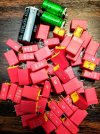
You may be looking for something like this, but sadly; this is an old photo and the only way I was able to obtain them was scavenging them from other equipment. However, it's proof that better 10uF film caps with lower voltage-rated, smaller size and correct lead spacing once existed, but are now totally unavailable it seems. :(

20251110_163109.jpg
 
Yes, very true and very irritating for those of us trying to keep vintage equipment alive and working great.
 
I see all these "Eva from Bevenbi film capacitor" ads everywhere. I reached out to them with the above photo and told them to PLEASE make some mkp radials in the 1,3.3,4.7,10uF ranges in the 50,63V ratings but haven't heard back from them. If nobody else is making them, they'd have this particular market cornered. I don't think they care as they haven't replied back and likely don't see any money in it. I tried y'all. :confused:
 
It's not a viable market for them anymore, they need to sell millions annually to make it viable, I think through hole components in general are going to be phased out.
 
I wish I had bought a bunch of the Wima 10uF while they were still available, but at the time I was pinching pennies and didn't have a real need.

Considering C0G as alternative, 20 x 0.47uF on a small (8x11mm) double sided PCB gets 9.4uF in a package slightly smaller than the Wima, but current best cost is about $7.

Then I heard of these:

1. If you INSIST on a film cap
2. If it MUST fit in the same space as electrolytic
3. If you're adventurous & can do fine soldering
4. If you have DEEP pockets

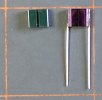
I present a 10uF/35v metallized acrylic film cap, SMD wired for thru-hole use. The orange grid lines are 1".
initial.jpg

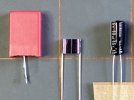
compared to Wima MKS2 10uF and Nichicon UKL 10uF
3-compared.jpg

thickness.jpg

measured.jpg

 
I haven't seen those before. They have a nice, small form factor. Acrylic for capacitors has an averaged, dielectric constant of around 2.8. This puts it somewhere within the middle of the hierarchy of film capacitors for performance -above polyester and polycarbonate.
 
Last edited:
A table in Bob Cordell's Designing Audio Circuits and Systems shows polyester at 3.3 and polystyrene at 2.5.

YDIC.co.jp shows acrylic at 2.7~4.5

Adding polypropylene to the mix at 2.2 and mica at 6.8

Lower numbers are higher performance.

However, polystyrene, mica and polypropylene are out of the running for higher capacitance values due to size and/or availability.

This type of polyester cap was used pretty widely in the 1970s to 1980s, mostly in aerospace and some high-end audio as I've been able to ascertain. I bought some recently manufactured for one project. They came with the legs attached, but similar idea to what Sean is showing with the acrylic caps.


Andante components.jpg
 
Back
Top Bottom