• The move to the new server is done. There are some software and database maintenance updates in process. This has us passing the hat around to help out. We appreciate any donations. Seriously, even a dollar helps. The payment page may be found here - https://www.audiokarma.org/support.html

Finding Modern Equivalent of Obsolete Transistors

D.E.K

Loader
While I was working on my SX-1010 a while back, I always asked markthefixer (whom I owe many thanks for the time and effort he put into guiding me through it) and he used to come up with a list of replacement transistors for the unit. I always wondered how he found the modern equivalent of the old obsolete 70's transistors. For instance 2SC945... I downloaded the Data Sheet for it but I don't know how to find it in Mouser's Catalogue. Could someone educate me on this. Thank you.

P.S: Mark, the SX-1010 project is on hold as of now.
 
Last edited:
Register to hide this ad
You just need to match the value and the voltage, which you can usually get off the schematic and then confirm by checking what's actually on the board. As for which sort of cap to use once you have those numbers, there are lots of threads and opinions on that here.
 
Doh, that number should've tipped me off. You're talking about transistors. That's way harder. That EchoWars guy right there helped me out last time I couldn't figure one out.
 
Maybe not the 'right' answer but I usually search google for the part number along with the word 'replacement'. Many times some thread will turn up somewhere in which the part in question has been dealt with. That's a start to get to more datasheets or maybe links to someone more knowledgeable than myself.
 
What I was told is that NTE products are not good and cost way too much. I can only confirm that they cost way (WAY) too much.
 
Granted, I rarely replace a transistor or IC, but I never knew that NTE was considered to have quality issues or expensive. I recently purchased and used two NTE transistors and they were less than $2 ea and worked fine. To my knowledge, NTE is what used to be ECG.
 
Noob question:

I have heard of a "good match" for a transistor. Example: 2N3906 PNP described as the proper match for 2N3904 NPN.

This was in the context of a device that required a pair of transistors.

Can someone explain this idea of properly matching pairs? Also, does the pair concept apply to replacement of transistors in typical audio amps?

Thanks!
 
Noob question:

I have heard of a "good match" for a transistor. Example: 2N3906 PNP described as the proper match for 2N3904 NPN.

This was in the context of a device that required a pair of transistors.

Can someone explain this idea of properly matching pairs? Also, does the pair concept apply to replacement of transistors in typical audio amps?

Thanks!


I guess a new thread should be started for that one.
 
I guess a new thread should be started for that one.

Probably!:yes:

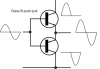
The 2N3904 and 2N3906 are not "matched pairs", they're what is known as "complementary pairs". They are commonly used in push-pull amplifier stages. Here's an example of a simple schematic using a complementary pair:
 

Attachments

  • Electronic_Amplifier_Push-pull.png
    Electronic_Amplifier_Push-pull.png
    16.3 KB · Views: 51
Uhhh excuse me, but why not install 2SC945s? They are readily available. Substitutes are fall back compromises in my opinion.
 
Besides substitutes... finding the real thing: there are a few threads on here about sources for old transistors that can't be found at Mouser, Digikey, Newark, etc. E.g., I found some NOS replacements for the complimentary pair of power transistors in one of my receivers from rcetronics.com
 
Finding replacements transistors is more tedious then anything else; looking up original data sheet, going onto digikey (personally hate mouser search engine), and when they have the drop down menus you have to select options that are the same with your original transistor. Voltage and current ratings, hfe, voltage across the different terminals... All of these need to be considered when trying to find a match.
 
Back
Top Bottom