

You are using an out of date browser. It may not display this or other websites correctly.
You should upgrade or use an alternative browser.
You should upgrade or use an alternative browser.
First attempt at testing
- Thread starter zackthedog
- Start date
-
- Tags
- stability williamson

Great thread. Thank you. I have a couple pair of "Williamson" style amps that I intend to rebuild this coming winter. I will need to do this sort of testing so it's instructive to follow along.
John
What amps do you have?

Mine are DIY builds but obviously Williamson from tracing the circuits. One is a pair of monoblocks with Quality Transformer UL OPTS, the other a stereo amp with ITC UL outputs. They are both 5881 amps. The monos use 6SN7 for driver and PI, the stereo amp uses 12AU7's. They are dirty and need a lot of work. I've already disassembled the mono amps and I was beginning to straighten and bondo the chassis when I decided to just reuse the iron and buy new chassis for them.
John
John
Attachments
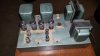
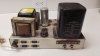
That stereo amp is ripe for resurrection! Are the any numbers stamped on the output trannies? And what's the model number on the mono OPT? I can't quite read it.

The output transformers on the stereo amp look suspiciously like Acrosound, but could also be Chicago/Stancor as well. Color code of the leads might help narrow it down a bit further.
Dave
Dave
I think we largely determined they are ITC:
https://audiokarma.org/forums/index.php?threads/tube-amp-transformer-id-help.751750/#post-10205719
The mono amp OPT's are model 6-W-23 and rated 30 watts. Same basic specs for both amps and same connections as TO-300's but with different color codes.
Both are a bit uncommon it seems and only time will tell if they are adequate or maybe better than adequate. I moved over the last 8 months and most of my hobby stuff is still in disarray so any work on these will be winter at earliest. I'm easily distracted by the most recent notion so who knows in reality.
Sorry for diverting your thread, I mainly just wanted to sign on and follow your progress.
John
https://audiokarma.org/forums/index.php?threads/tube-amp-transformer-id-help.751750/#post-10205719
The mono amp OPT's are model 6-W-23 and rated 30 watts. Same basic specs for both amps and same connections as TO-300's but with different color codes.
Both are a bit uncommon it seems and only time will tell if they are adequate or maybe better than adequate. I moved over the last 8 months and most of my hobby stuff is still in disarray so any work on these will be winter at earliest. I'm easily distracted by the most recent notion so who knows in reality.
Sorry for diverting your thread, I mainly just wanted to sign on and follow your progress.
John
Oh, not at all, that was a fascinating thread! Should be a fun rebuild. You've actually got more to go on than I do with the Heyboers. ;-)
Zack -- was able to take a look at a 10 kHz square wave through one of my Heath W-4s (the one with the Stancor transformer), which proved to be very similar to yours. My only defense is that the work I did on those amps was 11 years ago, during which time a lot of stability work has passed through the bench!
Dave

Dave
Zack -- was able to take a look at a 10 kHz square wave through one of my Heath W-4s (the one with the Stancor transformer), which proved to be very similar to yours. My only defense is that the work I did on those amps was 11 years ago, during which time a lot of stability work has passed through the bench!
Dave
View attachment 1540524
Oh, thanks, Dave! Yours are a bit flatter. I forget which phase lead cap I used but there were two choices, depending on the OPT, Chicago or Stancor, and I'm not sure what I have except that they're a date-matched pair. I'll try the other cap and see if it's smoother. I've got my new Picoscope hooked up to my media TV in the stereo room so it's easy to drop an amp in circuit and test it. ;-) But I have to tell you that they're terrific-sounding amps, no complaints there.
Which model of picoscope? Just looked them up. I haven't seen them before. Looks handy.
The 2204A, the cheapest one. Dual channel, built-in function generator, 20MHz, fine for general audio. It very easy to use once you familiarize yourself with the menus and buttons, took me about 10 minutes. ;-) The software is free. If you use it on Mac you have to install Mono first (channelling software). So far ir's great.
Does it include the FFT spectrum analysis for your unit? I wasn't sure from reading the web page.
The software is the same for all their products. The question is whether the 2204A has high-enough resolution for your needs. This is not something I'm familiar with yet. They do state that the 2000 series can do FFT:
https://www.picotech.com/oscilloscope/2000/picoscope-2000-overview
Just a note to say that for the time being I'm satisfied. The amps are a *lot* smoother and cleaner than before I was able to take a look at them. With the standard Williamson shelf network (4.7K + 200pF) and 240pF across the feedback resistor, they're stable with up to .1uF across the load, which I guess was not bad for the day. ;-). I'll put a zobel across the outputs for safety. They sure are a pleasure to listen to with Russian 807s ($5 each!). An easy-on-the-ear sound with amazing realism in terms of voices and instruments. At the moment they start to roll off at 30kHz and go down smoothly from there up to 200kHz. I don't see any crazy peaks after that.
The Heyboers did not respond well to my clumsy attempts at further stabilization. The sound got cramped and unlistenable. In the end you gotta go with your ears. ;-)
I'm going to keep studying up on the stability issue and learn more about it. Many thanks for all the instructive replies, I really appreciate it. My offer stands, if any really experienced builders want to tinker with the Heyboers I'll drop-ship you a pair. In the meantime, I think anyone who wants to build a "true" Williamson can get very nice results with them.
The Heyboers did not respond well to my clumsy attempts at further stabilization. The sound got cramped and unlistenable. In the end you gotta go with your ears. ;-)
I'm going to keep studying up on the stability issue and learn more about it. Many thanks for all the instructive replies, I really appreciate it. My offer stands, if any really experienced builders want to tinker with the Heyboers I'll drop-ship you a pair. In the meantime, I think anyone who wants to build a "true" Williamson can get very nice results with them.