
• The move to the new server is done. There are some software and database maintenance updates in process. This has us passing the hat around to help out. We appreciate any donations. Seriously, even a dollar helps. The payment page may be found here - https://www.audiokarma.org/support.html

Fisher 440t power switch

Drrickoxman

New Member
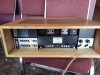
Help! I'm giving this vintage audio addiction another try. I picked up a Fisher 440t at an estate sale and it worked with tons of static and a hard to turn volume power switch. Cleaned and deoxit and resoldered spliced power cord. She looks great, but now no power on. I heard the volume pot/power switch on these like to go out so I checked continuity through switch, seems fine ,also checked power through aux outlets and power switch also seems fine and lastly checked for DC voltage coming out of transformer, got some , the unit powered on before I fixed it, lol . Any thoughts on what I did to this beauty?? Btw she has the most beautiful wood case with a lattice wood? vent instead of metalIMG_20190502_110230.jpg IMG_20190502_110158.jpg
 
Last edited:
Register to hide this ad
Welcome to A.K. !
Probably a fuse. service manual reads (F1) 1.5A slow blow. On the back panel? Pull and test.
service manual (good one) https://www.hifiengine.com/manual_library/fisher/440-t.shtml
Since it was working probably not healthy inside as aged (1965). You really should build a dim bulb tester.
upload_2019-5-4_8-47-19.png
1372266-f16bb2cedce3c21d78e51ff655701cc8.jpg
 
Welcome to A.K. !
Probably a fuse. service manual reads (F1) 1.5A slow blow. On the back panel? Pull and test.
service manual (good one) https://www.hifiengine.com/manual_library/fisher/440-t.shtml
Since it was working probably not healthy inside as aged (1965). You really should build a dim bulb tester.
View attachment 1498295
1372266-f16bb2cedce3c21d78e51ff655701cc8.jpg
Thanks for the reply! Checked the fuses and they both seem ok . What do I use the dim bulb tester for? After what I did to the unit, I think myself??
 
Try cleaning the inside of the fuse holder. That is easily overlooked when cleaning pots and switches but still is a spring loaded mechanical contact that could cause trouble. You can also temporarily bypass the fuse or switch with a jumper wire. Might be safer to use an ohmmeter at the line cord and check resistance when jumpering rather than doing it when connected to power.
 
Back
Top Bottom