• The move to the new server is done. There are some software and database maintenance updates in process. This has us passing the hat around to help out. We appreciate any donations. Seriously, even a dollar helps. The payment page may be found here - https://www.audiokarma.org/support.html

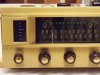
Fisher 500 (mono) - model variation question.

Hi folks! Can anyone tell me the input sensitivity for the AUX inputs on the Fisher TA-500? I'm trying to figure out if I should be using an in-line attenuator when connecting a modern digital source.

 
Probably about 250-300mv. I'd use an attenuator on Ipad's, mp3 players, or any digital source that doesn't have a volume control. Seen some digital sources with output voltages as high as 3v. Best to have one connected and rarely need it rather than not have one and need it.
 
5yrs after my 1st post on this thread, and having some console and stand-alone version of different units, I think I can come up with a plausible explanation.

I have a 63' Executive with a 800-C (10381 serial) and a 1965 800-C (33xxx serial) that have totally different Front glass above the numbers. Plus the exec's glass has the National Defense Markers on the AM band.

The 10001-19999 series of 800c was a console version only for the 63 Executive. The 20001-29999 was for stanalone's for 63' and into '64. The 30001-39999 series was for the '64 Executive AND standalones after the 29999 series ended.

From the TA-600 on (1959) FISHER added the Console model to the Face-plate lettering. TA-600 for stand alone and PREMIERE for the 1960 Premiere console. This was done also for the Executive, President, Statesman, etc. consoles that had the same model receiver or amp/tuner/ pre-amp.

From what I've seen the consoles got the 1st iteration (1st series) or 10001 serial units and stand alone units started from 20001 serial.

Now to the 500 MONO

From My understanding the EL-37 version was the 1st version of the 500 MONO, the EL-34, and 5881 versions came later.

The "Hi Fidelity receiver" printing I've only seen on console versions of various receivers. Stand alone versions had the Model # in the Glass (mid 50's) or faceplate (late 50's to mid 60's).

My impression is that Snashforce 500's date as follows;
The "Hi Fidelity" 10001 series came out in 1956 as a console version
The "Model 500" 30001 series came out in probably 1957 or 1958 as a stand alone.
 
Probably about 250-300mv. I'd use an attenuator on Ipad's, mp3 players, or any digital source that doesn't have a volume control. Seen some digital sources with output voltages as high as 3v. Best to have one connected and rarely need it rather than not have one and need it.

Larry,

Thank you for your reply. The digital source has a 2v output. I'll go ahead and use an attenuator as I do with another receiver that has a 150mv AUX input sensitivity. I was not expecting a detailed update about the dial glass variation! Good to know. Thanks for your insight. A few years ago I passed along the "High Fidelity Receiver" unit to a friend and kept the "Model 500" unit as the chassis is in better cosmetic condition. I have other amps and receivers for stereo listening, but use the Model 500 for mono albums. I use a single large Advent speaker with the 500 and the combination is just fine. I'm glad the Fisher forum is here, it's a great place to learn about these small details.
 
I’m reviving this old thread - partly for fun – and partly to add some additional information about differences in Fisher 500, based on vintage.

I had three Fisher 500, and sold one. The front panel of each unit that I owned had a slightly different appearance.


Fisher 500 shown on workbench. (I plan to have this unit restored, possibly to drive a center channel in my TV room.)

Serial # 10662 – D

Dial glass: “MODEL 500”

Chassis is labeled for EL-37

20200126_140749.jpg


Fisher 500 currently installed in bedroom. (Driving the center channel in a 3.1 system.)

Serial # 31616 L

Dial glass: “HIGH FIDELITY RECEIVER”

Chassis is labeled for EL-37

20200126_145641.jpg


Fisher 500 shown on workbench, next to SACD case. (This is the one I sold – IIRC it was forwarded to South Korea. Most of the lettering was worn off the brass faceplate.)

Serial # 160248

Dial Glass: “MODEL 500”

Chassis is labeled for 5881

100_2354.JPG

100_2363.JPG

Do you notice a difference in the appearance of the latest unit (i.e., Serial # 160248)? Look at the order of the lamps that indicate which input is selected. (The order is reversed.)

What prompted my interest in this thread is that I’m contemplating having my Fisher 500 Serial # 10662 – D restored, possibly to drive the center channel in a 3.1 system in my TV room (i.e., upgrading from 2.1). (Because of a recent upgrade to my bedroom system, my Fisher 500 in my bedroom drives the center channel in a 3.1 system, and I think this works great. https://audiokarma.org/forums/index...blends-vintage-with-modern-technology.898606/) I use Oppo universal players (e.g., UDP-205, BDP-105) to provide multi-channel analog audio connections, and play my multi-channel SACD, Pure Audio Blu-ray, and Blu-ray classical recordings.
 
Last edited:
Of all my electronic anachronisms--and I have greatly pared them down over the years--the TA500 is the last I shall ever part with.

Mine is a prototype or very early manufacture, with three numerals and one letter in the serial number. Other than the Fisher literature (as found on the first page of this thread) I have never seen another mono 500 unit with the Fisher logo badge centered on the bottom of the cabinet. This unit is pure magic, and it transforms me back in time whenever I cue up a mono LP.

At any rate, it has always been my understanding--and Earl Yarrow, who has owned more TA500 units than any human in the history of the world may have confirmed this at one point--that the stand alone receivers got the MODEL 500 dial glasses, while the otherwise-identical console units got the HIGH FIDELITY RECEIVER glasses...

IMG_7687.jpeg

IMG_7688.jpeg

zjzw8S7.jpg

Wn6l6pVa.jpg
 
Of all my electronic anachronisms--and I have greatly pared them down over the years--the TA500 is the last I shall ever part with.

Mine is a prototype or very early manufacture, with three numerals and one letter in the serial number. Other than the Fisher literature (as found on the first page of this thread) I have never seen another mono 500 unit with the Fisher logo badge centered on the bottom of the cabinet. This unit is pure magic, and it transforms me back in time whenever I cue up a mono LP.

At any rate, it has always been my understanding--and Earl Yarrow, who has owned more TA500 units than any human in the history of the world may have confirmed this at one point--that the stand alone receivers got the MODEL 500 dial glasses, while the otherwise-identical console units got the HIGH FIDELITY RECEIVER glasses...

View attachment 1750113

View attachment 1750114

View attachment 1750136

View attachment 1750144

Love it.
 
Of all my electronic anachronisms--and I have greatly pared them down over the years--the TA500 is the last I shall ever part with.

Mine is a prototype or very early manufacture, with three numerals and one letter in the serial number. Other than the Fisher literature (as found on the first page of this thread) I have never seen another mono 500 unit with the Fisher logo badge centered on the bottom of the cabinet. This unit is pure magic, and it transforms me back in time whenever I cue up a mono LP.

At any rate, it has always been my understanding--and Earl Yarrow, who has owned more TA500 units than any human in the history of the world may have confirmed this at one point--that the stand alone receivers got the MODEL 500 dial glasses, while the otherwise-identical console units got the HIGH FIDELITY RECEIVER glasses...

View attachment 1750113

View attachment 1750114

View attachment 1750136

View attachment 1750144
Love the room, like stepping back in time. Just as it should be.
 
Back
Top Bottom