• The move to the new server is done. There are some software and database maintenance updates in process. This has us passing the hat around to help out. We appreciate any donations. Seriously, even a dollar helps. The payment page may be found here - https://www.audiokarma.org/support.html

Fisher Factory Photographs

Cool Photos, Thanks for sharing, it was a great time in our history when everything
was made here in the good old U.S..

Tube

 
33BleeckerStBoxes.jpg


Even with all the Photoshop magic as I could conjure, the address stenciled on those boxes is still pretty blurry - but I think I reads:

Fisher Radio Corp.
33 Bleecker St.
New York, NY


I figured the only reason I recognized it must be because I had seen that address somewhere before. After some digging I found two help wanted ads placed by the Fisher Radio Corp. in the NY Times listing that address:

Sept. 25, 1949
TELEVISION & RADIO
Serviceman; must be thoroughly expd;
outstanding perm oppty; sal commensu-
rate with ability; freq increases; Write
or call: Fisher Radio Corp., 33 Bleecker
St., NYC


Aug. 8, 1950
RADIO WIREMEN
Experienced, quality receivers; excellent
working conditions. freq increases. Fisher
Radio Corp. 33 Bleecker St. N.Y.

The Lower East Side strikes me as an odd location for the Fisher Radio Corp. to use as a receiving facility. Or is it possible that this was where some stage of the consoles' assembly took place in the late 40s and/or early 50s? Modern photos, including an interior shot can be found at the current occupant's (Zurcher Studio) website:

http://www.galeriezurcher.com/about-us/

The columns are definitely different than those shown in Jon's photos and the floor is different so probably not. I would have expected Jon's photos to have been taken at the 21-21 44th Dr. facility in Long Island City. However, all of the windows shown in Jon's photos don't really match the type of windows in that building:

21-21 44th Drive, Long Island City, NY (Plant #2)

FisherPlantLICity.jpg


These windows are small casement windows surrounded by glass block. Of course, if you go to Google Earth you'll find that the glass block has been painted over at some point. In the illustration above it does look like at least one of the upstairs windows has a more standard arrangement of glass without the glass block. I suppose it's possible the back of the building has windows like that. Anyway, this is where I've always thought Fisher built most of his consoles - the 33 Bleecker St. address has really thrown me a curve. It's just odd that they would have had components shipped to an intermediate facility and then trucked across the East River for final assembly.

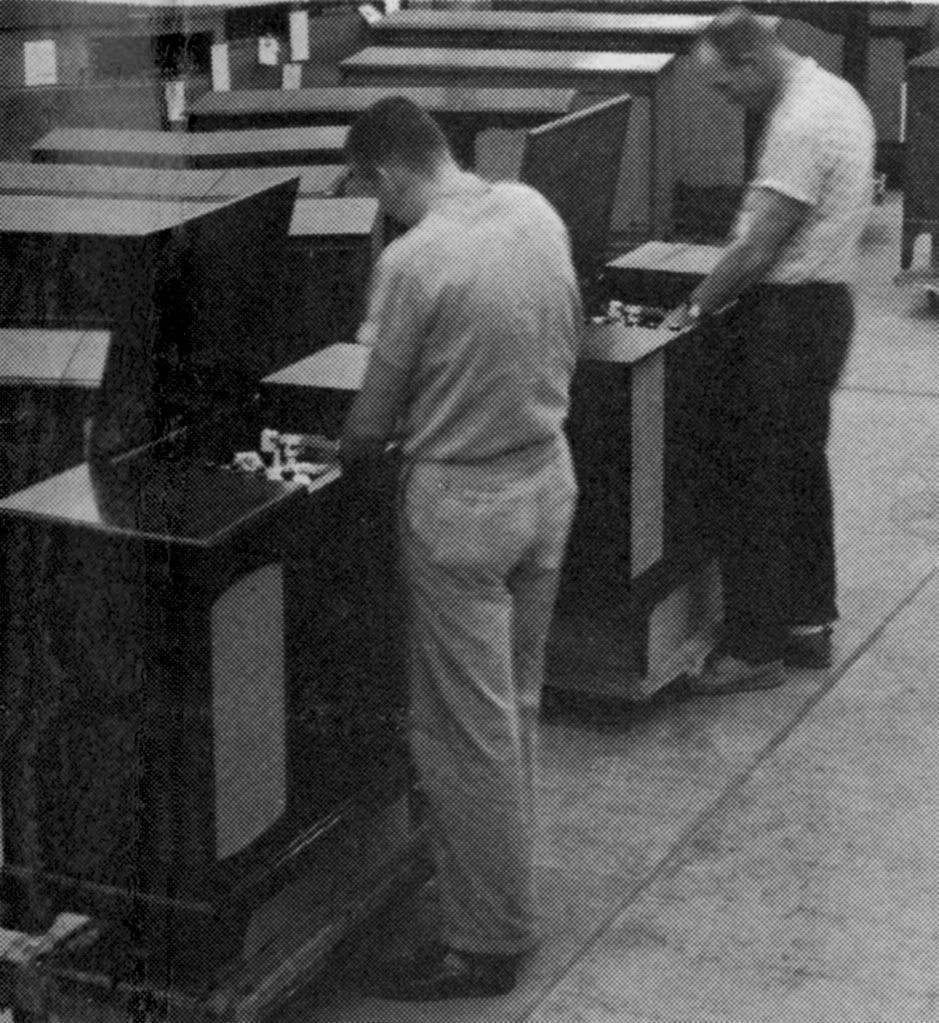
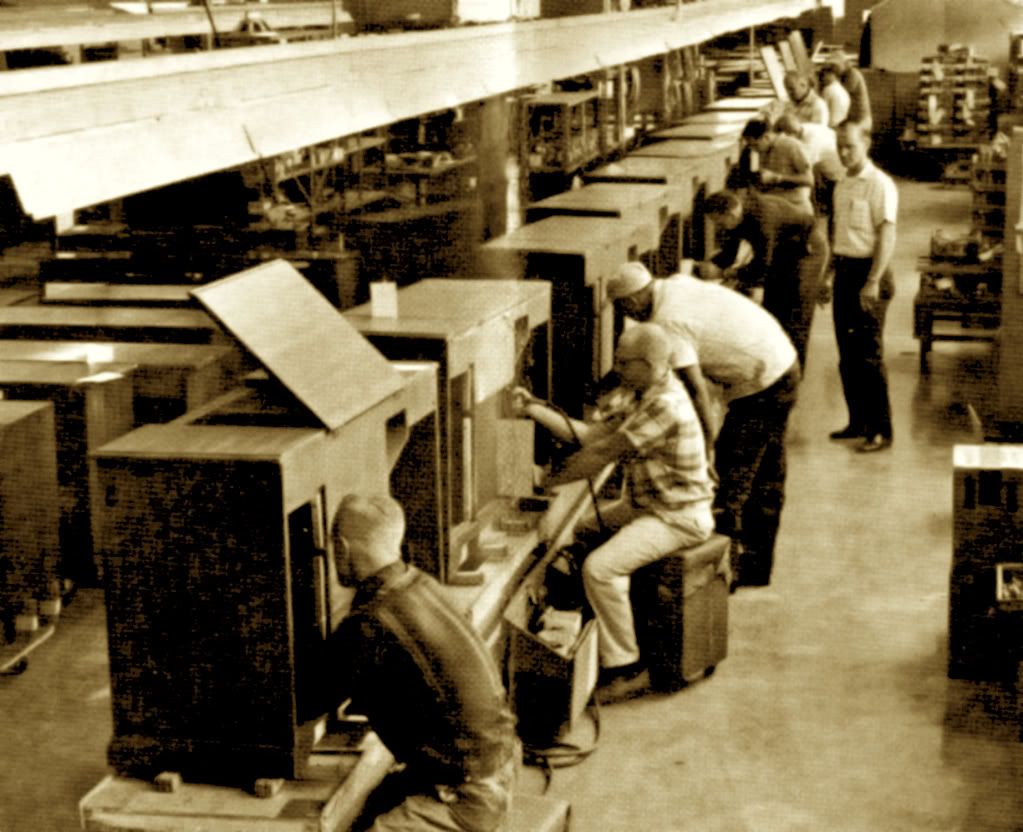
Here are a few other photos from the early 60s that I cropped out of some "Behind the Scenes At Fisher" paste-ups in the console catalogs. I have always thought these were taken in the Long Island plant.

#1
FisherConsoleAssemblyLine60s.jpg


#2
FisherConsoleAssemblyLine60s2.jpg


#3
FisherConsoleAssemblyLine60s3.jpg


#4
FisherConsoleAssemblyLine60s4.jpg
 
First post in this forum. I seems to me like it would be a good idea to set up an archive of all of these pictures, as well as photos of all the models that have been restored by you guys. Sort of a historical reference . . . and a fun place to visit.

It's really cool to see these factory pics--sort of a window into the past.

I don't own any Fisher . . . yet. My late cousin owned (as near as I can remember) an X-100-3 and an FM-200B (along with a Garrard TT) that he used to drive a set of Altec Lansing custom builds back in the late 60's and I have never forgotten the wow factor I had as a kid. My goal is to someday own the same.
 
I don't own any Fisher . . . yet. My late cousin owned (as near as I can remember) an X-100-3 and an FM-200B (along with a Garrard TT) that he used to drive a set of Altec Lansing custom builds back in the late 60's and I have never forgotten the wow factor I had as a kid. My goal is to someday own the same.

Not an unachievable goal! Certainly a good one.
A little patience, a little persistence.... you never know when these things will pop up. Just keep your eyeballs peeled...
 
Fisher was located on Van Dam street in LIC before moving to the 44th DR location, they also had a few other locations in LIC that escape me at the moment. I will have to dig into the files later to find them.

I work in LIC- and almost all of the buildings that the Audio companies were located in are still in use today.
 
I have also seen early photos of Avery Fisher in the "assembly" area of the factory and it is MUCH smaller than the area illustrated in the pictures posted here. I always assumed it was the location on 47th street, but maybe it's Bleecker Street.
 
EL-37, I would love to see that photo if you can find it. The 47th Street location in the old Hotel Marguery was the site of the Fisher Radio Salon until that building was razed to make way for the Union Carbide Building. I don't believe Fisher ever had manufacturing facilities at that location - just the showroom and offices.

The original Fisher 'Laboratories' were located at 116 W. 63rd St. according to the 1946 Manhattan Telephone Directory. That was where the earliest Fishers were manufactured. If you enter that address into a Google search you will find that 63rd Street no longer has a 100 block. I believe the building was on the corner of 63rd Street and Columbus Ave. diagonally across from the Empire Hotel . . . and that's pretty much exactly where Avery Fisher Hall stands today! How's that for an amazing coincidence?

In old newspaper articles from the early 60s I have seen before and after images of showing the site of the Lincoln Center. Since the 'before' photo seems to be taken from roughly the same perspective as the 'after' you can make out several 7-10 story office buildings along the west side of Columbus Ave., one of which must have been the site of Avery Fisher's 'Laboratories'. Most of the rest of the area was low-rise tenement housing identified as "slums" in the photo - so I guess the office buildings were just collateral damage from Robert Moses' Lincoln Square Urban Renewal Project.

Time magazine mentions that location in an article from Nov. 18, 1946:

For the Golden Ear

In a small shop near Manhattan's Columbus Circle last week, a few dozen workmen labored overtime, winding coils and wiring circuits for hand-built radio-phonographs.

Business had never been so good; they were twelve weeks behind orders. The Fisher radio-phonograph had sold mostly by word-of-mouth advertising. The New York Times has repeatedly turned down a Fisher ad which called it the "world's best" machine; last month, surveying the field, FORTUNE said it for Fisher.

Said FORTUNE: "The Fisher sells for less than the big-name 'quality' sets and, by ordinary standards, it is worth a good deal more. It reproduces the soft, small tones that give depth and texture to music with a clarity and realism that are startling to owners of average instruments. It is, in fact, perhaps the only set on the market that would completely satisfy a golden ear." The FORTUNE survey passed over lower-priced, lower frequency sets like Crosley, Philco and RCA-Victor, discussed chiefly such visually satisfying high-priced machines ($495 and up) as Scott (with its "impressive assortment of tubes, wires and gadgets on a chromium-plated base"), Capehart (which "holds 20 discs and turns them over automatically") and the Meissner ("offers high fidelity.) . . . Except for its cabinets, which are elegant, it claims no special features"). FORTUNE did not mention the newly imported London phonograph, which has the same record changer (Garrard) as the Fisher and lightweight pickup, but costs much more ($1,495 and $2,500) than the Fisher ($992 up).

The Fisher phonograph has a range so wide (20 to 12,000 cycles) that it can reproduce almost all sounds within the span of human hearing. The narrower ranges of most other machines (50 to 7,000) do not reproduce the full resonance of a symphony orchestra, fail to catch the high overtones of a flute. The popular-priced Zenith's "Cobra Arm" pickup almost eliminates surface scratches, says FORTUNE, but in order to do so also cuts out frequencies higher than 5,000 cycles.

Based on the addresses Fisher listed in their help wanted ads it appears that they moved their manufacturing and general offices out to the 45-41 Van Dam Street facility in Long Island City sometime prior to March 1951. The move to 21-21 44th Dr. took place sometime prior to July 1954. Also - sometime in the 60s, I believe - they built a very modern-looking headquarters building which I think may have been 11-40 45th Rd. There are a few other address in L.I.C. that Fisher used over the years. If you're ever driving around there with time to kill you might want to check them out:

45-34 32nd Place (repair/service facility)
32-19 Borden Ave. (repair/service facility)
37-23 33rd St. (warehouse)

EDIT: Looked up 11-40 45th Rd., L.I.C. on Google and that was, indeed, Fisher's headquarters. It's still standing and appears to be in excellent condition. The sign on the front of the building reads: Science of the Soul/Study Center/New York RSSB-A. (Interesting backstory in Wikipedia on that topic - though I don't think there's any connection with Fisher.)
 
Last edited:
Ah-ha! So the 33 Bleeker Street location was one of Fisher's first R & D Labs.

BleekerSt1947.jpg


I found this tidbit in Fisher's 1982 Product Line Brochure which was submitted as a 'specimen' to the Patent and Trademark Office when Fisher renewed one of its trademarks. (It's amazing where I find this stuff sometimes.) Sanyo was really digging deep into the old Philharmonic and Fisher files during this period - another untapped resource for early Fisher info.

Does anybody have a copy of this brochure? I could use a higher resolution scan of pages 4 and 5 since the USPTO files were somewhat compromised by the compression algorithms they used. In fact, it looks like their original was pretty beat up, too.

1982-1cover.jpg
 
Interesting, no ladies working the line back then.
Nowadays it would be all women wearing antistatic grounding straps (and no sweaters).
 
Interesting, no ladies working the line back then.
Nowadays it would be all women wearing antistatic grounding straps (and no sweaters).

Au contraire. First photo, first row, 5th person to the right. And directly across from her, the next person farther down.

But, pretty heavily male, not like you'd have seen during WWII.
 
I have a 24 console with a shipping tag on the back with the 33 Bleeker St return address Mabe this is where they were shipped out of after completion?
 
Here are 3 photographs from inside the Fisher factory.

1. Assemby line - can anyone identify the chassis(s)?

2. Factory - can anyone identify the cabinet models?

3. Testing lab

Hint - these photographs were taken in 1950/1951.
g r e a t
 
Back
Top Bottom