Logitech2010
New Member
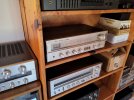
In December of last year, I spent a few nights at my grandmother's house and remembered she had an old stereo in her garage I saw a few years ago (before I was into audio). I opened the closet door it was in and I was greeted by a beautiful Fisher RS 1022 stereo receiver and some lil Realistic Minimus 7's on top of it.
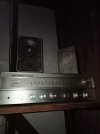
Went back there later that night to go test it out to find out the left channel was sending a loud humming and pulling the driver inwards. The right channel was working fine. Simply disconnected the left speaker and used the FM tuner on the right side for a while listening to the radio. Did that for the other two nights I was there. The morning of the last day I was out there playing around with it and my grandmother asked me if I wanted to yake it out of the closet. I said yes and she brought it out on the cabinet. Holy it was DUSTY on top of that thing, looks like decades of dust. I asked her for it, she said I could keep it and the speakers. Brought it home and did further testing, aux worked. Tried it on one of my Jensen TF-3A speakers, was pretty damn loud for only 22 watts.
I eventually got around to diagnosing what the problem with the left channel was and was greeted by burn marks on the pre amp board.
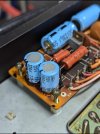
I replaced those two blue capacitors with the burnt glue on the bottom and it still didn't solve the dead channel issue. After further research I concluded that the problem was the STK-043 IC pack. They are notorious for failing in every electronic that has one. Ordered the replacement and it arrived a week later. Installed it on the amp board and the left channel was working again. Unfortunately there was a noticable buzzing from the left channel, not too loud but noticable. Probably caused by a failing transistor or the bulgy capacitors on the amp board (will be replaced eventually). After I fixed the dead channel, I wanted to fix the light bulbs in the indicator that were all burnt out. Opened it up to find every bulb was completely burnt out. -coming up was a mistake that the average rookie would make, I was new to vintage stereos at the time I did this- I went to O'Reilly's and got AGC glass fuses rated the same as the old fuses. Keep in mind the indicator needs fuse BULBS. Not normal fuses. I installed the glass fuses in the indicator assembly to no light at all (wrong part). Later that evening I went to listen to some music on it to find out it wasn't doing ANYTHING. The whole reciever was presumably dead. After diagnosing with a multimeter, I found that power was going into the transformer and not coming out, highly likely meaning I shorted the transformer. Ordered the part off eBay and it arrived 3 weeks later. At that time I also ordered Blue LEDs off Parts Express (correct part). I couldn't cancel the order after I killed the Fisher so they were going to arrive and I couldn't do anything about it. The transformer was here and all I had to do was replace the old one with the new. After a lil bit of work, I had finally installed the transformer and all I had to do was turn on the power switch. I turn it on and was greeted by bright blue pretty LEDs on the indicator.
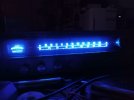
I plugged in a test speaker and low and behold, it was playing sound out both sides again. I was ecstatic to had finally gotten this receiver working after a month of it being dead. However, one of the LEDs in the tuner indicator wasn't turning on. It was just the clamp that holds it on wasn't making contact on one side. One quick and easy squeeze with pliers and it started working again. Here's a helpful but OBVIOUS piece of advice I didn't realize until it was too late, but do NOT put normal glass fuses in place of fuse bulbs. You WILL short your transformer or blow the fuse for the secondary.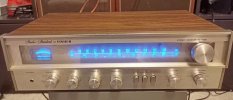
Went back there later that night to go test it out to find out the left channel was sending a loud humming and pulling the driver inwards. The right channel was working fine. Simply disconnected the left speaker and used the FM tuner on the right side for a while listening to the radio. Did that for the other two nights I was there. The morning of the last day I was out there playing around with it and my grandmother asked me if I wanted to yake it out of the closet. I said yes and she brought it out on the cabinet. Holy it was DUSTY on top of that thing, looks like decades of dust. I asked her for it, she said I could keep it and the speakers. Brought it home and did further testing, aux worked. Tried it on one of my Jensen TF-3A speakers, was pretty damn loud for only 22 watts.
I eventually got around to diagnosing what the problem with the left channel was and was greeted by burn marks on the pre amp board.
I replaced those two blue capacitors with the burnt glue on the bottom and it still didn't solve the dead channel issue. After further research I concluded that the problem was the STK-043 IC pack. They are notorious for failing in every electronic that has one. Ordered the replacement and it arrived a week later. Installed it on the amp board and the left channel was working again. Unfortunately there was a noticable buzzing from the left channel, not too loud but noticable. Probably caused by a failing transistor or the bulgy capacitors on the amp board (will be replaced eventually). After I fixed the dead channel, I wanted to fix the light bulbs in the indicator that were all burnt out. Opened it up to find every bulb was completely burnt out. -coming up was a mistake that the average rookie would make, I was new to vintage stereos at the time I did this- I went to O'Reilly's and got AGC glass fuses rated the same as the old fuses. Keep in mind the indicator needs fuse BULBS. Not normal fuses. I installed the glass fuses in the indicator assembly to no light at all (wrong part). Later that evening I went to listen to some music on it to find out it wasn't doing ANYTHING. The whole reciever was presumably dead. After diagnosing with a multimeter, I found that power was going into the transformer and not coming out, highly likely meaning I shorted the transformer. Ordered the part off eBay and it arrived 3 weeks later. At that time I also ordered Blue LEDs off Parts Express (correct part). I couldn't cancel the order after I killed the Fisher so they were going to arrive and I couldn't do anything about it. The transformer was here and all I had to do was replace the old one with the new. After a lil bit of work, I had finally installed the transformer and all I had to do was turn on the power switch. I turn it on and was greeted by bright blue pretty LEDs on the indicator.
I plugged in a test speaker and low and behold, it was playing sound out both sides again. I was ecstatic to had finally gotten this receiver working after a month of it being dead. However, one of the LEDs in the tuner indicator wasn't turning on. It was just the clamp that holds it on wasn't making contact on one side. One quick and easy squeeze with pliers and it started working again. Here's a helpful but OBVIOUS piece of advice I didn't realize until it was too late, but do NOT put normal glass fuses in place of fuse bulbs. You WILL short your transformer or blow the fuse for the secondary.