• The move to the new server is done. There are some software and database maintenance updates in process. This has us passing the hat around to help out. We appreciate any donations. Seriously, even a dollar helps. The payment page may be found here - https://www.audiokarma.org/support.html

Fisher wattage claims

nsgn007

Active Member
I am getting conflicted info on two consoles I have , both are solid state models one is the ambassador A-691 with the 69T chassis, and the other is a Regent R-592 with a 49T chassis . Reading some posts they claim whatever fisher states as output, you split it in half ...so the ambassador says 75 watts... so is that roughly 37 1/2 watts per channel? And for the regent, on the fisher site it says 120 watts ... so / 2 makes 60?... but on the dealers catalogue page located on this site it says 75 watts?? have no clue what measurement they are stating... IHF ? RMS? or what fisher is using in their wattage measurement...can someone enlighten me?
Thanks
 
Register to hide this ad
IHF is PEAK TOTAL WATTAGE (Both channels driven) with a quite high distortion(>1%). RMS wattage is quite different (usually at onset of distortion in the sine wave ) with lower distortion allowed. Roughly RMS watts per channel is 1/4 or therabouts of IHF total peak Wattage. 75Watts IHF would be about 18-20Watts per channel RMS, and 120Watts IHF would be about 28 Watts RMS per channel. And the 28W is very optimistic. At the time of manufacture IHF was the sort of standard. FTC testing to RMS wasn't promulgated until 1974.

The 69-T was a 1 year only receiver chassis built specifically for the 66 Futura and Ambassador. It was a transistion unit between the 59-T tuner/pre,59A Hybrid Amp of 1965 and the 1967 modified receivers used from 1967 on. It's not a bad unit, but it comes in about 18-20 watts. The Regent from 1967 is powered by a 31-R receiver. We haven't been able to corellate that to a standalone yet. Can you take a couple of good clear hi-res pics of the 31-R face and the chassis (if you feel so inclined.) It would help I.D. which stand-alone receiver at the time was actually used in the Regent.

The 49-T was the Tuner/pre-amp in the 1965/1966 Custom Electra with the Hybrid 49-A amp. The 49-A is basically identical to the 59-A with the 59-A having an additional 4 transistors in the outputs. The 49-T is a vertical unit, while the 31-R is horizontal. I'd have to compare the 69-T and the 31-R but supposition is that the 31-R is most likely a revision/improvement of the 69-T.
 
Last edited:
A lot of mfg engaged in some "hopes and dreams" wattage ratings at this time. Its a big part of why the FTC power ratings standards were developed. Those are an absolute torture test but result in extremely conservative power ratings. Its also why amps from the 70s are so much more powerful despite a similar claimed wattage.
 
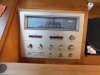
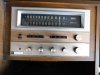
Well first of all... I was wrong on the Regent chassis … it is the 31R , not 49T … no idea where I got that number.. but here are a couple pics from both units except for a couple minor changes they look almost identical...
DSCN0078.JPG DSCN0079.JPG
 
From what I see of the schematics at 1st glance the chassis are very similar. Both are powered by Germanium output transistors, so don't crank them too hard. Power levels should be very similar, while giving the nod to the Regent, however slightly.
 
would you happen to know if there are any scans of the owners manuals somewhere on the web for these? I always try to get them for every console I have ....
Thanks
 
Unless you got them from the original owner, it's gonna be nigh on impossible to find O.M.'s. Especially 1965 on up.
 
The only meaningful power rating is continuous sine wave power (technically not called RMS power but often is). This can be calculated approximately if the supply voltage is known. If the supply is a dual supply at ±35 volts, figure it will drop to 30 volts under load and there may be up to 5 volts between the supply and the output. That would be ±25 volts peak to the speaker. An 8 Ω speaker would draw 3.13 amps peak. 3.13 x 25 = 78. Converting peak volts and amps to RMS is the same as dividing peak power by 2. So, in this example, the continuous output would be approximately 39 watts per channel.

It gets a bit more complicated because running at that full power, the transistors, heat sinks, and power supply components will get hot. Most amplifiers (Fisher included) are designed for music and the maximum power will only be needed for short durations (but still much longer than any goofy "music power" ratings) and the long term average would be about 10 dB lower, or 3.9 watts per channel long term. This is why McIntosh (and a few competitors) is so expensive because they will sustain maximum power long term. Many are used for other than music where that maximum power may be needed continuously long term.
 
You should be able to get scans of the manuals for your Fisher Regent from www.fisherconsoles.com. Went and checked and they do have the service manual. The Ambassador of the previous year's owner's manual is very close if not as sport on to your Regent. As they used a similar tuner/preamp chassis.
 
Last edited:
IIRC Dave measured a rebuilt (all the mods including EFB, etc) 800c at about 30-34w. As the 500c is basically the same in the preamp and amp sections I would presume similar numbers for the 500c. Stock is somewhere between 26-28wpc as I recall.
 
EFB corrects a lot for screen voltage sag, and thats a big reason output power drops off. Can't fix the main B+ sag, but if the voltages are kept proportional it still helps a lot. Just knocking back the idle current really doesn't cut back on output power, provided the driver can actually produce enough signal.
 
Back
Top Bottom