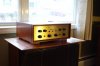
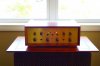
I am rebuilding a Fisher X-202. Some features are a GZ34 rectifier, PP 7189 (6BQ5 family) and fixed bias design. I prefer fixed bias vs cathode bias, but perhaps that is just me.
Some other attributes of this X-202 is the original power supply design. The power supply uses two parallel 250 ohm resistors in-between the rectifier and first capacitor for 380 volts DC to the power tube plates.
7189 are rated for 400 volts, but rather high voltage for a 6BQ5 type tube. Even if 7189s have some difference I could not measure internally vs the 6BQ5, 7189s are rare and expensive. Further tests of a 7189 in a 6BQ5 circuit did not produce any different sound using same brand of tube.
Removing the fore-mentioned power supply resistor and adding a 4HY choke makes for a wonderful choke input design and lowers the voltage to a more comfortable 340 volts DC. If the line voltage is over 120 volts AC, perhaps 350 volts DC. The screens are now at 250 volts vs the original 280 volts. Further down stream, two 2.4K resistors are used for a CRCRC network. I changed the first resistor (closest to the power supply high B+) from 2.4K to 1.2K to bring up the voltage closer to spec downstream of the screen supply for the preamp tubes. The power supply can afford lower voltage drop across the new resistor without higher ripple due to the far superior filtering of the new choke input and new 100uF capacitor.
Choke input power supplies provide good regulation and affords a higher rated filter capacitor for the tube rectifier maximum specification. In this case, I used 100uF for about 2.2 volts AC ripple under load. An old approximate calculation is HY x C = total capacitance. In this case 4HY x 100uF = 400uF of effective capacitance.
The bias supply also supplies DC for the phono and preamp tubes. I am a little surprised the tubes are operating at a starved filament voltage of 9.5 volts DC each as two tubes are wired in series. My tests have shown not so great performance below 5.5 volts on 6.3 volt wired preamp tubes.
I removed the old bias bridge rectifier and installed a Schottky bridge using 80 volt rated rectifiers. My thinking of 80 volts rating is the AC input to the bridge rectifier is 24 volts. Designs with 2.5 x the diode operating voltage makes for failures disappearing. This is old school general based design info.
The new bridge rectifier affords 25.4 volts DC output. Preamp tubes are operating at 12.7 VDC or within spec. I rebuilt the old can cap and raised the original 2x 1000uF @ 30 volt caps to 4700uF @ 35 volts.
The power tubes have a convenient bias adjust pot. Simple adjustment back to -14 volts factory spec is a breeze. I used -13 volts bias. This bias point is excellent for GE 6BQ5s at the operating voltages. I like to operate Mullard EL84 hot at -11 for best sound at the new voltage ratings.
This amp sound marvelous without the better tubes & coupling capacitors I propose right now. In fact, it makes me rethink about Mullard 7247 not sounding so great. Another (not Fisher) amp was disappointing using the Mullard 7247. I do have top shelf CBS 7247s on the way.
Bottom line. I have to buy a Fisher X-202 for myself. My Fisher 400 with extensive upgrades is already nervous. Our toys have feelings, right? Perhaps not.
I will follow up on the X-202 rebuild.
Some other attributes of this X-202 is the original power supply design. The power supply uses two parallel 250 ohm resistors in-between the rectifier and first capacitor for 380 volts DC to the power tube plates.
7189 are rated for 400 volts, but rather high voltage for a 6BQ5 type tube. Even if 7189s have some difference I could not measure internally vs the 6BQ5, 7189s are rare and expensive. Further tests of a 7189 in a 6BQ5 circuit did not produce any different sound using same brand of tube.
Removing the fore-mentioned power supply resistor and adding a 4HY choke makes for a wonderful choke input design and lowers the voltage to a more comfortable 340 volts DC. If the line voltage is over 120 volts AC, perhaps 350 volts DC. The screens are now at 250 volts vs the original 280 volts. Further down stream, two 2.4K resistors are used for a CRCRC network. I changed the first resistor (closest to the power supply high B+) from 2.4K to 1.2K to bring up the voltage closer to spec downstream of the screen supply for the preamp tubes. The power supply can afford lower voltage drop across the new resistor without higher ripple due to the far superior filtering of the new choke input and new 100uF capacitor.
Choke input power supplies provide good regulation and affords a higher rated filter capacitor for the tube rectifier maximum specification. In this case, I used 100uF for about 2.2 volts AC ripple under load. An old approximate calculation is HY x C = total capacitance. In this case 4HY x 100uF = 400uF of effective capacitance.
The bias supply also supplies DC for the phono and preamp tubes. I am a little surprised the tubes are operating at a starved filament voltage of 9.5 volts DC each as two tubes are wired in series. My tests have shown not so great performance below 5.5 volts on 6.3 volt wired preamp tubes.
I removed the old bias bridge rectifier and installed a Schottky bridge using 80 volt rated rectifiers. My thinking of 80 volts rating is the AC input to the bridge rectifier is 24 volts. Designs with 2.5 x the diode operating voltage makes for failures disappearing. This is old school general based design info.
The new bridge rectifier affords 25.4 volts DC output. Preamp tubes are operating at 12.7 VDC or within spec. I rebuilt the old can cap and raised the original 2x 1000uF @ 30 volt caps to 4700uF @ 35 volts.
The power tubes have a convenient bias adjust pot. Simple adjustment back to -14 volts factory spec is a breeze. I used -13 volts bias. This bias point is excellent for GE 6BQ5s at the operating voltages. I like to operate Mullard EL84 hot at -11 for best sound at the new voltage ratings.
This amp sound marvelous without the better tubes & coupling capacitors I propose right now. In fact, it makes me rethink about Mullard 7247 not sounding so great. Another (not Fisher) amp was disappointing using the Mullard 7247. I do have top shelf CBS 7247s on the way.
Bottom line. I have to buy a Fisher X-202 for myself. My Fisher 400 with extensive upgrades is already nervous. Our toys have feelings, right? Perhaps not.
I will follow up on the X-202 rebuild.
Attachments
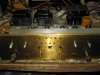

Last edited:


 I'm putting some cash aside for some of those Brimars for my phono section of the 400. I've dabbled a bit already with tube rolling, and they DO make a difference. The PC equivalent of tube rolling is selecting RAM. 1GB from one company can't be tweaked but Corsair memory can be overclocked and my PC runs like a chicken in Ethiopia! Corsair does cost more, though.