• The move to the new server is done. There are some software and database maintenance updates in process. This has us passing the hat around to help out. We appreciate any donations. Seriously, even a dollar helps. The payment page may be found here - https://www.audiokarma.org/support.html

FM signal distortion mystery - I am stumped!

OscarEmmy

VHFSE Originator/Blogger
I have a problem with an LXI (Sanyo) 562 receiver (75w per channel) that only affects FM.

1) It works flawlessly on AM, Phono, AUX at any listening level up to full volume.
2) On FM and FM MPX it only works well up to about a 1/4 turn of the control. Beyond this level, loud distortion occurs. The distortion stops when I reduce volume again.
3) If I press the Loudness button the distortion tends to occur sooner (as sound levels increase).
4) The point at which distortion occurs depends on input level - for example, quiet music or voice during an FM transmission remains distortion free at higher gain levels compared with, say loud rock music.
5) I also note that when distortion kicks in, the FM signal strength indicator falls to a lower level.
6) The problem does NOT occur when listening through headphones, only when playing through speakers. I have tried different speakers, all with the same result.

I have never come across anything like this before. Can anyone suggest a cause and/or remedy?
 
Register to hide this ad
Sounds like a power supply problem. The power supply voltage to the FM is probably low to begin with and when the load increases on the supply, the FM supply drops further, causing distortion.
 
Yeah, that's a bit odd.

Yes, do check the power supply when driving loudspeakers or other loads. You might try to see if it has the same behavior when driving headphones only.

It doesn't sound like you're losing tweeters. I only mention that for the possibility that there's some supersonic junk coming out of you tuner's audio output, possibly being amplified and clipping your amplifier.

Jon, it does not occur at all when using headphones only. When listening to both speakers and headphones, it occurs and can be heard both via headphones and speakers. So it appears related to something affecting the FM signal itself. I say this because AM is unaffected regardless of listening levels.

I am presently uploading a YouTube video showing the problem...it will take about 90 minutes to be viewable (so about 2.30 p.m. Eastern), but here is the link: http://youtu.be/-tROHPfypac

Don't bother with the Youtube video. I know it's the power supply. The fact that the signal strength drops is a dead giveaway. Measure the power supply voltage for FM. The most likely place is the supply for the IF section, so you can measure on one of the IF amplifier IC's. Look up the data sheet on the IC and find the power supply pin. Normally it is around 12V. If the voltage is low, look in the power supply section for a transistor with a metal tab on top, maybe with a heat sink attached. Check the solder joints on all transistors like that. If you see a dark ring around the component lead, resolder the joint.
 
Thanks Dr. Audio - I will do that! I also note this only occurs when the units warms up - from a cold start it plays perfectly at any output level. That would also suggest movement with heat expansion, so a bad solder joint might well be the issue! :)
 
The reason you don't hear with headphones is the fact they don't draw any current from the supply, the speakers are drawing lots of current causing the supplies to sag abnormally.

Craig
 
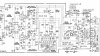
Great...so I was trying to measure voltage at a transistor on the power supply board (Q351 one of a pair associated with voltage regulator) that are attached to a heat sink), and my probe slipped and shorted out the transistor - flash and a puff of smoke, and now of course no sound at all! :tears::( I will need to replace Q351 at least, probably Q352 also. I have attached circuit diagrams of the PSB.
 

Attachments

  • Capture1.jpg
    Capture1.jpg
    101.5 KB · Views: 6
  • Capture2.jpg
    Capture2.jpg
    94.3 KB · Views: 5
  • Capture3.jpg
    Capture3.jpg
    101.2 KB · Views: 3
Great...so I was trying to measure voltage at a transistor on the power supply board (Q351 one of a pair associated with voltage regulator) that are attached to a heat sink), and my probe slipped and shorted out the transistor - flash and a puff of smoke, and now of course no sound at all! :tears::( I will need to replace Q351 at least, probably Q352 also. I have attached circuit diagrams of the PSB.

Test the transistors and the zener diode connected to the base, also. In the future, wrap electrical tape around the meter probe so only the very tip is exposed. Helps prevent shorting things out.
 
Thanks for the tip regarding the probes...I'll do that when the new transistors arrive. Did you mean "test the capacitors and the zener diode connected to the base"? I can see the diodes and there are caps connected to the base, but no other transistors in that part of the circuit that I can see.
 
Yes, one of the zener diodes has failed - D362. Of course, that might have gone when I shorted the associated transistor. The other diode (D363) is fine.
 
Yes, one of the zener diodes has failed - D362. Of course, that might have gone when I shorted the associated transistor. The other diode (D363) is fine.

I thought there was a good chance you killed the diode along with the transistor. No, I meant check the transistors....AND the diodes connected to the base. Good idea to check the caps, but I was pretty sure the original problem was a bad solder joint. Had you checked those first instead of measuring you may have found the problem. I understand why you checked the voltage, though. I was just trying to save you some time.
 
Back
Top Bottom