• The move to the new server is done. There are some software and database maintenance updates in process. This has us passing the hat around to help out. We appreciate any donations. Seriously, even a dollar helps. The payment page may be found here - https://www.audiokarma.org/support.html

For those about to built sweep tube amps... I salute you!

GordonW

Speakerfixer
Subscriber
OK... with all the different threads that have "mutated" into sweep tube amp discussions, I thought a thread ACTUALLY ABOUT THEM in the first place would be a good idea.

I'm thinking of coming up with a design for one, for one thing... a design with elements of some of the Berning designs (biasing/direct coupling of output tube grids, etc), and incorporating some aspects of some of the "classic" designs (Mullard circuit, etc), but with greater power output (60-80 watts/ch).

One idea I had, was something like the following:

Input: Pentode, like EF86, EF804, 6EJ7/EF184, or like in grounded-cathode mode

Phase splitter: 6SN7 or 6CG7/6FQ7 or 12AT7 in LTP

Gain stage/driver: 2- 12B4A, grounded cathode (models at ~ 900 ohm output impedance) DIRECT COUPLED (with a separate B+ and B- supply for the 12B4As)- no coupling caps to the grids of the output tubes (to allow AB2 mode, if necessary for full output). This would use a bias scheme (DC biasing of the 12B4s would provide output DC voltage adjustment for the grids of the output tubes) like the Berning EA-230, in essence. This looks like it could actually get the necessary voltage swing (like +- 150 volts AC or so) to drive the screens of the outputs.

Output tube: 6AV5 or 12AV5 in sweep-drive PP.

No semiconductors; this is strictly an "old-school" design.


Another, more ambitious design idea- a three-stage (is it possible?)!

Input: 6AV6/12AV6 in "max gain" tuning in grounded-cathode (or maybe a SRPP or something similar using a 12AX7 or 6EU7 or the like?)

Phase splitter/driver: 6H30P in LTP (would have less than 2K output impedance), DIRECT COUPLED to the output tube grids (no couplling caps- would require separate B+ and B- for the LTP).

Outputs: 6AV5 or 12AV5 in sweep-drive PP.


Any thoughts on either of these ideas? My thoughts are that the first design (four-stage) is much more plausible... it seems to be do-able, according to TubeCad and the like, comparing specs to circuit alignments in the Berning amps and Eico HF22/HF35 front-end designs. Looks like GOOD bandwidth would be possible (as in like over 250KHz open-loop bandwidth, maybe higher).

The second design is temptingly attractive to me, IF it could be done. I like the idea of only three stages- basically, a near-classic Mullard design, only with probably a triode input stage (to get lower output impedance driving the LTP). But, as might be expected, there's pitfalls everywhere- bandwidth limitations on the first two stages (haven't modeled the 6H30P yet, so I don't know how it would work for the LTP- might be better?), gain limitations vs. balance in the phase splitter vs. output impedance driving the grids of the outputs, etc. It's definitely a challenge!

For either of these, I'm thinking of some of the economical Edcor output transformers... they've got a nice 60 watt PP transformer, that's only about $70, and a 100 watt for about $90... could be a good start...

So, any thoughts?? I'm trying to draw out schematics as I work them out in my head... I'll try posting up some hypothetical circuit diagrams, if I can get 'em where they seem where they might actually be reasonably practical, in theory...

Regards,
Gordon.
 
Register to hide this ad
This could be a complete train wreck waiting to happen, but...

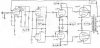
I drew out a schematic, of the most plausible idea I've had so far.

It's a hybrid of a bunch of stuff... Mullard front-end/phase splitter, with a somewhat modified Berning "business end", with my own contribution between as a driver stage.

attachment.php


As can be seen, there's quite a lot still to do. Haven't figured out exact tunings and biasing for the stages yet, among other things... that's why there's no resistor or cap values listed yet. HOWEVER... at least in THEORY, all the stages CAN be made to have appropriate gains and bandwidths (and input/output impedances, where needed).

The main "weirdness" of this design, would have to be the voltage arrangement on the 12B4 driver stage... this stage will be SEVERAL HUNDRED VOLTS BELOW GROUND, for the most part, so that the anode of the tube will be placed AT THE RIGHT VOLTAGE to DIRECTLY drive the 12AV5 grid, for proper bias. With an output impedance of around 1K ohms for the 12B4 driver, I don't think there will be any problem with grid current... class AB2, here we come, if needed! To get this, there will be a moderate-voltage B2(+) supply (somewhere like 150-200 volts or so) and a good size B2(-) supply (around -500 volts or so). This will obviously require a second transformer secondary (and another heater winding, so I can DC-offset the heater winding appropriately on the 12B4s, to maintain proper heater/cathode voltage limits)... I'm working on a way to do this. Might wind up with more than one power transformer... but, given that the B1+ and possibly B2- supplies MAY be able to be done with 110/220 step-up transformers and voltage doublers, it might not be as expensive as it might first seem. That, and some bell transformers for heaters... should be no real problem.

One note- the resistors on the cathodes of the 12AV5 output tubes are just SENSE resistors... about 10 ohms, probably. These are just for bias current testing.

Found what I think MIGHT be a suitable output transformer- Edcor CXPP100-MS-5K:

http://www.edcorusa.com/products/transformers/cxpp/cxpp100-ms-5k.html

Might not be exactly what's wanted for the thing in screen drive mode, as far as impedance is concerned... but I'd think I should be able to still get around 60 watts or so out of it. Might require B+ to be lower... but that'd certainly be OK...

So, any thoughts regarding my scribbled madness? :D

Regards,
Gordon.
 

Attachments

  • gwscreenamp.jpg
    gwscreenamp.jpg
    29.1 KB · Views: 1,046
The pentode up front is interesting:yes: I see that's where your injecting the feedback as well, probably a good idea. On the other hand, the 6AV6 is one of my all time favorite tubes. I don't know who made them for Fishers brand, but they are very special.:thmbsp: I'll be watching this one close, and good luck.
 
hey-Hey!!!,
I think I will stay with conventional g1 drive and run as pentodes. Likely a 5k output too.

I plan for a regulated g2 supply, likely shunt regulated with a gas tube. I will use one of the bigger ones, likely 6LW6. According to Tubelab, they stand more than 50% over their rated plate dissipation. I am working up the circuit; can't decide if I'll implement the usual E-Linear front end with a customized, multiple tapped OPT. If I run something like the RCA circuit, I don't need any taps and can try a few of my OPT collection off the rack. The RCA circuit does sound pretty good, even in PPP.

Gordon, I have my doubts of using the plate of the driver instead of its cathode. Delivering current will counteract the rising plate voltage...I'll wait over here while you try it...:)
cheers,
Douglas
 
I have my doubts of using the plate of the driver instead of its cathode. Delivering current will counteract the rising plate voltage...I'll wait over here while you try it...:)

ditto that. Gordon, If you're not too afraid of semiconductors, tubelab's 'powerdrive,' as he calls it, a MOSFET source follower - offers, in addition to low output impedance, no need to worry about h/k voltage ratings.

I'm assuming when you say AB2, that you mean grid current draw, but a screen drive amp will always be drawing grid or screen current (depending on what you are calling the screen for this), and with 6AV5, even before you get the huge shoot-up in Ig2 at low plate voltages, there can be up to 20mA of screen current. A cathode or source follower is best for this. And be sure to keep screen resistors low.

Let us know how it turns out! ...and which transformers you go with and how they fare. :thmbsp: Good luck
 
Nice little LTP phase splitter there--very basic. :thmbsp: They work, but usually can stand a bit of tweaking. Evolved from this ckt was the famous--or infamous--however you looked at it--"Golden Ear" technology in phase splitting technology, with a nightmare of cross-coupled triode stages to assure that the phase and amplitude feeding the final stages were guaranteed to get an even dose of excitation--and in proper phase coherence....(ho hum...)

I haven't lately Googled such "antique" expressions as I've spouted tonight, but I can likely count on one having a seriously good time--and a lot of time spent in such--in such research....As thesear probably still principles of operation that are getting plenty of air-time. Prepare for a quagmire if that is where you want to go in phase splitting techniques. The terms "hair" and "phase" seem equally to be split in such discussions--that have been ongoing since the early '50s for sure..... :rolleys: Still good info, but.... :rolleyes: just the same.... :D

Obviously won't get too much power out of the triode plan, but....
 
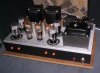
My Sweep Amp. (Well sweep tubes anyway) :)

When I get the Schem cleaned up, I'll post it. (No Solid State parts at the moment)
(not running screen drive, but "conventional" grid drive)

6FY7/6FM7/6FJ7 (AT THE MOMENT RUNNING THE J) voltage gain to a 6BK7/6BQ7/6BZ7
schmidt type LTP splitter out to the 6AV5's wired in triode and using some Sansui 1000A
outputs for push pull triode. The power supply is Lc,Lc to the outpts then an old ST-70 :)
choke to feed the front end, then each triode gets it's own RC stage, only using that low
MU/beefy portion for the voltage amp, the switch on the front turns on or off bipass caps
for those input tubes. Paralell 5V4's for rectification. Chassis is one I modded from Ebay. :)
(switch on for running 6FY7/6FM7, switch off when running 6FJ7, good gain this way)

At the moment I'm using a funky cathode bias schem that I'm surprised to say works well.
(Will convert to/try fixed bias when I get to it, I'm not in a hurry though)

Overall I find it hard to be happier about the outcome, still got some tweaks/painting to do.
 

Attachments

  • keg_amp_666.JPG
    keg_amp_666.JPG
    101.4 KB · Views: 319
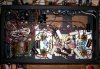
Under Side.

Here's a pic of my Rats Nest!
 

Attachments

  • keg_amp_666_und.JPG
    keg_amp_666_und.JPG
    140.1 KB · Views: 268
hey-Hey!!!,
Since the pix only tell part ov the story, that is one professional looking amp in person. Very nicely done...:) not that we expect anything less, eh? Beats heck out of 1kV B+ rigged up on plywood and tied together with clip-leads:nono:
cheers,
Douglas
 
Use the Berning 30W circuit: http://www.triodeel.com/brnea230.gif

6JN6 is quite similar to 6DQ6, 6AV5, 6GT5, and many other small sweep tubes.

Agree!

The two quantities you are looking for in a g2-drive tube are gm and triode mu. Lower mu factor is better, low as is possible. Given the mainstream audio pentodes run between 10 and 20, the 4.4 is a good number. Valves like 6LF6 get down to ~3 IIRC but they're hideously 'spensive.
cheers,
Douglas
 
Looks like it would be more practical, to use the 12B4As as cathode followers, and make up the gain somewhere else. With the current capacity of the 12B4, it'll man-handle the screen of the 12AV5, I'd think! :D

Anyone got a feel for which one of these pentodes might be capable of the most gain, while still being able to drive a 12AT7 LTP phase splitter?

EF86
EF804
6EJ7
6BH6

Or, if anyone has any other pentode suggestions... glad to hear 'em!

I don't want to have to "current starve" the things as bad as Futterman, if I don't have to... but whatever I can do to get the gain, safely and usefully...

Regards,
Gordon.
 
hey-Hey!!!,
6EJ7/EF184 can do the most gain with a given B+/plate load combo I think. 12BY7 would be another option, as would 6CL6 and EL84.
cheers,
Douglas
 
6EJ7 has a high gm and is easy to find... there are some video pentodes too like 12BY7, 12GN7, 6CL6, but you don't that much drive current. The 6EJ7 is good triode wired too...
 
hey-Hey!!!,
6EJ7/EF184 can do the most gain with a given B+/plate load combo I think. 12BY7 would be another option, as would 6CL6 and EL84.
cheers,
Douglas

Douglas knows this, but to others - I've had excellent results with the 6CL6, very linear in LTP with CCS tail. Would make an excellent final gain-stage, I've been able to get pretty ridiculous swings out of it. And it'll take a good deal of plate dissipation, so you can keep a fairly low plate load for good hf response. I'll take it back to bench if there is an increased interest. I may use it for my g2drive amp.

For my amp, I was thinking: input -> 6AU6 LTP -> 6CL6 LTP -> source/cathode followers -> 6DQ6 screens
 
Back
Top Bottom