Fosi Audio BT20a MAX User Experience and Presentation
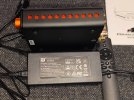
I received a new package from Fosi audio. Thank you very much for trusting my neutral reviews and thank you for not expecting anything "only positive" from my review. I was given free rein to write an honest user review. Let's see what arrived. Their latest desktop compact amplifier, the BT20a Max, arrived to me before the New Year. It was supposed to be introduced at the end of 2025, but the final date was postponed to January 10, 2026. The price ranges from 280-320 USD, depending on the power supply output (32v 5a - 48v 5a and 48v 5a Gan), but as is usual with Fosi promotions, I see a 20% introductory sale on their website. Let's not wait any longer, unpack and see what's in the box:
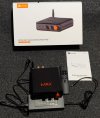
Contents: BT20A MAX
48v 5a Gan power supply
Remote control
Bluetooth antenna
User manual.
Before we start, let's take a quick look around, front panel:
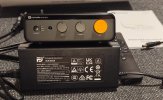
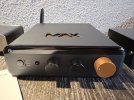
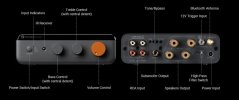
It's immediately clear that the design is new, obviously I'm mainly thinking of the front panel here. It's different from what we're used to. It has a designer, rounded front panel. With a plastic decorative strip on top. This is the first device with all four edges of the front panel rounded. We find a power button on it, which is also the channel selector. Here we can see that we have 3 input channels. We see a series of LEDs that indicate the currently used input, the remote control sensor, an equalizer and a motorized volume control. The layout is very logical, I like it too.
The device has very good parameters. I don't usually fill my reviews with specifications, I prefer real-world usage reviews. If you want more details, you can find everything on the manufacturer's website. I'll mention a few:
Hi res Bluetooth Audio, With Bluetooth 6.0, the BT20A MAX supports a wide range of high-quality codecs, such as LDAC, aptX and aptX Lossless, Qualcomm chip: QCC3095. PFFB (this is Fosi's first stereo amplifier with PFFB) 2x300 watts on Ohm, Hi pass filter, snr 112 pcs. distortion 0.003%. Separate power supply for digital and analog sections. Elna capacitors. Built-in cooling.
Factory data:

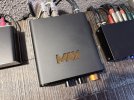
The housing is reminiscent of the v3 mono design. We also find the round side ventilation openings. It finally got a top opening where the heated air can escape. This is the MAX inscription itself. We know from physics that the flow of hot air rises upwards. It got a significant help for ventilation: a built-in fan, which is relatively quiet. The ventilation MAX inscription visible on the top of the housing is equipped with a perforated orange insert plate like the side vents. We can hear a discreet rustling (and airflow) from close up during operation. Since I sometimes listen to music very quietly, I hear it, and during the break between two songs can hear, which bothers me. A basicnoise during the break. After a few days of use, I couldn't get used to it, so I took it apart and pulled off the fan's contact lug because it can still ventilate through the slots and checked if it overheats. I don't encourage anyone to do this, but there was no significant heating. After a few hours of use, without active cooling, I measured 33-34 degrees Celsius. I've been using it for two days now without active cooling, with normal room volume, and there is no significant heating. So far, it has never exceeded 34 degrees Celsius. Unfortunately, I haven't measured it with the fan running before, but when I touched it with my hand, the heating was very similar. It may be that the change is only minimal. I don't want to disassemble it again for accurate measurement, I will obviously monitor the temperature in the long term and if necessary, I will restore the active cooling. If I ever notice overheating, and I need to reset the factory cooling. I will report it in the article or in a comment.
I couldn't get used to the sound of the cooling fan.
Many people are reassured by the fact that it has active cooling. It bothers me. We are not all the same...
Back:
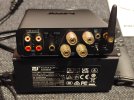
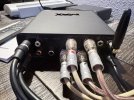
From left to right we find two RCA inputs. Then a bypass button to turn the equalizer on and off. Below that we find a sub output, then the speaker outputs. These are easy to use with your fingers, not too small. They are larger than the v3 banana sockets, the same as the LC30 banana sockets. They are better because they are big enough for your fingers to comfortably reach and tighten well, but unfortunately they do not fully accept the standard banana plugs. Only about half.
AudioQuest SureGrip 100 BFA:
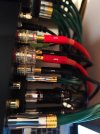
They are not deep enough. In any case, the connection is stable. The sockets are not loose. They hold the plugs tightly. I think this may change in the future if possible. It would be nice if they were made of copper and gold plated. These banana jacks are similar on several of their devices. I recommend that in the future we use a jack that accepts standard plugs along their entire length, and is also big enough to comfortably reach and tighten them if we are not using the plugs, but clamps or a fork. Let's move on. Next is the trigger input. There is no output, so further chaining (stitching) with a trigger is not possible. (This is not a problem, because it is not needed at the end of the chain, just an option) Below it we find a high-pass filter switch, which, when using a subwoofer, cuts off the bass from the main output at 80 Hz and sends it to the subwoofer output so that we can use the 2.1 system. Next to it are the bluetooth antenna and the power supply input.
Top vent hole „MAX”

From the external dimensions it is clear that we cannot really pair this amplifier (on top of each other) with any other Fosi product. If it had been a little wider, it would have matched the members of the za/zd/zh series and then there would have been room for a balance button on the front panel, which would be a great help for those listening to music in an asymmetrical room, and perhaps an additional RCA input and a trigger output on the back panel. This is just my imagination. But this way, it would have fit into the family of existing devices with its dimensions. But it was not designed for an existing device family. This is a new device. Used separately, it is a very nice device. It should be treated as such.
Side vent holes:
Motorized volume controll. Well, it is not my favorite. I do not understand what this method, which was widespread in the 1990s-2000s, is doing in today's devices. It is not accurate, it never was unless it is very, very subtle, slow. It should be much slower than it is now. In this specific case, it is also disturbing. Because if we use the zd3, zh3 with a fixed output, it overdrives the bt20a max. In practice, this means that the volume control goes from zero to a comfortable listening level in the room too quickly. Usually, physical potentiometers are not accurate in the lowest position. One side often sounds earlier. When we turn the potentiometer a little higher, this normalizes, but that is exactly why a slow and long-travel volume increase would be important. Here, unfortunately, we barely move the volume knob and we reach the normal volume. This is too fast. I encountered the same problem when pairing the p4 preamp and the v3 monos. There, I also reached the listening level too quickly. However, this volume control is completely fine when using CD players, turntables or tape recorders. With a normal 75-85db output signal, the motorized control works well from the remote control. This is a small anomaly caused by the high output signal level in the case of the zd3 and zh3 and of course when using any other company's 110 – 120+db output source, dac or streamer. This can be easily remedied if when pairing the BT20a max with, for example, the ZD3, ZH3 (or other high output sources), they are used in preamp mode. Not on the fixed (full volume level) output. By setting the bt20a max to maximum volume, we adjust the volume on the preamplifier. But this anomaly could have been avoided with a volume control like the long way, slow, infinite volume control used in the zh3.. For me, this is very annoying.
Usage:
We don't have much trouble with the assembly. We just wind up the antenna, connect the speakers, the sources, the power supply and the fun can start!
Yes, it's fun, because the sound quality is very good! The performance is light, spacious, airy. The stereo space is very good. The Bluetooth connection is stable. The signal processing is good!
The sound is also very good in Bluetooth mode. We get very good detailed sound that is true to the instrument. This is a really good little compact device that will definitely be a success. I wrote my little complaints only because of my habits and my own expectations. You don't have to take it seriously because there are people who will love it for exactly the same reasons I complained about it. It is very important to me and many users that we like the devices. It should have features that we really like in daily use. That's why I write personal reviews and personal expectations about them. Next products should always be better and better..
Controls and connectors:
I usually never use the Bluetooth connection. Regardless, this is a very useful feature. If you need it, it's there. Of course, it provides convenient use, there are those who will love it just because of the bluetooth connection. But I don't play music from my phone at home. I did it just now for the sake of thorough testing. I like to use my reliable cables and my playback devices or the PC player software. During the test, I played many high-resolution files with the full version of the Poweramp application used on my phone. Every detail sounded very good. Whether it was a hi-res or a plain flac file in the phone's player, it was always sufficiently detailed and true to the instrument. The space is very good. It has the same good quality as my v3 monos, and in fact better. Although in the past I have modified my V3 monoblocks with a few extra capacitors, better banana sockets and op amps. In addition, I use them with better quality and double-priced xlr cables than the rca cables of the new comer bt20 max . I don't want to exaggerate the sound again, which is why I compare it to the v3 monoblocks. What can be said about the mono sound quality of the v3 is also here, and even a little better. The Bt20a max provides a very pleasant listening experience. In a home environment, it can easily hold its own in the main hi-fi system. It won't have many other challengers or real competitors in your office thanks to Bluetooth 6 connectivity, two analog inputs and excellent sound quality, as well as its compact size and remote control.. The sound quality is great, very good space, large power reserve which is more than enough for anything. I paired it with large floor-standing speakers. This small amplifier has the power needed to deliver a punchy sound.. The equalizer can be turned off, but it does not introduce noise that can be heard by ear into the sound even when used. The equalizer effect is correct. Good remote control. Unfortunately, the ZH3 is not among the manageable devices. This would have been really good.
Distortion: 0,003%. Very good! Of course, at high volume, you should not expect the factory-specified distortion value (this varies similarly with all amplifiers) But even this is fine with the BT20a max. At normal volume, its sound is really very nice. There is no noticeable distortion or noise when listening to loud music. It could certainly be measured with measurements, but I didn't hear anything..
Since I already took it apart because of the fan, I also updated the op amps, although the ne5532 is a very good op amp, but I hear it as thin and digital to sound, so since I had many opa1612 and opa1656 and oracle II 02 at home in reserve, I put the opa1612 in it.
Note: The possible versions for modifying the op amps are limited because the integrated cooling fan reduces the space, so only normal height I.C. s can fit without removing the entire fan. Since the op amps are under the fan and a little further in, some manual dexterity is required
I spent days doing a/b testing using the lc30 so that there would not be a momentary pause in listening when switching. I have to say that (I repeat) everything that can be said about the v3 monos in terms of sound quality is also present in the BT20, even the stereo space is slightly better, and I really like my monoblocks and I think the op amps are better in them (akliam LC5). That's why I'm going to get negative comments because according to the measurements there's nothing audible between the op amps. But I feel like these aren't expensive op amps, and some of them I can't hear better because I spent too many dollars on them. Even among the similarly priced ones, there are some that I've thrown away because I liked one and not the other. For example, the opa1656. For me, this sound is not right. That's all for now. Let's skip on this theme..
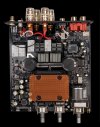
Another positive observation: The buffer capacitors in the BT20A Max are larger than those built into the V3 Mono.
Inside BT20A MAX:
Summary: Versatile, three-channel compact amplifier with very good sound quality, stable, high-resolution bluetooth 6 connection, two analog inputs and a high-pass filter, as well as a sub output for 2.1 use. With switchable equalizer, built-in cooling, motorized volume control and remote control. Due to its excellent sound quality, it may be a favorite of many users, and may also be popular due to the high-quality Bluetooth connection. Fosi engineers deserve a lot of praise for achieving such sound quality. In the A/B test, I do not hear the advantage of monoblocks. Despite the fact that they were V3 monos powered by a 48V 10A GAN power supply, the BT20A Max 48 V5 A GAN was driven. Neither in sound quality nor in spatial representation. My objections described at the beginning arise from my own habits and expectations. I feel that my small complaints are realistic, but I did not find any fault with the sound quality. Excellent! They have built a serious rival to the V3 mono. Since the sound quality is the same or better in favor of the newcomer, the new amplifier also plus that we have to use a single amplifier, a single power supply, plus there is a volume control, equalizer, and the use of a remote control. High-resolution bluetooth, less heat generated, more inputs, subwoofer output for 2.1. High-pass filter. The overall user experience is high.
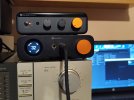
Let's enjoy it because it's good.. :
Pros:
High-resolution and stable bluetooth connection
Excellent sound quality!
Switchable equalizer
High-pass filter and subwoofer output for 2.1 use.
Good build quality
3 input chanel
High user experience
Cons:
The motorized volume control does not work well with a high input signal. It adjusts itself too quickly, the volume control knob reaches the room listening volume with minimal movement. (This is not a fault at all with a lower input signal!)
The remote control is less user-friendly than the ZH3
The sound of the cooling and flowing air is too loud for me. Perhaps an even larger ventilation opening on the roof without a built-in fan would have been enough. Or a temperature sensor control to turn on/off the active cooling.
Due to its unique size, it cannot be stacked directly with other Fosi products.
I received a new package from Fosi audio. Thank you very much for trusting my neutral reviews and thank you for not expecting anything "only positive" from my review. I was given free rein to write an honest user review. Let's see what arrived. Their latest desktop compact amplifier, the BT20a Max, arrived to me before the New Year. It was supposed to be introduced at the end of 2025, but the final date was postponed to January 10, 2026. The price ranges from 280-320 USD, depending on the power supply output (32v 5a - 48v 5a and 48v 5a Gan), but as is usual with Fosi promotions, I see a 20% introductory sale on their website. Let's not wait any longer, unpack and see what's in the box:
Contents: BT20A MAX
48v 5a Gan power supply
Remote control
Bluetooth antenna
User manual.
Before we start, let's take a quick look around, front panel:
It's immediately clear that the design is new, obviously I'm mainly thinking of the front panel here. It's different from what we're used to. It has a designer, rounded front panel. With a plastic decorative strip on top. This is the first device with all four edges of the front panel rounded. We find a power button on it, which is also the channel selector. Here we can see that we have 3 input channels. We see a series of LEDs that indicate the currently used input, the remote control sensor, an equalizer and a motorized volume control. The layout is very logical, I like it too.
The device has very good parameters. I don't usually fill my reviews with specifications, I prefer real-world usage reviews. If you want more details, you can find everything on the manufacturer's website. I'll mention a few:
Hi res Bluetooth Audio, With Bluetooth 6.0, the BT20A MAX supports a wide range of high-quality codecs, such as LDAC, aptX and aptX Lossless, Qualcomm chip: QCC3095. PFFB (this is Fosi's first stereo amplifier with PFFB) 2x300 watts on Ohm, Hi pass filter, snr 112 pcs. distortion 0.003%. Separate power supply for digital and analog sections. Elna capacitors. Built-in cooling.
Factory data:
The housing is reminiscent of the v3 mono design. We also find the round side ventilation openings. It finally got a top opening where the heated air can escape. This is the MAX inscription itself. We know from physics that the flow of hot air rises upwards. It got a significant help for ventilation: a built-in fan, which is relatively quiet. The ventilation MAX inscription visible on the top of the housing is equipped with a perforated orange insert plate like the side vents. We can hear a discreet rustling (and airflow) from close up during operation. Since I sometimes listen to music very quietly, I hear it, and during the break between two songs can hear, which bothers me. A basicnoise during the break. After a few days of use, I couldn't get used to it, so I took it apart and pulled off the fan's contact lug because it can still ventilate through the slots and checked if it overheats. I don't encourage anyone to do this, but there was no significant heating. After a few hours of use, without active cooling, I measured 33-34 degrees Celsius. I've been using it for two days now without active cooling, with normal room volume, and there is no significant heating. So far, it has never exceeded 34 degrees Celsius. Unfortunately, I haven't measured it with the fan running before, but when I touched it with my hand, the heating was very similar. It may be that the change is only minimal. I don't want to disassemble it again for accurate measurement, I will obviously monitor the temperature in the long term and if necessary, I will restore the active cooling. If I ever notice overheating, and I need to reset the factory cooling. I will report it in the article or in a comment.
I couldn't get used to the sound of the cooling fan.
Many people are reassured by the fact that it has active cooling. It bothers me. We are not all the same...
Back:
From left to right we find two RCA inputs. Then a bypass button to turn the equalizer on and off. Below that we find a sub output, then the speaker outputs. These are easy to use with your fingers, not too small. They are larger than the v3 banana sockets, the same as the LC30 banana sockets. They are better because they are big enough for your fingers to comfortably reach and tighten well, but unfortunately they do not fully accept the standard banana plugs. Only about half.
AudioQuest SureGrip 100 BFA:
They are not deep enough. In any case, the connection is stable. The sockets are not loose. They hold the plugs tightly. I think this may change in the future if possible. It would be nice if they were made of copper and gold plated. These banana jacks are similar on several of their devices. I recommend that in the future we use a jack that accepts standard plugs along their entire length, and is also big enough to comfortably reach and tighten them if we are not using the plugs, but clamps or a fork. Let's move on. Next is the trigger input. There is no output, so further chaining (stitching) with a trigger is not possible. (This is not a problem, because it is not needed at the end of the chain, just an option) Below it we find a high-pass filter switch, which, when using a subwoofer, cuts off the bass from the main output at 80 Hz and sends it to the subwoofer output so that we can use the 2.1 system. Next to it are the bluetooth antenna and the power supply input.
Top vent hole „MAX”
From the external dimensions it is clear that we cannot really pair this amplifier (on top of each other) with any other Fosi product. If it had been a little wider, it would have matched the members of the za/zd/zh series and then there would have been room for a balance button on the front panel, which would be a great help for those listening to music in an asymmetrical room, and perhaps an additional RCA input and a trigger output on the back panel. This is just my imagination. But this way, it would have fit into the family of existing devices with its dimensions. But it was not designed for an existing device family. This is a new device. Used separately, it is a very nice device. It should be treated as such.
Side vent holes:
Motorized volume controll. Well, it is not my favorite. I do not understand what this method, which was widespread in the 1990s-2000s, is doing in today's devices. It is not accurate, it never was unless it is very, very subtle, slow. It should be much slower than it is now. In this specific case, it is also disturbing. Because if we use the zd3, zh3 with a fixed output, it overdrives the bt20a max. In practice, this means that the volume control goes from zero to a comfortable listening level in the room too quickly. Usually, physical potentiometers are not accurate in the lowest position. One side often sounds earlier. When we turn the potentiometer a little higher, this normalizes, but that is exactly why a slow and long-travel volume increase would be important. Here, unfortunately, we barely move the volume knob and we reach the normal volume. This is too fast. I encountered the same problem when pairing the p4 preamp and the v3 monos. There, I also reached the listening level too quickly. However, this volume control is completely fine when using CD players, turntables or tape recorders. With a normal 75-85db output signal, the motorized control works well from the remote control. This is a small anomaly caused by the high output signal level in the case of the zd3 and zh3 and of course when using any other company's 110 – 120+db output source, dac or streamer. This can be easily remedied if when pairing the BT20a max with, for example, the ZD3, ZH3 (or other high output sources), they are used in preamp mode. Not on the fixed (full volume level) output. By setting the bt20a max to maximum volume, we adjust the volume on the preamplifier. But this anomaly could have been avoided with a volume control like the long way, slow, infinite volume control used in the zh3.. For me, this is very annoying.
Usage:
We don't have much trouble with the assembly. We just wind up the antenna, connect the speakers, the sources, the power supply and the fun can start!
Yes, it's fun, because the sound quality is very good! The performance is light, spacious, airy. The stereo space is very good. The Bluetooth connection is stable. The signal processing is good!
The sound is also very good in Bluetooth mode. We get very good detailed sound that is true to the instrument. This is a really good little compact device that will definitely be a success. I wrote my little complaints only because of my habits and my own expectations. You don't have to take it seriously because there are people who will love it for exactly the same reasons I complained about it. It is very important to me and many users that we like the devices. It should have features that we really like in daily use. That's why I write personal reviews and personal expectations about them. Next products should always be better and better..
Controls and connectors:
I usually never use the Bluetooth connection. Regardless, this is a very useful feature. If you need it, it's there. Of course, it provides convenient use, there are those who will love it just because of the bluetooth connection. But I don't play music from my phone at home. I did it just now for the sake of thorough testing. I like to use my reliable cables and my playback devices or the PC player software. During the test, I played many high-resolution files with the full version of the Poweramp application used on my phone. Every detail sounded very good. Whether it was a hi-res or a plain flac file in the phone's player, it was always sufficiently detailed and true to the instrument. The space is very good. It has the same good quality as my v3 monos, and in fact better. Although in the past I have modified my V3 monoblocks with a few extra capacitors, better banana sockets and op amps. In addition, I use them with better quality and double-priced xlr cables than the rca cables of the new comer bt20 max . I don't want to exaggerate the sound again, which is why I compare it to the v3 monoblocks. What can be said about the mono sound quality of the v3 is also here, and even a little better. The Bt20a max provides a very pleasant listening experience. In a home environment, it can easily hold its own in the main hi-fi system. It won't have many other challengers or real competitors in your office thanks to Bluetooth 6 connectivity, two analog inputs and excellent sound quality, as well as its compact size and remote control.. The sound quality is great, very good space, large power reserve which is more than enough for anything. I paired it with large floor-standing speakers. This small amplifier has the power needed to deliver a punchy sound.. The equalizer can be turned off, but it does not introduce noise that can be heard by ear into the sound even when used. The equalizer effect is correct. Good remote control. Unfortunately, the ZH3 is not among the manageable devices. This would have been really good.
Distortion: 0,003%. Very good! Of course, at high volume, you should not expect the factory-specified distortion value (this varies similarly with all amplifiers) But even this is fine with the BT20a max. At normal volume, its sound is really very nice. There is no noticeable distortion or noise when listening to loud music. It could certainly be measured with measurements, but I didn't hear anything..
Since I already took it apart because of the fan, I also updated the op amps, although the ne5532 is a very good op amp, but I hear it as thin and digital to sound, so since I had many opa1612 and opa1656 and oracle II 02 at home in reserve, I put the opa1612 in it.
Note: The possible versions for modifying the op amps are limited because the integrated cooling fan reduces the space, so only normal height I.C. s can fit without removing the entire fan. Since the op amps are under the fan and a little further in, some manual dexterity is required
I spent days doing a/b testing using the lc30 so that there would not be a momentary pause in listening when switching. I have to say that (I repeat) everything that can be said about the v3 monos in terms of sound quality is also present in the BT20, even the stereo space is slightly better, and I really like my monoblocks and I think the op amps are better in them (akliam LC5). That's why I'm going to get negative comments because according to the measurements there's nothing audible between the op amps. But I feel like these aren't expensive op amps, and some of them I can't hear better because I spent too many dollars on them. Even among the similarly priced ones, there are some that I've thrown away because I liked one and not the other. For example, the opa1656. For me, this sound is not right. That's all for now. Let's skip on this theme..
Another positive observation: The buffer capacitors in the BT20A Max are larger than those built into the V3 Mono.
Inside BT20A MAX:
Summary: Versatile, three-channel compact amplifier with very good sound quality, stable, high-resolution bluetooth 6 connection, two analog inputs and a high-pass filter, as well as a sub output for 2.1 use. With switchable equalizer, built-in cooling, motorized volume control and remote control. Due to its excellent sound quality, it may be a favorite of many users, and may also be popular due to the high-quality Bluetooth connection. Fosi engineers deserve a lot of praise for achieving such sound quality. In the A/B test, I do not hear the advantage of monoblocks. Despite the fact that they were V3 monos powered by a 48V 10A GAN power supply, the BT20A Max 48 V5 A GAN was driven. Neither in sound quality nor in spatial representation. My objections described at the beginning arise from my own habits and expectations. I feel that my small complaints are realistic, but I did not find any fault with the sound quality. Excellent! They have built a serious rival to the V3 mono. Since the sound quality is the same or better in favor of the newcomer, the new amplifier also plus that we have to use a single amplifier, a single power supply, plus there is a volume control, equalizer, and the use of a remote control. High-resolution bluetooth, less heat generated, more inputs, subwoofer output for 2.1. High-pass filter. The overall user experience is high.
Let's enjoy it because it's good.. :
Pros:
High-resolution and stable bluetooth connection
Excellent sound quality!
Switchable equalizer
High-pass filter and subwoofer output for 2.1 use.
Good build quality
3 input chanel
High user experience
Cons:
The motorized volume control does not work well with a high input signal. It adjusts itself too quickly, the volume control knob reaches the room listening volume with minimal movement. (This is not a fault at all with a lower input signal!)
The remote control is less user-friendly than the ZH3
The sound of the cooling and flowing air is too loud for me. Perhaps an even larger ventilation opening on the roof without a built-in fan would have been enough. Or a temperature sensor control to turn on/off the active cooling.
Due to its unique size, it cannot be stacked directly with other Fosi products.