vinylisfinyl
Member
Since I've been stuck at home these past couple of weeks, I've gotten back into playing with cassettes and have been experimenting with recordings on my Pioneer CT-M66R. Today I got the idea to run a frequency sweep through it just to see what kind of response I'd get.
To run this, I used the Log Frequency Sweep Track 6 and 1.6 kHz tone Track 33 from the Bink Audio Test CD, playing them via my PC connected to my Onkyo TX-8050 stereo through a Schiit Fulla DAC with the Pioneer recording on Tape Out.
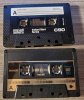
I used two tapes for the test: a Type I black-shell Maxell Communicator Instant Start series and a Type II black-shell Maxell UD XL II. The latter was an old mix it tape from a cousin of mine, while the former was brand new from shrink wrap as of couple weeks ago. Both had music recorded on them at least one time prior.
After recording the test tracks, I played back both tapes to my PC using and the Line In port on the motherboard (old Biostar from 2008 with an Intel Core 2 Quad). I recorded the tracks using Audacity at 32 bit, 44.1 kHz and exported both tracks as 24 bit FLACs. I then used Spek to draw spectrographs of the frequency response and foobar2000 to playback the files via my DAC/stereo combo through my Grado SR125 headphones. I also exported the original Bink test tracks as one FLAC file to compare
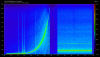
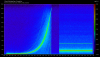
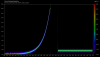
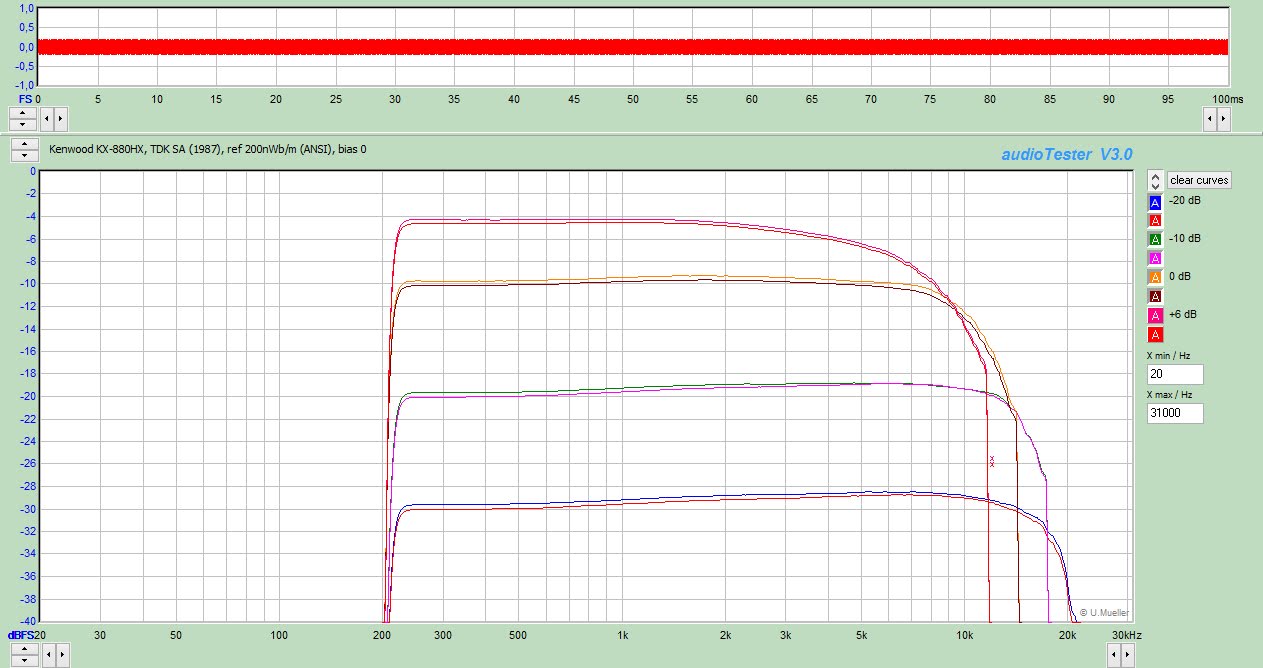
The results were quite interesting. As expected, both tapes had a noticeable roll-off starting at 14 kHz onward, but I was pleasantly surprised I could still hear tones up to about ~16 kHz, the same as the original track (probably a combination of my hearing limit and my headphones). It appears that the Type II tape has *slightly* more dB above the 14 kHz point, seen as more green around the main line. The Type I tape held up quite well considering it's original market intent.
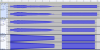
The spikes one sees in the Type I chart are drop outs, which can be seen in the Audacity picture too. Extra harmonics are seen as the matching and mirrored lines elsewhere from the original audio. If you play the files, you can hear them slightly during the 1.6 kHz tone which sounds more pure in the original file than the records. You can also hear a "swishing" above 14 kHz (seen as verticle traces in the spectrographs) which I think are probably filters or something hitting a resonance. Finally, one can see the tape noise as constant deep blue color in the spectrographs, though I can't hear much if any hiss when I play the files.
Overall, a cool experiment with interesting results. If you wish to do this yourself over this long stay-in, you can get the software and test tracks here:
Bing Audio CD test tracks: https://www.dropbox.com/sh/vhtje97km4m713j/AABEFdcsEKGVQRj4SwOi6LzHa?dl=0
Audacity: https://www.audacityteam.org/
Spek: http://spek.cc/
foobar2000: https://www.foobar2000.org
Comment away!
To run this, I used the Log Frequency Sweep Track 6 and 1.6 kHz tone Track 33 from the Bink Audio Test CD, playing them via my PC connected to my Onkyo TX-8050 stereo through a Schiit Fulla DAC with the Pioneer recording on Tape Out.
I used two tapes for the test: a Type I black-shell Maxell Communicator Instant Start series and a Type II black-shell Maxell UD XL II. The latter was an old mix it tape from a cousin of mine, while the former was brand new from shrink wrap as of couple weeks ago. Both had music recorded on them at least one time prior.
After recording the test tracks, I played back both tapes to my PC using and the Line In port on the motherboard (old Biostar from 2008 with an Intel Core 2 Quad). I recorded the tracks using Audacity at 32 bit, 44.1 kHz and exported both tracks as 24 bit FLACs. I then used Spek to draw spectrographs of the frequency response and foobar2000 to playback the files via my DAC/stereo combo through my Grado SR125 headphones. I also exported the original Bink test tracks as one FLAC file to compare
The results were quite interesting. As expected, both tapes had a noticeable roll-off starting at 14 kHz onward, but I was pleasantly surprised I could still hear tones up to about ~16 kHz, the same as the original track (probably a combination of my hearing limit and my headphones). It appears that the Type II tape has *slightly* more dB above the 14 kHz point, seen as more green around the main line. The Type I tape held up quite well considering it's original market intent.
The spikes one sees in the Type I chart are drop outs, which can be seen in the Audacity picture too. Extra harmonics are seen as the matching and mirrored lines elsewhere from the original audio. If you play the files, you can hear them slightly during the 1.6 kHz tone which sounds more pure in the original file than the records. You can also hear a "swishing" above 14 kHz (seen as verticle traces in the spectrographs) which I think are probably filters or something hitting a resonance. Finally, one can see the tape noise as constant deep blue color in the spectrographs, though I can't hear much if any hiss when I play the files.
Overall, a cool experiment with interesting results. If you wish to do this yourself over this long stay-in, you can get the software and test tracks here:
Bing Audio CD test tracks: https://www.dropbox.com/sh/vhtje97km4m713j/AABEFdcsEKGVQRj4SwOi6LzHa?dl=0
Audacity: https://www.audacityteam.org/
Spek: http://spek.cc/
foobar2000: https://www.foobar2000.org
Comment away!