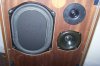
I've been casually watching this listing and it has recently been pulled. I'm assuming that they have been sold. They took awhile to sell and one can draw from this that either not many in the Central Va area know what IMF/Fried speakers are and/or are wary of speakers that been modified.
Just food for thought.
I've envisioned a couple of ideas for modifying my IMFs (the RSPM Mk IVs).
One of the ideas does include replacing both tweeters with a single tweeter. My theory on why there are two tweeters in the IMFs is simply because tweeters in those days were not capable of going from 3kHz all the way up to 20kHz on their own. The HF2000, for example, has its flattest response after 13kHz (where it is employed in the IMFs), and the HF1300 is best up until about 15kHz. It's certainly more complicated to run two tweeters, but in those days if you wanted to get a flat response within a few dB between 3kHz and 20kHz, that's what you had to do. These days, tweeters can run the whole gamut without any problems.
You would solve a couple issues, here - one is phasing. Getting both tweeters to be phase congruent with the rest of the drivers is more challenging, which is partially why the IMF crossovers are a bit complicated.
Two is dispersion. Although it was argued above that two tweeters would have better dispersion, this is incorrect. Modern tweeters are capable of producing a wider dispersion with a flatter response than vintage tweeters.
Three of course, is treble quality. The tweeters of today are manufactured with tighter tolerances and more advanced engineering as well as materials, and outperform vintage tweeters (which is evident in the fact that vintage tweeters were not capable of covering the entire treble frequency range on their own).
Another idea is to completely rebuild the crossovers. What I thought I would do is simply install connectors on to the front (or maybe back) of the speaker, and build external crossovers that can be plugged into the speaker. The idea here would be that you could swap between the original and the upgraded crossover. More ideally, however, would be to allow tri-amping of the speaker and use an active crossover. However failing that, with building external crossovers you could do away with the ironcore inductors and cheaper parts and you could even remove the adjustment potentiometers for a cleaner signal. Unfortunately, this would alter the speaker's sound and delineate away from its originality (likely a great deal). The upside here, though, is you may end up with a better product than the original.
Finally, I think another solid improvement is making a better tube for the midrange enclosure inside the cabinet. The one in there is decent, but you could make it more inert with better materials.
Of course it goes without saying these ideas would completely remove any original value the speakers have. This would be viable if these were speakers you plan to keep or, if you can somehow make the changes reversible (for example, building a second set of baffles to accommodate the single tweeter and, slightly modifying the cabinets to allow an external crossover with the option of installing the originals).
IMF speakers are, no doubt wonderful, but there have been improvements made in components for speakers over the years and with advanced crossover design techniques and computer aid, the IMFs could be greatly improved upon. Is it worth it, though? I suppose if you factor in the cost of making cabinets and buying drivers, it could be. At some point, though, they will no longer be IMFs.
Anyway, those are my thoughts on the matter. That's why I think the tweeter replacement done here may have been done appropriately and intelligently, and may have indeed resulted in an improved HF response. It's hard to say without measuring them and listening to them, though.