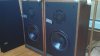
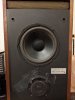
They are not real transmission lines. They are a simplification - real TLs have a heavily damped tube (usually folded to fit into a large but conventional enclosure) with a length of around a quarter of a wavelength of the resonant frequency of the driver, whereas most of the Frieds had a tunnel completely filled with a block of foam (I'm coming up short in trying to remember the name of the design - resistive line?). The damping, which supposedly absorbs the backwave completely, differentiates TLs from things like the Stromberg Carlson Acoustical Labyrinth, which was similar in construction, but undamped which meant there was significant bump at, or close to, resonance.
TLs are known for clear deep bass (my hunch is that it is the (relative) lack of any resonance at the low end that makes the very deep response audible) but don't expect them to have overwhelming powerful bass - for that you want resonance.
There have been a bunch of Transmission Line manufacturers. IMF was the best known, and before Fried Loudspeakers, Bud Fried was the US importer of IMF (which he somehow persuaded to use his initials for their name). He claimed involvement in design and implementation of the speakers (though this was disputed by John Wright, the founder of the company - I have no knowledge of the accuracy of either claim, but clearly both were talented speaker designers, since both made highly regarded speakers after falling out - Fried with his eponymous firm and Wright with TDL). But Radford, Lentek, Exposure, ESS (the Transtatic), pop into my mind before my memory gives out.
The much simpler to build Fried resistive lines sound very good - though perhaps they don't have exactly the same low end as a full TL. And that highlights an issue with TLs, which has been there from the beginning when Bailey published his paper codifying the idea. Which is that, in fact, the rear wave is not actually entirely dissipated by the damped line. So one might look at the design as an exceedingly complicated and expensive bass reflex with a lot of damping. Or as an aperiodic design, which would be way simpler and cheaper - the aperiodic Dynaco A 25 still is a remarkably nice speaker for its original bottom end price. And frankly, to my eye, the Frieds look like tuned aperiodic enclosures, if that isn't an oxymoron - the damped long rectangular tunnel's function seems to be to affect a more specific set of frequencies than a simple damped hole does.
I think it might be helpful to include a comment about Fried's other distinction - series crossovers. Most crossovers split the various frequency bands and run them in parallel, but series crossovers have the components in a single circuit. I readily admit I haven't been able to grasp how this works (I also haven't tried that hard). But Bud Fried argued strenuously that they were better than standard crossovers, and that might be another reason for how the speakers sound.