• The move to the new server is done. There are some software and database maintenance updates in process. This has us passing the hat around to help out. We appreciate any donations. Seriously, even a dollar helps. The payment page may be found here - https://www.audiokarma.org/support.html

Full range driver vs woofer

butcherblock

New Member
like the title says... Full range driver vs woofer. So this discussion is for only a single driver that has full range capabilities (such as a Fostex), not a coaxial vs a woofer that usually rolls off about 1500. What in the construction, special traits our design create the full spectrum? Is there really actually a full range driver? Something that achieves 20hz-20khz? I believe a Walsh does.

Let me know what you know. It's it worth it sonically? What's your opinion and mechanics of it all. I am just beginning to embark on engineering a driver from scratch... If this is a repeat discussion i apologize, it's just that i cannot find anywhere explaining how a driver is designed to be full range.

Thanx
 
Register to hide this ad
Well, full ranges are more like wide ranges. The only true full ranges i can think of would be an electrostatic speaker, which is both large enough and light enough to do both high and low as well as it does. There are drawbacks to the design, but everything here is give and take.

A full range will have a light mass cone, sometimes with a whizzer cone to extend the highs. All things being equal, the driver will tend to be 8" or smaller, and tend to be concentrating on the mids, getting them right, and there will be rolloff on the highs and lows. For fullrange nuts, thats okay, since they like their mids to be pure.

Full ranges will do 20-20khz, technically many speakers can, but they dont do it flatly. Which means at quieter volume levels, they do well, but pushed, they will begin to distort. The trade off is good coherence and frequency range at the expense of volume.

Ps, as for my opinion, they work great in cars, and i understand the home appeal, but im not a huge fan otherwise. We have gotten to the point where phase distortion in a simple two way design can be pretty well eliminated. Ive heard many full range setups, but compared to a lot of well designed two ways ive heard, they weren't better in anyway I could tell. Of course, i can hear over 17khz, so YMMV.
 
Last edited:
It is nice to think that you can the full audio spectrum with one driver and no crossover, but it will be a compromise, and both ends suffer. What is your music source, and what do you listen to now?
 
Very enlightening gaz... Food for thought... Freddy,i listen to everything and have tons of gear that is not the problem our issue at hand. I am trying to decifer the secret behind a full range driver. It seems to me that there is to much in a 2, 3 especially 4 way enclosure. Why is it so hard and rare for a single driver to create a prefect balance with today's tech without all that crossover wizardry... And to bring down the cost. Focus on one driver and perfect it.

Let's keep this going i am just getting started lol
 
Try Fostex, some Tang Band and others that are point sources. they can sound great with certain music, congested with others. Just remember as the cone size goes up, the production of midrange is not as good and the highs really start to roll off. I hope Poultrygeist does post in this thread as he has tons of knowledge in this area.
Agreed, Fostex 6 inchers, great bang for the buck, especially for small Jazz band music.
 
Other interesting tidbits... I am really refirring to the construction of the speakers though. The differences in them physically and mechanically. Ask of you have defiantly mentioned size is a great factor. It appears to me as if it just a little game of give and take. Fine tuning the driver. But, now that leads me to why is larger worse for highs. I understand that bigger is better for lows do to their enormous wave pattern. Do those dilute or even cancel high frequencies? Hmm...
Why are there no big tweeters? Like 8"domes?
Anyone have a preference of dispersion? Direct forward or omnidirectional? Personally i want the room to fill up, not just have a line of fire...
 
Other interesting tidbits... I am really refirring to the construction of the speakers though. The differences in them physically and mechanically. Ask of you have defiantly mentioned size is a great factor. It appears to me as if it just a little game of give and take. Fine tuning the driver. But, now that leads me to why is larger worse for highs. I understand that bigger is better for lows do to their enormous wave pattern. Do those dilute or even cancel high frequencies? Hmm...
Why are there no big tweeters? Like 8"domes?
Anyone have a preference of dispersion? Direct forward or omnidirectional? Personally i want the room to fill up, not just have a line of fire...
Basically, a larger speaker cant do treble as well as it cant move as fast, or rather, it resists quick motion, simply because it weighs more. Some speakers will try, and thats where the term "breakup" comes from, where the roll off naturally occurs. The higher frequencies start getting really ugly.

If you are looking for omnidirectionals, companies like Ohm, EPI, and even radio shack and zenith have all had their own versions.

Methinks you would do well with some DCM Timewindows. They can fill a room, while still making a usable sweet spot with good imaging should you occasionally want that.
 
I have yet to meet a full range speaker that does 20-20k, +/- 25 dB. If you know of any, please let me know.

As for the Walsh cylinder, it is three speakers glued and doped together.
 
I have yet to meet a full range speaker that does 20-20k, +/- 25 dB. If you know of any, please let me know.
The problems begin when you introduce a listening space larger than a human ear canal. Most microphone diaphragms and headphone elements can exceed the above specs provided they are not exposed to the damping effect of a large volume of air, like a room for example.

Full range folks like to deny the reality of "no free lunch".
 
Other interesting tidbits... I am really refirring to the construction of the speakers though. The differences in them physically and mechanically.

Around 1930 when Paul Voight designed the driver now known as the Lowther he had the notion that he'd get the best performance using the lightest possible cone with the most powerful possible motor. So the Lowthers use a very light paper cone with very powerful motors using large magnets and a very tight magnetic gap. Highs are extended by a whizzes cone and a central plug that avoids high frequency interference nulls from one side of the cone to the other, akin to the phasing plug used in a high quality compression driver.

A problem with Voight's approach is that the powerful motors overdamp the drivers leading to very poor low frequency performance but he cleverly worked around this by loading the back of the driver into a horn that raised the level of the low frequencies to compensate for the high roll off. Horn loading in self defense. Thus Lowthers are generally used horn loaded below 200hz or so but as direct radiators above that frequency.

Some of the best speaker systems I heard used Lowthers. And some of the worst too. They are capable of excellent dynamics and great clarity but can also have serious tonal problems and sound like Skilsaws.
 
Last edited:
Full range folks like to deny the reality of "no free lunch".

I knew several fellas who played with them and I did too, but none of us were dogmatic single driver guys and most of us used big hog horn systems as well. And sometimes single driver systems grew into big hog horns. One friend bought SupraVox field coil full range drivers that he used in large plexiglass open baffles and he tuned the magnetic field to underdamp the speaker, giving better bass. Then he bought a couple of big Oris horns to put the Supravoxes in but now he had no bass so he bought a couple of JBL 4648 bassbins from the famous JBL online tent sale to get bass. Then he later added Fostex tweeters so ended up with a 3-way.
610191C1-F5D2-46D4-B139-6BFD0A6DC083.JPG
 
I cannot hear above 14,000 hz because I am 60 years old and have been playing drums for fifty years. So the Goldwood 8" with whizzer cones drivers I put in Boston Acoustics T1000 cabinets sound very good to me. They go down to 40hz, and the YPAO in my Yamaha AVR smooths out the response quite well. I usually use them with subwoofers but sometimes turn the subs off when listening to music. I really like how they sound. Peace and goodwill.
 
Last edited:
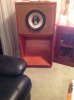
IMG_5926.JPG

I'm no type sure if this fits the bill.
Goodman Triaxiom 212C.
I have a friend that has always used speakers in the 20 grand mark who has listened to these and is trying to replicate these cabinets.
Same drivers, same cabinets.
He's blown away with the soundstage and instrument vocal separation
 
Back
Top Bottom