• The move to the new server is done. There are some software and database maintenance updates in process. This has us passing the hat around to help out. We appreciate any donations. Seriously, even a dollar helps. The payment page may be found here - https://www.audiokarma.org/support.html

Garrard 301 (UK to USA) Runs Fast (Changed Voltage and Pulley)

Payton1985

Active Member
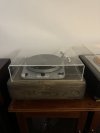
Good evening - hope everyone is well. I have a grease bearing Garrard 301 from the UK. I changed the voltage over to the 100-130 range using the internal voltage conversion block and swapped the pulley to a 60hz version (https://www.classichifi-shop.co.uk/product/garrard-301-60-hz-usa-japan-pulley/). Still, after doing so, the turntable runs ~20% fast or so to the extent where the pitch of vocals are much higher - almost mickey mouse like for lack of a better comparison.

I'm wondering if anyone has any information on what could be causing this issue even after changing the voltage and pulley on the turntable. Thanks everyone.

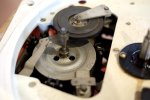
IMG_7755.jpg

Best,
T
 
Register to hide this ad
Mine ran a touch fast when I got it. Fixed it with stacking a couple neodymium magnets on top of the eddy brake. Alternatively, you can also get pulleys from classichifi that are made for 301s that run fast
 
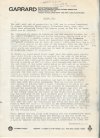
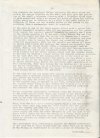
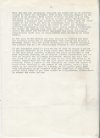
The above is one possible solution, Garrard actually published a paper about 301s running fast and suggested wiring an in series low wattage light bulb, takes something like a 60-80 watt depending….

Another alternative is a voltage regulator or a variac that will reduce the voltage to 100-107 volts, both of the above usually reduces vibration a bit :thumbsup:

Andy

Edit: one more solution, order a custom pulley from Ray at classic turntable company, just tell him how fast it’s running….
 
Last edited:
Thank you, both - I already purchased and installed the 60hz pulley linked above from Classic HiFi and unfortunately the table still runs fast. Might have to do a bit more research.

I will also take a look at some neodymium magnets as a next step.
 
Thank you, both - I already purchased and installed the 60hz pulley linked above from Classic HiFi and unfortunately the table still runs fast. Might have to do a bit more research.

I will also take a look at some neodymium magnets as a next step.
Our outlet voltage is way too high for 1950s table… Ray sells custom sized pulleys to compensate.
 
I gather then the Garrard isn't using a synchronous motor. I hope now that SME is making the 301 they have fixed that issue. They certainly charge enough for the reissued model. If I won the lottery a model 15 or 20 SME would be on my list to replace my TD 125 Thorens. Who can afford a model 60?
 
The 301 uses a synchronous motor, so reducing the voltage to it will have no effect (until it gets so low that there's no torque, obviously!). The idea of the series lamp is simply to reduce the energy going into the motor to theoretically reduce rumble. However, in a well fettled 301 this shouldn't be a problem.

It sounds like the pulley is not quite right - I'd go back to the people you bought it from.
 
The 301 uses a synchronous motor, so reducing the voltage to it will have no effect (until it gets so low that there's no torque, obviously!). The idea of the series lamp is simply to reduce the energy going into the motor to theoretically reduce rumble. However, in a well fettled 301 this shouldn't be a problem.

It sounds like the pulley is not quite right - I'd go back to the people you bought it from.
Believe your conflating the synchronous hysteresis motor like in a ROK with the shaded pole design motors in Garrard and Thorens?

The 301 uses a 4 pole motor so both frequency and to a lesser extent voltage has an effect on speed, voltage acts much like a bias control …..125v outlet will cause it to run slightly faster than 100v outlet

Here is a copy of the Garrard paper recommendation for an in series light bulb to control slight speed issues, this came about because of people changing from grease to oil in the grease bearing models.

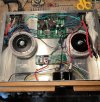
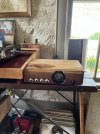
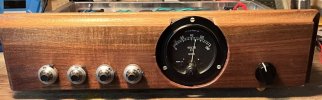
Will also add a couple of photos of fine speed control devices I’ve built or used, these are just for fine speed control….this device controls both Hz and voltage so it controls all speed, 33, 45 78 without changing the table’s speed lever—note the voltage reading on the power supply meter ;)

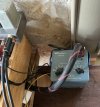
The last one is an old voltage control/selection device the voltage output will be slightly higher than what listed on the device because of the higher supplied voltage at the outlet these days compared to when it was made

The in series light bulb will also suffice, but again its more of a bias speed control

edit: it takes about a 7-10v change to change the speed appreciably…


G1.jpegG2.jpegG3.jpeg
IMG_1920.jpeg
IMG_1927.jpeg
IMG_1921.jpeg
IMG_0122.jpeg
 
Last edited:
I gather then the Garrard isn't using a synchronous motor. I hope now that SME is making the 301 they have fixed that issue. They certainly charge enough for the reissued model. If I won the lottery a model 15 or 20 SME would be on my list to replace my TD 125 Thorens. Who can afford a model 60?
It’s not an issue with new Garrards, we’re talking about 70 year old tables with different lubricants oil vs grease, much higher outlet voltages and possibly weak magnets on the bias controller….
Andy
 
It’s not an issue with new Garrards, we’re talking about 70 year old tables with different lubricants oil vs grease, much higher outlet voltages and possibly weak magnets on the bias controller….
Andy
Any issue that affects the old Garrards will affect the new ones as the motors, idlers, pulleys and eddy current brake discs are all original and re-used, albeit refurbished.
 
Let me first say that I agree with everything Andy (adnick) has said. He has good insight into the 301. Here are a couple other points to consider:

Correct grease? The viscosity of the grease has a purpose. Higher viscosity will slow rotation a bit (probably not 20%)

There are 2 very good DIY speed controller options on DIYAudio. One is called "supaspin" and the other "SG4". These are very good sine wave generators. Bot allow for frequency reduction. Both also drop voltage after start-up. Both do need a small amplifier to bring the output up to approximately 115VAC. I've built many of both of these and they are superb. They have the advantage of being more steady and cleaner than mains power. If you have difficulty finding either, start a conversation and I'll try to help.

There's also the controller shown by Andy. It's the "NSC" from Lenco Heaven and based on the XR2206 chip. I've built 5 or 6 of these. With a good IC it works beautifully and is over-engineered so will last forever. The boards for this controller include an integrated amplifier and are very versatile. The boards are not always available. If you go this route, be sure to read about finding the correct lot code for the XR2206 (sometimes Nigel has these for sale).

Good luck.
 
Any issue that affects the old Garrards will affect the new ones as the motors, idlers, pulleys and eddy current brake discs are all original and re-used, albeit refurbished.
Within new production processes it’s simple to build for today’s outlet voltage and all of the new models are oil bearing with new Eddy current brakes, so the bias speed control performs as expected without additional equipment…

My outlet voltage is somewhat variable 122-125v and my 301 was built 69 years ago when outlet voltage was (USA) 100-110 so that much change has an effect, however if I’m running the original grease bearing (with grease, not oil) then the eddy brake still works as designed for speed control, it’s only when the giant uprated oil bearing from CTC is installed that my eddy brake has a difficult time working properly with todays outlet voltages….

@hirscwi , Bill brings up the sine wave topic, which is one of the reasons someone like me goes to the trouble to build complicated power/speed control devices, not something many would/need to worry about ;) (Bill is way above my skill level, obviously)

@heyraz, Rich has pointed out that todays power networks provide very stable 60Hz power so that’s why a slightly different size pulley, other than the original 60Hz, will alleviate any bias speed issues it just requires one to specify exactly how fast the table is running….

Had the OP had known how fast his table was running he could have purchased the appropriate sized pulley from CTC, assume his 301 had a 50Hz pulley it’s difficult to determine the actual model 301 the OP has because it’s hammertone with silver plates, and that’s not an original combination, nothing wrong with that, just hard to determine what model it is……

Couple of points to reiterate:

With the appropriate grease in my 70 year old grease bearing 301 the speed control eddy brake controls speed within 33, 45, & 78 rpm specifications without additional equipment or modifications.

Again, it’s a simple matter for SME to slightly modify the new offerings to operate wonderfully in modern times, now the price is another matter altogether :rflmao:


VR
Andy
 
Apologies @Payton1985, I’d missed the 20% part, or read it as 2%…..so it’s running almost 40 RPM when set at 33 and the eddy brake maxed out? if so that sounds like it’s engaging the 45 pulley when set to 33….

Remove the platter and check where the idler is running set at 33, because the only way to adjust that much excess speed is by frequency manipulation, but that mu speed variation isn’t common….

@hirscwi Bill you’re comment about 20% finally sunk in :rflmao:

Andy
 
@Payton1985
Is the "runs 20% faster" you mentioned in your first post something you measured or is that an estimation?
(60Hz is 20% greater than 50Hz)
Have you checked the diameter of your new 60Hz pulley to make sure it's not the same size as the original 50Hz pulley?
 
Last edited:
All - thanks for the helpful information and guidance. For avoidance of doubt, indeed the table running 20% fast is an estimation. I'm about to order a contact/non contact laser tachometer to confirm the precise RPM at the 33 RPM setting. I have confirmed that the pulley is positioned properly so that the table when set at 33 RPM is not engaging the 45 RPM pulley. Further, when I purchased the table, the seller knowing that it would be shipped to the US provided a 60Hz pulley in lieu of the 50Hz pulley that was originally on the table. I purchased a second pulley 60Hz from Classic HiFi for confirmation and the speed of the table at the 33 RPM setting is identical to that of the first pulley in terms of sound/speed.

It is reassuring to know there are speed controllers available and will keep that in mind as a solution if other options do not suffice.

To the extent it may be helpful, the serial number is: 18,2XX.

Will check back when I have more information on the precise speed and other options I've tried to address the issue.

Best,
T
 
W
All - thanks for the helpful information and guidance. For avoidance of doubt, indeed the table running 20% fast is an estimation. I'm about to order a contact/non contact laser tachometer to confirm the precise RPM at the 33 RPM setting. I have confirmed that the pulley is positioned properly so that the table when set at 33 RPM is not engaging the 45 RPM pulley. Further, when I purchased the table, the seller knowing that it would be shipped to the US provided a 60Hz pulley in lieu of the 50Hz pulley that was originally on the table. I purchased a second pulley 60Hz from Classic HiFi for confirmation and the speed of the table at the 33 RPM setting is identical to that of the first pulley in terms of sound/speed.

It is reassuring to know there are speed controllers available and will keep that in mind as a solution if other options do not suffice.

To the extent it may be helpful, the serial number is: 18,2XX.

Will check back when I have more information on the precise speed and other options I've tried to address the issue.

Best,
T
Given your information something is terribly amiss, actually can’t envision what else would cause such speed.

Just out of curiosity are you running a new idler, and old or new eddy brake ?

Here’s a photo of my rimless grease bearing running at 33 rpm prior to restoration, it was actually a few 1/10s slow before the grease was changed….

IMG_4027.jpeg
 
How fast is it running if the eddy brake isn’t set to speed reduction?

Should have asked if the bearing has been changed, and what oil are you using in the bearing?

Do you know your outlet voltage?

Is your speed check with the arm up or down, dropping tonearm should probably reduce speed by a 1/10 or so depending on tracking force….just wondering about the possibility of cumulative issues?
 
Back
Top Bottom