
I have both a Zero 100 and three Dual 1219s. Have stacked 45s with Dual's. They work well. Have had my Zero since last Christmas. Works well.not sure how it might work with 45s. Need to find a 45 adaptor...


I have thousands of 45's and 78's and am not willing to play them singly on my Thorens. I am looking for a decent changer to add to my system for this purpose.
I have been looking at the Zero 92, but have not had much luck in locating any information on them. Is it the same as the Zero 100, except for the 78 rpm speed? Which version of the Zero 100 is it most like? Is the 92 a direct drive, belt drive or rim drive? Is the arm exactly the same as on the 100?
Has anybody seen a website that discusses the Zero 92 at all? I have seen several that talk about the Zero 100, and some mention the 92 but that is about all.
Thanks,
Dick Schneiders
None of the Garrard Zero series ever had 78 RPM. Only two speeds. If you're going to buy a Zero, stick to the original model and idler drive. 1942 and later 78 RPM discs are also best played manually, they did poorly in period changers. Specialty discs I also do not stack. If you do use a changer, remember you need something which can track at 3-4 grams for 78 RPM duty. Dual 1019, Dual 1218, the Elac Miracords are much better choices for 3 speed duty.
That very well may be, Celt. But 1.I can't use one on my OM10Super because they don't make one for it, and 2. I was under the impression that ellipticals have better treble and generally track better overall? I'd say that my tin ears can't tell the difference when an LP is at the platter level or it's 4 discs up.
Tom
Kent, you are right on The Zero 100, no 78 speeds. I did have a Zero 92 with three speeds.
You're right there.
 I will get a replacement real one when I find one cheap enough. So, after a year of work... the table works fine. A Shure 44MA cart with a conical stylus seems best for 45's, which is the whole reason for this table. Stacking singles.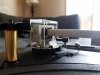
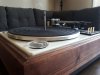
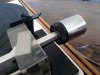

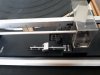
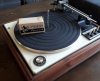
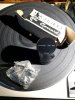
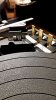
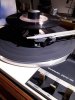
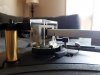

The Zero 92 differs from the Zero 100 in that the bearings in the articulated arm are simply plastic (I assume Delrin) sleeve bearings, whereas the 100 had ball races, or at least something that looked like them. My 92's bearings were worn, but I had a 100 arm and I swapped the bearings.
My big problem was that that one of the arm contacts for the cartridge sled had been bent back and broken, so I ended up rewiring it. Big pain, but got it done. but now, a couple of years later, I have a hum that I haven't tracked down yet.
When I use these tables, I can hear their problems, but I also hear their virtues - the arm, for all its issues, does remove a layer of distortion/fog from the sound, and while it is noisier than the Duals I've used, it is also gutsier - it has the idler virtues (and failings) more than the Duals.
I'd also add that if I were replacing a Garrard with another changer, it would be a Dual 1019 or a ELAC/Miracord (or, if I were feeling optimistic, a PE). I think the later Duals are smoother and less interesting sounding, and have a lot more plastic in them. But tastes differ.


I find these negative comments about Garrard somewhat laughable. I have dozens and have repaired hundreds and while some are lost causes or poorly designed, that would be true of all brands. By in large, from my 301 which recently sold for $15,000 and worth it for a variety of reasons to my half dozen Zero 100 types and others, these are fine tables once on cleans and adjusts them. Duals are often more solid. As are Thorens. But Lenco, Garrard, BSR, Dual, Sony, Technics, and so on all made hits and flops. And Garrard has its fair share of home runs! I just clean up a Zero 92 and it sounds fabulous with no tracking error from its arm design, very little friction in any of its moving parts, a nice heavy, well balanced platter, and after 50 years it still works like a dream as a changer. What's not to love? I expect it will still be be fine when we are all long dead.

