• The move to the new server is done. There are some software and database maintenance updates in process. This has us passing the hat around to help out. We appreciate any donations. Seriously, even a dollar helps. The payment page may be found here - https://www.audiokarma.org/support.html

Germanium amplifiers

Capitol C

AK Subscriber
Subscriber
I saw a Leak Stereo 30 amplifier on line, and discovered that it was a germanium-transistor integrated amplifier, soon replaced with the Leak Stereo 30+, which used silicon. I thought it might be fun to get a hold of a germanium amplifier, but the Leak is rare in the US, and I can't find a list of products that used germanium in the early days of solid state. Yes, I know they are unreliable and often badly designed, but it seemed like a fun thing to add to the restore pile. Can any AK experts provide make and model numbers, plus comments? Thanks in advance!
 
Last edited:
Register to hide this ad
Fisher 600-T receiver and similar TX-300 amplifier. These units stack 4 output transistors in series to handle the voltage. They are impedance sensitive and have a back panel switch to add resistance when driving 4 ohm loads. Don't block airflow by covering the units as they are also heat sensitive. Early versions had bias adjustment pots which are noted for losing contact and going open if disturbed. That causes the bias to run away. Later modifications changed this. That said, I rebuilt a 600-T around 2014, modified the bias networks, and it has been running good since then. The restoration thread is in the Fisher forum, sometime around 2014.

Several of the Fisher consoles, both hybrid and all transistor, used variations of the same 600-T power amplifier.

The other one I know of is the knight kit KG-870. Circuit design is junk but it is germanium. This one was bad enough that when we were cross connecting components, including my homemade speakers, it became instantly obvious to several of us that the suspect homemade speakers were fine and the poor sound was the amplifier.
 
Forgot the Heathkit AA-21. Output circuit is similar to the Fishers. Probably derived from the same RCA Transistor Manual.
 
Forgot the Heathkit AA-21. Output circuit is similar to the Fishers. Probably derived from the same RCA Transistor Manual.
I checked on these to get an idea of prices, and it looks like the Heathkit AA-21 is a tube amp.
I found an old note that I had from another AK member that the Electrovoice EV-1180 has germanium output transistors. I have an EV-1181 which is all Si.. From the 1181 schematic, the output is quasicomplementary PNP, which makes germanium likely. Also the EV-1122 is the amplifier only version of the 1180.
 
Hi,
I just purchased a Stereo 30 off ebay 2 weeks ago, it's true they are hard to find here even on
ebay. I am using it and there do have a unique sound smooth and bright at the same time. When
I use them with my B&W's 302 they're really good with my tangent (LS3/5A copies) very smooth,
(the Tangent need more power). You might have good luck on ebay uk, there's lot's of them on that
UK version of the site, but beware the shipping is high, unless you find a dealer who would work with
you with shipping price, because a lot of dealer are using the ebay shipping program and that out of
this world.
 
A couple of issues with germanium SS amps that spring to mind.
Firstly, the transistors had nowhere near the noise, power and bandwidth capability of later silicon transistors and of course this was reflected in their audio capability.
Secondly, most of the designers had grown up with valves (myself included) and many amplifier designs mimicked valve amp topology. These were the early days of SS and everyone was on a learning curve. The amplifier topologies used later are completely different , and so they should be.
If you think of more modern times - you can use ua741 OPAmp in amplifier driver circuits (and they will work), but nobody does that any more because the later alternatives are leagues better.
 
Secondly, most of the designers had grown up with valves (myself included) and many amplifier designs mimicked valve amp topology.

Sherwood's early solid state efforts very much resemble their tube circuits, just with transistors instead of triodes. They skipped the germanium era and went straight to silicon though.
 
Sherwood's early solid state efforts very much resemble their tube circuits, just with transistors instead of triodes. They skipped the germanium era and went straight to silicon though.

Same with Fisher. Many of the units appear to be taking the tube circuit for each stage, substitute a single transistor, change the bias, and it's done. Transistor sockets were used extensively throughout and transistors were even shipped individually in small boxes that were almost identical to the tube boxes. My Heathkit AR-15 (1967 design) was the first I saw that actually used 2 transistors in many stages in a Sziklai configuration. Gain of a stage was much easier to calculate and was probably also more consistent with the ratio of feedback resistors.

Marshall Leach (1977) and Harman-Kardon (~1989) appear to be among the first to move toward what is considered good by todays standards.
 
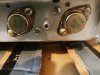
Looking for something that would replace these out of a Fisher model 95. Any suggestions?
 

Attachments

  • 20210616_200713.jpg
    20210616_200713.jpg
    94.2 KB · Views: 39
Back
Top Bottom