• The move to the new server is done. There are some software and database maintenance updates in process. This has us passing the hat around to help out. We appreciate any donations. Seriously, even a dollar helps. The payment page may be found here - https://www.audiokarma.org/support.html

Getting the overhang correct.

catman

Addicted Member
Banned
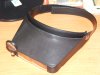
G'day all, I must be feeling motivated today because I've been in the mood to get things done, and one of my assigned tasks was to check the cartridge overhang on my Kenwood turntable. In the past I had just used the supplied AT95E as reference and simply set up my other cartridges that get used on that turntable to the same measured distance, and since I've noted no IGD, I've presumed good overhang adjustment. Anyway I got out my Shure two point Baerwald protractor and magnifying helmet and checked it with my M97xE in place.

According to the protractor the inner null point was slightly 'out' so the overhang was readjusted as per my usual procedure at both null points (about a 1 mm shift forward). I then checked the tracking weight (with my M97xE) and it was close to correct (1.25 to 1.3 grams). I then played one side of a record.

I can't say that it really sounded much better, but two things were immediately noticeable. Firstly that record being slightly dirty, always produced a substantial collection of fluff around the stylus tip by the end of the side. Well I checked the stylus tip at the end of the side with my X10 magnifier and a perfectly clean tip was seen! Also on that record the cartridge always 'repeats' on a bad scratch and I was stunned to hear a 'click' but then it kept on playing normally! No doubt about it, getting the overhang right is a fiddly process but it is definitely worth it! :yes: Regards, Felix aka catman.
 
Register to hide this ad
G'day mate, it's nothing special, but it does the job, and more than compensates for my poor eyesight! Regards, Felix aka catman.
 

Attachments

  • Catman's magnifying helmet..jpg
    Catman's magnifying helmet..jpg
    114.9 KB · Views: 35
G'day all, a bit of an update. This whole overhang thing can be (is) actually quite an adventure!? Since checking and slighly readjusting the overhang with my trusty Shure Baerwald two point protractor the other day which is normally a (reasonably) straightfoward procedure, I've been forced to include yet another parameter into the equation, that of cartridge offset angle.

The other day, although the general overhang looked ok as per my general approach http://www.mds975.co.uk/Content/vinyl07.html I felt that the cartridge wasn't quite 'parallel' in reference to the grid lines, which ideally it should have been!

So in the end, I had a closer look at things using the cantilever as the point of reference, which ideally we are trying to align (assuming it is properly 'centred' itself). The whole process becomes a two step affair, firstly that of setting the overhang 'distance' nominally correct (almost a 'coarse' adjustment), and then twisting or skewing the cartridge, if needed, in order to satisfy the 'parallel' requirement. In the end a very slight twisting was necessary (using Baerwald) in order to get the cantilever properly 'parallel' in reference to the grid lines at both null points, and close listening on headphones do suggest that the general tracking error is less and things sound a trifle better.

This article by JaS at the Vinyl Engine is mandatory reading on this subject. http://www.vinylengine.com/twi.....hell.shtml Just my thoughts anyway! Regards, Felix aka catman.
_________________
 
Last edited:
G'day all, a bit of an update. This whole overhang thing can be (is) actually quite an adventure!? Since checking and slighly readjusting the overhang with my trusty Shure Baerwald two point protractor the other day which is normally a (reasonably) straightfoward procedure, I've been forced to include yet another parameter into the equation, that of cartridge offset angle.

The other day, although the general overhang looked ok as per my general approach http://www.mds975.co.uk/Content/vinyl07.html I felt that the cartridge wasn't quite 'parallel' in reference to the grid lines, which ideally it should have been!

So in the end, I had a closer look at things using the cantilever as the point of reference, which ideally we are trying to align (assuming it is properly 'centred' itself). The whole process becomes a two step affair, firstly that of setting the overhang 'distance' nominally correct (almost a 'coarse' adjustment), and then twisting or skewing the cartridge, if needed, in order to satisfy the 'parallel' requirement. In the end a very slight twisting was necessary (using Baerwald) in order to get the cantilever properly 'parallel' in reference to the grid lines at both null points, and close listening on headphones do suggest that the general tracking error is less and things sound a trifle better.

This article by JaS at the Vinyl Engine is mandatory reading on this subject. http://www.vinylengine.com/twi.....hell.shtml Just my thoughts anyway! Regards, Felix aka catman.
_________________

Funny you mention this, I just did the same exact thing today with the same exact cartridge. I had set the overhang just as you had and didn't pay a lot of attention to getting the cartridge parallel with the Baerwald guide. Once I went back and got it parallel it wasn't a major difference, but I did, as you did, notice that the tracking error diminished and I could hear certain passages a little bit clearer.

Just out of curiosity, I've read a lot of confusing things about the Shure M97xE's tracking force and the anti-skate setting. I always keep the brush down and so the tracking force is at 1.75, and there is a debate over whether the anti-skate should be set at 1.25 or 1.75- just wondering what yours is set at, mine is 1.25 and sounds fine but I'm always looking for any small improvements in sound.
 
G'day mate, the anti skating adjustment is a bit 'iffy' in my opinion. I normally leave it at 1.25 g regardless (matching the tracking weight), as I rarely use the dynamic stabiliser, unless it's really needed and of course if I use the dynamic stabiliser I increase the tracking weight by .5 grams.

I've never really considered the anti skating adjustment overly critical, beyond a certain point. Regards, Felix aka catman.
 
its worth remembering that 'overhang' is simply
effective length 'minus' tonearm mounting distance when you achieve the correct alignment at both null points for the geometry that your arm is capable of aligning to...
the offset angle often results in a correctly aligned cartridge being non parallel to the headshell sides because each cartridge design varies in the distance between the stylus tip from the cartridge body mounting slots...and movement is limited by the length of the headshell slots..
no turntable manufacturer can anticipate which cartridge will be in installed by the user on any given turntable so don;t worry if aligning to both null points results inyoru at 95e being at a slight angle in the headshell...it simply means the cartridge body itself is at the correct 'offset angle' and that is as it should be..

the method of aligning the cantilever itself with the grid around the null points is probably the best method of fine tuning cartridge alignment once you are in the ball park...small adjustments here can often unlock a bit more subtlety ..especially in those dense inner grooves...
 
Back
Top Bottom