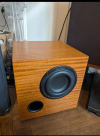
I'm a newbie to making anything from wood and so I was really pleased how this turned out.
The main intention of this post is to encourage others and to leave a record of what I did.
Firstly I watched lots of others on yt doing same and felt envy and inadequacy.
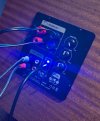
I decided to build one of those powered subs using a plate amp. Got the plate amp from eBay fairly cheap. You can see the one I used in the photos. It's pretty common, probs a clone of some other brand.
I had seen others use the TangBand w5-1138smf so I got the same.
I used various bits of software to calculate that a 5cm port flared at both ends and about 180mm long would be tolerable from a chuffing point of view. Got conflicting answers on the port size from different software. I even got Gemini to give it's opinion and since it agreed roughly with one of the app provided options I went with that.
Has anyone else used Gemini to help spec a build? Exclosures, parts, ports , radiators etc etc? Even sourcing suppliers. How did it go?
I ordered the port from HiFi Collective and their parts are cheaper and better than the stuff I saw on eBay.
I got the driver from SoundImports.
I got CutMyMdf to supply the cut MDF which came perfectly sized. cutmy.co.uk
In retrospect I could/should have asked CutMyMdf to cut all the holes in the panels too as they are really good value and it would have saved me time.
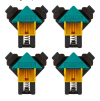
I used some springy corner clamps and cheapo (labelled wolfcraft but I'm sure they are all knock offs). These were very very handy.
Also got 2 of those 18" quick grip clamps (spreader clamps). Should have gotten 4. Got em cheapo somewhere, maybe screwfix?
I decided to use Gorilla Polyurethane glue. Not sure why. But it does go off quite quickly to a handling strength which was cool. And it expanded to fill most cracks at the joints and was easy to sand off. Not a bad choice.
I used no nails or other fixing except for the amp and driver.
Assembled the enclosure on the kitchen table with a thin sheet of MDF to avoid messing up the counter. Did all the work that way. Annoyed the wife.
I had to use a router for the big hole and a 60mm hole saw for the port. This is equipment I had to buy so more time and money.
At one point I thought I wouldn't needs a router at all but I was really grateful for it when I came to cutting through the veneer to reveal the holes.
However if all I need it for is cutting away the veneer then I suspect a much cheaper option is to get a Dremel clone from eBay and use that. Probably safer (no lost fingers) too and takes up less cupboard space.
I did use a roundover bit for the big hole but that was actually more of a pain once I have put the veneer on as the roundover meant there was a floating bit of vener over the roundover that I had trim carefully. But I'm getting ahead of myself.
I got the veneer from WoodVeneerHub and it was about £18. Unbacked veneer that I had to apply using the "hot iron PVA" approach. Again maybe not the best approach.
Sanded the enclosure and applied 2 coats of PVA to the box and 2 to the back of the veneer letting it dry to the touch each time. Then cut veneer roughly to size to fit the box and used the iron to apply it.
BTW During prepping the veneer I got glue on the front of the veneer. Don't do this as it's a pain to remove from the front. I found that putting IPA (isopropyl) on it and quickly sanding made it roll off gummy. Giant pita.
I trimmed the veneer with a modelling knife.
I applied the bottom veneer, then the sides , then the back then front then top. This approach to minimise visibility of the veneer edge, but I think maybe it was no need. But anyway it's a plan.
Then I gave the whole thing a hand sand with 120 grade paper and a wipe with the IPA.
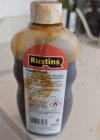
I then applied maybe 5 coats of French polish (shellac) and I've photographed the bottle below. Didn't leave more than a few mins between coats.
Left that for an hour and applied some beeswax.
Used a lint free cloth for the finish and wax.
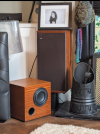
Put the amp, port and driver in and hooked it up to my NAD 3020e to fill in the bass with my B&W DM4.
Sounds great to be honest. I am not a audiophile. But it really fills out the bottom and in a way I had no idea what I was missing. Whole instruments and mood that were missing in everything I listened to.
But then my NAD blew a fuse (that's another project) and so I hooked the DM4 up to the subwoofer speaker outs instead. TBH it sounds pretty good that way.
Normally I drive the NAD and the sub off a cheapish BT device and Spotify. The BT device has a pair of regular line out outputs I hookup to the aux input of the NAD and also a headphone out that I hooked up to the subwoofer. That worked well until the nad died.
What you do need to do is set the level and the frequency cutoff of the subwoofer to match a given level on the nad and from then on control the volume from the phone. It's actually a bit less hassle using the plate amp alone but you still need to get the levels right.
This combo is not a loud subwoofer. But I was surprised how little sub I needed to add to the DM4 to fill out the bottom.
I have used with classical mostly and some Johnny Cash etc but today I put some more bassy punchy pop into this setup (plate amp as nad still dead) and it's well loud enough for a party if the need arose (typical London house).
I was building this setup for my son at uni but may well just keep it as it's too nice to give away.
I will next have a go at building some bookshelf speakers for daughter and see what I can squeeze out in terms of full range and smallish.
(I know I can't hear anything over 13khz!)

The main intention of this post is to encourage others and to leave a record of what I did.
Firstly I watched lots of others on yt doing same and felt envy and inadequacy.
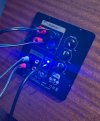
I decided to build one of those powered subs using a plate amp. Got the plate amp from eBay fairly cheap. You can see the one I used in the photos. It's pretty common, probs a clone of some other brand.
I had seen others use the TangBand w5-1138smf so I got the same.
I used various bits of software to calculate that a 5cm port flared at both ends and about 180mm long would be tolerable from a chuffing point of view. Got conflicting answers on the port size from different software. I even got Gemini to give it's opinion and since it agreed roughly with one of the app provided options I went with that.
Has anyone else used Gemini to help spec a build? Exclosures, parts, ports , radiators etc etc? Even sourcing suppliers. How did it go?
I ordered the port from HiFi Collective and their parts are cheaper and better than the stuff I saw on eBay.
I got the driver from SoundImports.
I got CutMyMdf to supply the cut MDF which came perfectly sized. cutmy.co.uk
In retrospect I could/should have asked CutMyMdf to cut all the holes in the panels too as they are really good value and it would have saved me time.
I used some springy corner clamps and cheapo (labelled wolfcraft but I'm sure they are all knock offs). These were very very handy.
Also got 2 of those 18" quick grip clamps (spreader clamps). Should have gotten 4. Got em cheapo somewhere, maybe screwfix?
I decided to use Gorilla Polyurethane glue. Not sure why. But it does go off quite quickly to a handling strength which was cool. And it expanded to fill most cracks at the joints and was easy to sand off. Not a bad choice.
I used no nails or other fixing except for the amp and driver.
Assembled the enclosure on the kitchen table with a thin sheet of MDF to avoid messing up the counter. Did all the work that way. Annoyed the wife.
I had to use a router for the big hole and a 60mm hole saw for the port. This is equipment I had to buy so more time and money.
At one point I thought I wouldn't needs a router at all but I was really grateful for it when I came to cutting through the veneer to reveal the holes.
However if all I need it for is cutting away the veneer then I suspect a much cheaper option is to get a Dremel clone from eBay and use that. Probably safer (no lost fingers) too and takes up less cupboard space.
I did use a roundover bit for the big hole but that was actually more of a pain once I have put the veneer on as the roundover meant there was a floating bit of vener over the roundover that I had trim carefully. But I'm getting ahead of myself.
I got the veneer from WoodVeneerHub and it was about £18. Unbacked veneer that I had to apply using the "hot iron PVA" approach. Again maybe not the best approach.
Sanded the enclosure and applied 2 coats of PVA to the box and 2 to the back of the veneer letting it dry to the touch each time. Then cut veneer roughly to size to fit the box and used the iron to apply it.
BTW During prepping the veneer I got glue on the front of the veneer. Don't do this as it's a pain to remove from the front. I found that putting IPA (isopropyl) on it and quickly sanding made it roll off gummy. Giant pita.
I trimmed the veneer with a modelling knife.
I applied the bottom veneer, then the sides , then the back then front then top. This approach to minimise visibility of the veneer edge, but I think maybe it was no need. But anyway it's a plan.
Then I gave the whole thing a hand sand with 120 grade paper and a wipe with the IPA.
I then applied maybe 5 coats of French polish (shellac) and I've photographed the bottle below. Didn't leave more than a few mins between coats.
Left that for an hour and applied some beeswax.
Used a lint free cloth for the finish and wax.
Put the amp, port and driver in and hooked it up to my NAD 3020e to fill in the bass with my B&W DM4.
Sounds great to be honest. I am not a audiophile. But it really fills out the bottom and in a way I had no idea what I was missing. Whole instruments and mood that were missing in everything I listened to.
But then my NAD blew a fuse (that's another project) and so I hooked the DM4 up to the subwoofer speaker outs instead. TBH it sounds pretty good that way.
Normally I drive the NAD and the sub off a cheapish BT device and Spotify. The BT device has a pair of regular line out outputs I hookup to the aux input of the NAD and also a headphone out that I hooked up to the subwoofer. That worked well until the nad died.
What you do need to do is set the level and the frequency cutoff of the subwoofer to match a given level on the nad and from then on control the volume from the phone. It's actually a bit less hassle using the plate amp alone but you still need to get the levels right.
This combo is not a loud subwoofer. But I was surprised how little sub I needed to add to the DM4 to fill out the bottom.
I have used with classical mostly and some Johnny Cash etc but today I put some more bassy punchy pop into this setup (plate amp as nad still dead) and it's well loud enough for a party if the need arose (typical London house).
I was building this setup for my son at uni but may well just keep it as it's too nice to give away.
I will next have a go at building some bookshelf speakers for daughter and see what I can squeeze out in terms of full range and smallish.
(I know I can't hear anything over 13khz!)