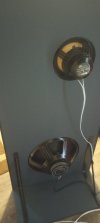
Sharing the details and end results of an OB speaker build I finished recently.
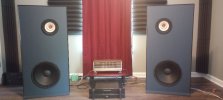
The Build Specs:
3/4" Baltic Birch, painted for a modern look. Nearly every speaker I have purchased or built has had a wood finish, so I wanted to give something new a try.
Mechanical stability was a priority given the large surface area of these baffles and the displacement of the 15-inch woofers. To eliminate unwanted panel resonance, I used large heavy-duty L-brackets (rated for 600 lbs!) to rigidly couple the baffles to the bases. This has proven highly effective; the structure remains inert even at higher volumes. By neutralizing baffle vibration at the source, the Tang Band’s micro-dynamics stay clear and free from the smearing that can be caused by low-frequency energy. At this time, I have no plans for additional bracing.
Details:
Results:
The speakers sit 3' off the front wall with a slight toe-in. The result is "artist in the room" realism. I’m getting excellent imaging, which is very important to me, along with depth, speed, and dynamics. Because I have a small listening room, it is easy for the room to be overloaded. The bass quality from these OBs is tight and goes deep. At first I thought about building a couple of H frame OB subs; however, after some adjustments and tweaks there is no need for subs. The active crossover allows me to perfectly match the gain of the different amplifiers and make fine adjusts to get the best performance in my room. So far, so good. Will I make any changes? Maybe, but for now I'm exceedingly happy with how this turned out.
The Build Specs:
3/4" Baltic Birch, painted for a modern look. Nearly every speaker I have purchased or built has had a wood finish, so I wanted to give something new a try.
Mechanical stability was a priority given the large surface area of these baffles and the displacement of the 15-inch woofers. To eliminate unwanted panel resonance, I used large heavy-duty L-brackets (rated for 600 lbs!) to rigidly couple the baffles to the bases. This has proven highly effective; the structure remains inert even at higher volumes. By neutralizing baffle vibration at the source, the Tang Band’s micro-dynamics stay clear and free from the smearing that can be caused by low-frequency energy. At this time, I have no plans for additional bracing.
- Dimensions: 24" W x 48" H, mounted on a 14" base with felt isolation pads.
- Drivers: Tang Band W8-1808 and Eminence Alpha 15a
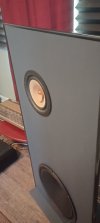
- The Tang Band is offset on the baffle to address diffraction, while the Eminence is mounted near the bottom for boundary reinforcement.
- No binding posts are used. Each driver is directly connected to its respective amplifier.
Details:
- Tang Band: No crossover and directly connected to the amp with a 50 Hz high-pass filter between the amp and preamp. I have been trying different amps, some have settings that allow me to further tailor the sound.
- Eminence: Currently driven by a Bryston 4B SST via an active analog crossover.
- Harrison Labs FMOD 50 Hz high pass. While the Tang Band W8-1808 is a spectacular full-range driver, asking any 8-inch driver to handle deep bass creates physical challenges. This inline filter between the preamp and amp helps control intermodulation distortion, increase the headroom of the amplifier powering it, and protects the driver from being pushed past its physical limits. It also ensures the two drivers aren't fighting over the same low-frequency air space, allowing for a better mid bass transition.
- I am utilizing a 24 dB slope for the woofer that’s currently set at 90 Hz.
- DBX 223 XL analog active crossover, for the woofer only.
- Cables: I started with Belden 9497 but switched to 14 AWG zip cord for more "meat on the bone". Just recently I swapped in some 13 awg Supra Classic 2.5 cables and plan to try them out this weekend.
- Dedicated 12'x14' listening room, dedicated power, and acoustic treatments.
Results:
The speakers sit 3' off the front wall with a slight toe-in. The result is "artist in the room" realism. I’m getting excellent imaging, which is very important to me, along with depth, speed, and dynamics. Because I have a small listening room, it is easy for the room to be overloaded. The bass quality from these OBs is tight and goes deep. At first I thought about building a couple of H frame OB subs; however, after some adjustments and tweaks there is no need for subs. The active crossover allows me to perfectly match the gain of the different amplifiers and make fine adjusts to get the best performance in my room. So far, so good. Will I make any changes? Maybe, but for now I'm exceedingly happy with how this turned out.
Last edited: