• The move to the new server is done. There are some software and database maintenance updates in process. This has us passing the hat around to help out. We appreciate any donations. Seriously, even a dollar helps. The payment page may be found here - https://www.audiokarma.org/support.html

Goodmans Mezzo 3 issue - buzzing on bass driver

audiogymp

Active Member
Hi

Looking for some suggestions on a Goodmans speaker that has an issue. I have a pair of Mezzo 3s and one sounds good but the other has a buzzing in the bass driver. Not a common speaker and not a lot of info available about them.

The buzzing is frequency dependent. Sometimes you can barely hear it, sometimes it is strong. The sound is a bit like a resonance but the other speaker doesn't have the problem. I've tried replacing the cap on the affected speaker but this seems to make no difference. I haven't pulled the speaker out but it appears to move freely and nothing to suggest rubbing.

I haven't had anything like this before. Any thoughts about what to try next?

Thanks, Jon
 
Register to hide this ad
Pull the driver, rotate it 180 degrees and reinstall. It could be that gravity has caused some sagging. A half turn could remedy it.
While you have the driver out:
1. Check for free movement by hand.
2. Check to make sure spider is properly attached.
3. Check tinsel leads between basket and cone. Make sure they aren't vibrating against cone.
4. Make sure that adequate gasket material is between baffle and woofer.

Good luck
 
I've looked at a couple of speakers that had that issue. Other areas to check are where the dust cap attaches to the cone and where the flex lead goes through the cone.

A friend had a pair of Ohms with the dust cap had come loose in one corner and vibrated like a son of a gun at certain frequencies and made a noise like you described. Regluing the dust cap to the cone fixed that issue.

Another friend had a set of Genesis Iis where the flex lead at the point where it goes through the cone had worked its way loose from the sealant. It took a while with the stethoscope to locate it, and about five seconds with a tiny dab of clear silicone to fix.

Good luck!
 
Just remembered one more:
5. Check the front baffle and other cabinet seems for failed glue, epoxy, and loose screws.
 
These buzzes can be aggravating.
I recently had a guitar amp with a buzzing speaker. I traced it to a spot on the outer rim of the basket, between screw holes. removing and regaling the gasket didn't fix it. Drilling a hole and installing another screw at that spot fixed it.
 
Thanks for all the excellent suggestions. It's difficult to see much of the speaker in situ because the grill isn't removable but I will take it out and check the things in your replies.

I also have a guitar amp with a rattle and may be able to recycle the learning there.

Thanks again, Jon
 
You may have a problem in bond from the surround to the cone. The adhesive sometimes lets loose after this many years.

I believe Goodmans used a rubber-type cement (rubber dissolved in a solvent). This bond will oxidize over the years (about 50) and it eventually loses its adhesion.

It's an easy fix, but I wouldn't slather white glue all over it. (I don't belong to white glue cult.) I'd use a little solvent glue diluted down and painted with a brush. Don't add mass to the surround or stiffen it.

It's ok to use solvent glues as long as you're doing one-offs and don't breath the fumes like a bored twelve year old. I wouldn't want to do it on a production line, of course.
 
Hi all. Speaker fixed. The dust cap had come off completely and was probably rattling against the bass driver.

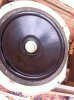
I've included a pic of the driver before fixed and I'll include some quick comments for other Mezzo 3/Goodmans owners since info is quite limited.

The speaker was not easy to get off. Screws were only finger tight but with time the speaker had become welded to the baffle.

Nice looking bass drivers with cast Al basket. Cut away at the sides so that the cone is almost as wide as the enclosure. The cones appear to have some sort of polymer (PVC?) lining the outer surface which is contiguous with the speaker surround - ie the surround in not a separate thing glued on. If you look at the pic you can see that the shiny surface of the PVC(?) has pulled away from the paper cone material behind it around where the dust cap was attached. This is probably what made the dust cap come off.

I didn't concern myself with the small amount of delimitation noted above. Glued the dust cap back where it was using PVA glue - seemed to have no problem taking to the PVC(?) on the cone.

Speakers sound good - I'm quite impressed by these little Mezzo 3s. I've had them for a couple of years but the variable buzzing quality (which I only recently localised to a particular driver) stopped me thinking much of them.

Retrovert - what type of solvent glue do you use and what do you use to dilute it?
 

Attachments

  • IMG_0293.jpg
    IMG_0293.jpg
    62 KB · Views: 20
Nice fix! Goodmans made a lot of great-sounding speakers. I know some people prefer Tannoy, but the fact is that Tannoy had to buy Goodmans to put it out of business, so that ought to say something.

A number of solvent-based cements exist for gluing cones, surrounds, and spiders and everything else. Basically rubbery materials dissolved in a solvent. The real expert on this is Ken Kantor. The industry changed to green alternatives because solvents are problematic for humans, but the amount of exposure to fix a speaker is negligible.

I would expect that the butylene rubber one (think chewing gum, dissolved in toluene) used for the surrounds on AR and KLH speakers would be fine. This is very flexibly and very sticky and stays sticky for decades (why Singapore banned chewing gum), and very little mass is required to do the job. The trouble with most cements, particularly gasket cement as has been well-documented here by RoyC, is hardening over time. PVA does this, too. One adhesive sold for this purpose (Service Cement from GC Electronics) is celluloid (probably something else, too) dissolved in acetone.
 
Thanks for the info on solvent glues. I might try contact adhesive thinned with a little acetone or toluene and work outwards from there.

This is drifting away from the subject a little but I have another speaker with a rubber surround that needs to be glued back. The rubber surround needs to be stretched a little to conform to the cone (the surround is almost 2D) and so I will need good initial bond strength. Contact adhesive comes to mind as a suitable choice. I've only ever used PVA glue for speakers before but it looks from the info above on solvent glues like there is no reason not to use contact adhesive, possibly in thinned form.

Cheers, Jon
 
Yes, PVA may not be the best adhesive for this application.

The change from adhesives using petrochemical solvents to water-based non-toxic and non-flammable ones was to protect workers in manufacturing plants from exposure to lightweight petroleum solvents, which is a laudable goal. That doesn't mean the new, safe, green alternative is the best functional solution, it means it is the best manufacturing solution. (We often say "solvent" as a synonym for petroleum solvent, but that's inaccurate because water is a solvent, too. So is alcohol. So are a number of liquids. I should have clarified, lest someone take me to task for inaccurate use of terminology.)

Creating a lightweight, sticky, flexible, and fast-drying adhesive which does not use petroleum solvents is difficult, and this is why not as many water-based adhesives exist for these kinds of applications.

If you search for discussions of speaker adhesives by Ken Kantor you'll find that adhesive selection is a very important part of speaker manufacturing, and minor variations can cause wide variations in yields.

I agree with you that a dilute petroleum-solvent contact adhesive should work fine, and this is what I like to use because I find them more removable than water-based solutions and easier to work with. At the same time, I do this in a well-ventilated area, because I'm not interested in absorbing toluene into my CNS and liver.
 
Back
Top Bottom