• The move to the new server is done. There are some software and database maintenance updates in process. This has us passing the hat around to help out. We appreciate any donations. Seriously, even a dollar helps. The payment page may be found here - https://www.audiokarma.org/support.html

Goodmans Triaxiom + ARU 172, worth fixing?

qui

New Member
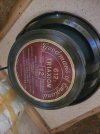
Recently picked up this pair of Goodmans. They sound awful, extremely veiled with very poor frequency response, and zero stereo image to speak of.. I'm fairly sure the crossover caps are finished, as the drivers look to be pristine.

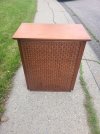
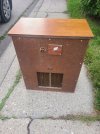
Are they worth fixing or should I part them out and cut my losses? I've never heard a triaxial driver before so I'm not sure what to expect. Also, the cabs seem to be much too small for these drivers, if the 128L recommendation on the basket is to be believed.

Also, does anyone have any info on the 612c and its crossover? I can't find much on it at all.
 

Attachments

  • 33df5b4a-24da-4f2d-8282-bd6cd4c698a5.jpg
    33df5b4a-24da-4f2d-8282-bd6cd4c698a5.jpg
    318.8 KB · Views: 59
  • 20260908_185255.jpg
    20260908_185255.jpg
    177.9 KB · Views: 52
  • 20260908_182306.jpg
    20260908_182306.jpg
    185.1 KB · Views: 53
  • 20260908_173126.jpg
    20260908_173126.jpg
    373.2 KB · Views: 50
  • 20260908_173121.jpg
    20260908_173121.jpg
    353.9 KB · Views: 55
Register to hide this ad
I believe Goodmans Axioms are highly regarded, so I'd certainly not trash them. If the caps are bad (and they may not be), then try changing them.
I'm just guessing looking at the enclosures, but they appear the have 'Boffles', which were a sort of hanging door that sealed the enclosure at low volumes but vented it at higher volumes, so emulating a larger volume. Maybe sort of aperiodic.
I think those might sound very good when restored. They won't sound like modern speakers, but that is a backhanded compliment...
 
  • Like
Reactions: qui
Recently picked up this pair of Goodmans. They sound awful, extremely veiled with very poor frequency response, and zero stereo image to speak of.. I'm fairly sure the crossover caps are finished, as the drivers look to be pristine.

Are they worth fixing or should I part them out and cut my losses? I've never heard a triaxial driver before so I'm not sure what to expect. Also, the cabs seem to be much too small for these drivers, if the 128L recommendation on the basket is to be believed.

Also, does anyone have any info on the 612c and its crossover? I can't find much on it at all.

Recap them if you can, and what amp did you use? For something like that I’d suggest using a tube amp.
 
Recap them if you can, and what amp did you use? For something like that I’d suggest using a tube amp.
Using an HH Scott LK-72A. I've recapped them which fixed the veiled sound, but I think it might be a cabinet issue.

The cab was clearly designed for a traditional 3-driver 3-way setup, as it has blanked baffle ports for a mid and horn tweeter, and a blanked hole for mid controls on the back panel. With the driver in the woofer position, being coaxials, the horn loaded tweeters are basically level with my ankles when listening. When I lay on the floor they sound quite good, startling even. The bass is particularly impressive. But sitting in my normal listening position they sound awful. I'm just assuming, but the cabinet is what makes most sense to me. I suppose it could also be a driver issue.
 
Last edited:
Using an HH Scott LK-72A. I've recapped them which fixed the veiled sound, but I think it might be a cabinet issue.

The cab was clearly designed for a traditional 3-driver 3-way setup, as it has blanked baffle ports for a mid and horn tweeter, and a blanked hole for mid controls on the back panel. With the driver in the woofer position, being coaxials, the horn loaded tweeters are basically level with my ankles when listening. When I lay on the floor they sound quite good, startling even. The bass is particularly impressive. But sitting in my normal listening position they sound awful. I'm just assuming, but the cabinet is what makes most sense to me. I suppose it could also be a driver issue.

Interesting, older coaxial and triaxial drivers are usually really loose with placement. They are usually wide range and rather forgiving.

Odd that that the HF would sound off, I am wondering if the caps are just shot in the HF range and not allowing the full signal to pass or even causing it to sound off.

What are the cap values?

Have you pulled the drivers out and ran them OB? You may want to give that a go, can you post a picture of the crossovers?

I wish you were in CA, Id love to see the set in person. I have a small collection of coaxials for mono gear I use. Big fan of FRD and Coaxials.
 
  • Like
Reactions: qui
Interesting, older coaxial and triaxial drivers are usually really loose with placement. They are usually wide range and rather forgiving.

Odd that that the HF would sound off, I am wondering if the caps are just shot in the HF range and not allowing the full signal to pass or even causing it to sound off.

What are the cap values?

Have you pulled the drivers out and ran them OB? You may want to give that a go, can you post a picture of the crossovers?

I wish you were in CA, Id love to see the set in person. I have a small collection of coaxials for mono gear I use. Big fan of FRD and Coaxials.
Just a single cap per crossover at 1.5uf. I wonder if the horn should be oriented vertically instead of horizontally? Photo attached from before the recap. I suppose the L-pad could be an issue, but it wasn't scratchy at all, and I can't find a way to open it non-destructively.
 

Attachments

  • 20260909_173227.jpg
    20260909_173227.jpg
    107.9 KB · Views: 20
Just a single cap per crossover at 1.5uf. I wonder if the horn should be oriented vertically instead of horizontally? Photo attached from before the recap. I suppose the L-pad could be an issue, but it wasn't scratchy at all, and I can't find a way to open it non-destructively.

1.5uF that's an odd value! I think I may have some for you!

As for the L-Pad, try spraying it with some Deoxit F100 or F5 faderlube, the green can. Do not use the red can.

I usually go with the sticker on the motor/Magnet to know what direction the horn should be. From the back side of the woofer the text should be in the correct position.

Hard to see what cap that is but it looks like a more modern cap, wonder if someone swapped them already? Is that a dayton cap?

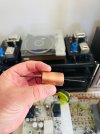
Oddly enough I think I have a bunch of 1.5uF Obbligato Copper wound caps that I have no use for. They look to be the same size to.

Let me know if you want them, If so I can pull them out and snap a few pic, you can have them for free as Id rather them go to a good home than just sit and expire. Had to make Free big so the site doesn't think i am trying to sale something. I am not, Just have a lot of overstock caps I don't use. If you can use them Id gladly give them to you.

Ill be off work in a few, Ill dig them out and post some pix. If you want them we can communicate via PM.
 
  • Like
Reactions: qui
Using an HH Scott LK-72A. I've recapped them which fixed the veiled sound, but I think it might be a cabinet issue.

The cab was clearly designed for a traditional 3-driver 3-way setup, as it has blanked baffle ports for a mid and horn tweeter, and a blanked hole for mid controls on the back panel. With the driver in the woofer position, being coaxials, the horn loaded tweeters are basically level with my ankles when listening. When I lay on the floor they sound quite good, startling even. The bass is particularly impressive. But sitting in my normal listening position they sound awful. I'm just assuming, but the cabinet is what makes most sense to me. I suppose it could also be a driver issue.

Also Nice on the LK72, I recently added an LK-72 to the collection, I got the brown one or the Chocolate one. Beautiful amps!
 
1.5uF that's an odd value! I think I may have some for you!

As for the L-Pad, try spraying it with some Deoxit F100 or F5 faderlube, the green can. Do not use the red can.

I usually go with the sticker on the motor/Magnet to know what direction the horn should be. From the back side of the woofer the text should be in the correct position.

Hard to see what cap that is but it looks like a more modern cap, wonder if someone swapped them already? Is that a dayton cap?

Oddly enough I think I have a bunch of 1.5uF Obbligato Copper wound caps that I have no use for. They look to be the same size to.

Let me know if you want them, If so I can pull them out and snap a few pic, you can have them for free as Id rather them go to a good home than just sit and expire. Had to make Free big so the site doesn't think i am trying to sale something. I am not, Just have a lot of overstock caps I don't use. If you can use them Id gladly give them to you.

Ill be off work in a few, Ill dig them out and post some pix. If you want them we can communicate via PM.
I can't turn some caps down, that would be awesome, thanks!

And the current cap does look quite new from afar, but its actually an old Hunts Metallized. Unfortunately whatever the casing is made from is simultaneously splitting, melting, and bulging on the ends.

Regarding the Lpad, I'm thinking of just deleting it altogether. I did that on my EV-4a's and its one of the best choices I've ever made.
 
I can't turn some caps down, that would be awesome, thanks!

And the current cap does look quite new from afar, but its actually an old Hunts Metallized. Unfortunately whatever the casing is made from is simultaneously splitting, melting, and bulging on the ends.

Regarding the Lpad, I'm thinking of just deleting it altogether. I did that on my EV-4a's and its one of the best choices I've ever made.

Yea I like to delete them too seems to make the HF come alive.

IMG_2295.jpeg

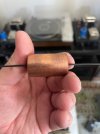
The copper looks a little oxidized but they are brand new.

IMG_2294.jpeg

Hard to see the printing but they are 1.5uF I think 300v but not sure. They should be fine in a crossover. I’ve used them in tube amps and really like the copper series.

I have 8 of them, how many you need?
 
My impression is that 60s audio systems tended to be in large rooms, speakers against the wall, and listeners seated on sofas and low chairs. So even though the tweeters were usually fairly low, listeners would be far enough away to be in the (limited) area of high frequency coverage. That may not be how you listen, and though you could tilt the speakers, that would look stupid.
I believe if you want dispersion up and down, the long axis of the horn should be horizontal - the smaller dimension disperses better, even though it looks like that curving horn our to be spewing sound out the sides.
Sound radiates in a hemisphere from a very small radiator, but a larger radiator beams more because only the wavefronts emanating from the sides disperse much - wavefronts from the larger area interfere with each other, creating a straight line wave front which just goes forward. As the wave moves, the interference patterns change, and the edges start curving more and more, so that after a certain distance (which is related to the size of the radiator), the wave is essentially hemispherical.
 
My impression is that 60s audio systems tended to be in large rooms, speakers against the wall, and listeners seated on sofas and low chairs. So even though the tweeters were usually fairly low, listeners would be far enough away to be in the (limited) area of high frequency coverage. That may not be how you listen, and though you could tilt the speakers, that would look stupid.
I believe if you want dispersion up and down, the long axis of the horn should be horizontal - the smaller dimension disperses better, even though it looks like that curving horn our to be spewing sound out the sides.
Sound radiates in a hemisphere from a very small radiator, but a larger radiator beams more because only the wavefronts emanating from the sides disperse much - wavefronts from the larger area interfere with each other, creating a straight line wave front which just goes forward. As the wave moves, the interference patterns change, and the edges start curving more and more, so that after a certain distance (which is related to the size of the radiator), the wave is essentially hemispherical.

Maybe but what’s your explanation for larger speakers like that, that do not require you to be sitting in a low chair? There are many sets like this that don’t have a low frequency issues. Goodman drivers are pretty well regarded drivers, I’d be surprised if they didn’t have good top end. I think a quick google search of the drivers would tell you if they lacked in the top end.
 
The lowboy speaker was a compromise, early waf acknowledgement perhaps? Regardless, an inch or two under the front will tilt it up to your ears.
 
Well, I can't explain everything, but never overlook marketing when considering speaker design.
Most consumer speakers back then tended to be designed to look like furniture, and something low that fit in with the credenza was a lot more likely to meet with domestic approval than something that dominated the room. Yes, there were Bozaks, Patricians, and Voice of the Theaters that hulked over the room, but they were for the die hards, and the well heeled die hards, at that. The average consumer needed something his wife (and that was the market then) would tolerate.
Furthermore, if you put the woofer near the floor, you improve the low end. Prior to acoustic suspension speakers, the low end was a real problem, requiring large enclosures - see above for the problem created. A low woofer is no problem if the tweeter is up high, but then the sound sources are in different places, the audibility of which some people objected to strongly. It may be that mono makes two points sources more obvious - by the time you have two speakers, neither of which is in front of you, there are so many room reflections that a foot or two of driver displacement isn't obvious to most people.
There was a real bias in British audio for single point sound sources - witness the archetypal British speaker, the coaxial Tannoy, and the Quad ESL (admittedly a line source). So Goodmans had been making coaxials, and it was natural to continue using them (only one hole and only one set of mounting screws), even if a midrange was added (and, of course, back when you bought the driver and the enclosure, adding a midrange later was a common option).
X
 
Well, I can't explain everything, but never overlook marketing when considering speaker design.
Most consumer speakers back then tended to be designed to look like furniture, and something low that fit in with the credenza was a lot more likely to meet with domestic approval than something that dominated the room. Yes, there were Bozaks, Patricians, and Voice of the Theaters that hulked over the room, but they were for the die hards, and the well heeled die hards, at that. The average consumer needed something his wife (and that was the market then) would tolerate.
Furthermore, if you put the woofer near the floor, you improve the low end. Prior to acoustic suspension speakers, the low end was a real problem, requiring large enclosures - see above for the problem created. A low woofer is no problem if the tweeter is up high, but then the sound sources are in different places, the audibility of which some people objected to strongly. It may be that mono makes two points sources more obvious - by the time you have two speakers, neither of which is in front of you, there are so many room reflections that a foot or two of driver displacement isn't obvious to most people.
There was a real bias in British audio for single point sound sources - witness the archetypal British speaker, the coaxial Tannoy, and the Quad ESL (admittedly a line source). So Goodmans had been making coaxials, and it was natural to continue using them (only one hole and only one set of mounting screws), even if a midrange was added (and, of course, back when you bought the driver and the enclosure, adding a midrange later was a common option).
X

Well said!
 
Back
Top Bottom