• The move to the new server is done. There are some software and database maintenance updates in process. This has us passing the hat around to help out. We appreciate any donations. Seriously, even a dollar helps. The payment page may be found here - https://www.audiokarma.org/support.html

Graphic Equalizers

Theophilus Punoval

The Queen says it's OK...
Are graphic equalizers a better way to tune sound based on music types, listening space, equipment limitations/strengths and personal preference or a way to bamboozle the Great Unwashed out of a few more escudos?

It seems like a great idea, but if they were so good why aren't there more in use? I ask because I've never seen many in use. I admit that most of my friends are as broke (and cheap) as I am, but even those few who have managed to claw their way out of the great proletarian abyss don't have them.
 
Register to hide this ad
Use them to cut, not to boost. If you want more bass, cut the highs.

Use them to overcome a problem that nothing else will fix. In my case the graphic eq replaces lpads that are purposefully removed from the equation.

They are a last resort and if you don't need one, you are better off without.
 
For me I find the shortest signal path is the best for sound quality as do others so that's a known fact.

What I do have in the chain from source to speakers is the best quality I can get. 99.9% of the EQs and switch boxes and anything else you can think of sticking in there isn't the same quality. Top shelf flagship preamps don't have tone controls for a reason...again short signal path.

If the media and mastering is bad I get a better one.
I don't expect all recordings and mastering work to be perfect.

Some of the best EQs are in mastering labs in the form of a sound board. Many are custom built with the best parts and the signal doesn't go through all frequency sliders, they can pick only the one their golden ears need to make only that adjustment.
 
Use them to cut, not to boost.

Words of the wise. The way I set mine for headphones it attenuates a mid-bass peak at 125Hz so I curve it down slightly and very progressively starting at 62Hz (remember it's headphones so they reach down), dipping a little further towards 125Hz once there smooth climb up to defeat at 250. Failing that the sound is poor regardless of the equipment used to drive them. I have at least 22 pairs of HP's ranging from mid-fi to high-end so I know a little about the sound signature of each, and practically all of them have that peak. Software EQ gets them back on track presto.
 
For me I find the shortest signal path is the best for sound quality as do others so that's a known fact.

What I do have in the chain from source to speakers is the best quality I can get. 99.9% of the EQs and switch boxes and anything else you can think of sticking in there isn't the same quality. Top shelf flagship preamps don't have tone controls for a reason...again short signal path.

If the media and mastering is bad I get a better one.
I don't expect all recordings and mastering work to be perfect.

Some of the best EQs are in mastering labs in the form of a sound board. Many are custom built with the best parts and the signal doesn't go through all frequency sliders, they can pick only the one their golden ears need to make only that adjustment.
If I've learned anything here - and that's a mighty big if - it's that there are very few "known facts".
 
The filters are to broad and there is two much over lap with a graphic equalizer. Early room equalizers used 1/10 octave filters spaced a 1/3 of an octave apart that blended perfectly at about the -6 db setting to get the best over all effect with out to much adjacent interference. Later on Rane came up with constant Q filters that maintained the same bandwidth no matter the setting. Today 1/6 and 1/12 octave constant Q filters are preferred. All these room EQ's cut only, no boost. Boosting increases unwanted distortion and increases the likely hood of clipping and reduces signal to noise. Lyngdorfs Room Perfect system used in his equipment, Mcintosh, and Steinway-Lyngdorf systems use computer controlled analysis and 1/12 octave filters to reduce room effects with out trying to effect the original anechoic sound of the speaker in a room. Graphic Eq's can change the sound for sure, I have one that I use for a little tweak now and then, But I drag out the test equipment before touching the EQ's I use as room equalizers. Oh and I do have Room Perfect in my HT processor that I use, too.
 
If I've learned anything here - and that's a mighty big if - it's that there are very few "known facts".
Not the way he put it. It is a known fact that some people find the shortest signal path is the best for sound quality. If you aren't aware of that, read some more.
Whether or not it actually does produce the best sound quality, that is not a known fact, it's opinion. All depends on what sound qualities you're looking for.

A persons relationship with music is like a personal relationship. Not everyone is looking for the same thing in a relationship. Something that works for one relationship won't necessarily work in another, even if that relationship is with the same partner(song) that was in the previous relationship.

Plenty of people like EQs, plenty of people don't. Some people use them to correct, some people use it to modify, some use it to enhance. Get one, try it however you think it should be used, and decide for yourself if it's for you.

I recommend one with a signal to noise ratio over 100db.
 
use my eq to record tapes or cd,s gives a boost or cut to old lps from the late 60;s or 70's very handy as my pre has no controls for sound. Eq is a parametric unit.
 
Not the way he put it. It is a known fact that some people find the shortest signal path is the best for sound quality.
I will most certainly agree when the application involves external analog equalizers attached via tape loops and more interconnects in the signal path.

With my HT, however, parametric equalization is part of the DSP functionality so it doesn't involve added circuitry or cables. There are not gaggles of added op amps in the signal path as you find with equalizers I've used in the past or current models from companies like McIntosh.
 
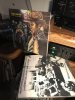
00C05CE9-7118-43C5-AAF9-D56585B5D09D.jpeg

That little EQ peeking out from under the tuner and amp on top does both L&R channels with one set of sliders. I prefer the simplicity. It’s for tone control. Room adjustments not so much. Very low THD. It’s been recapped FYI.

Very handy to tweak the the sound with just the slightest nudge hear & there.

I have another system that runs nearly always on Tone Defeat.

And one other, where I use it’s myriad of tone controls all the time.

As another member has stated in their signature, “ If it sounds good, it’s good.”
 
It is a known fact that some people find the shortest signal path is the best for sound quality.
After that a sound, being transformed into the electrical signal in the microphone, having passed through microphone amplifiers (and for low level sound sources, also through a microphone transformer), then through line amplifiers, audio mixing consoles with their stereo panorama controls, phase shifters et stereo balance controls, filters (high-pass, low-pass, “presence”, “voice filters” etc.), studio equalizers, dozens of DACs and ADCs elements, then through electromagnetic transformers in tape recorder heads, electrical frequency response correction circuits in recording amps, then through electromagnetic transformers in tape recorder heads, electrical frequency response correction circuits in playback amps, then, in the case of vinyl records, through correction circuits forming the standard cutting characteristic for cutter heads, through transformation of the electrical signal into mechanical groove form by the cutter, then the reverse transformation of the mechanical groove form into modulation of the magnetic field by the stylus and the cantilever, then into electrical signal by the cartridge (after a MC type cartridge, also through a step-up transformer), the reverse correction circuits forming the standard playback characteristic for cartridges, then again elements and elements of DACs and ADCs, emphasizers and de-emphasizers…


But, after all this, adding an equalizer by a listener will “destroy the mythical “shortest signal path”?..

Are you serious?
 
Last edited:
After that a sound, being transformed into the electrical signal in the microphone, having passed through microphone amplifiers (and for low level sound sources, also through a microphone transformer), then through line amplifiers, audio mixing consoles with their stereo panorama controls, phase shifters et stereo balance controls, filters (high-pass, low-pass, “presence”, “voice filters” etc.), studio equalizers, dozens of DACs and ADCs elements, then through electromagnetic transformers in tape recorder heads, electrical frequency response correction circuits in recording amps, then through electromagnetic transformers in tape recorder heads, electrical frequency response correction circuits in playback amps, then, in the case of vinyl records, through correction circuits forming the standard cutting characteristic for cutter heads, through transformation of the electrical signal into mechanical groove form by the cutter, then the reverse transformation of the mechanical groove form into modulation of the magnetic field by the stylus and the cantilever, then into electrical signal by the cartridge (after a MC type cartridge, also through a step-up transformer), the reverse correction circuits forming the standard playback characteristic for cartridges, then again elements and elements of DACs and ADCs, emphasizers and de-emphasizers…


But, after all this, adding an equalizer by a listener will “destroy the mythical “shortest signal path”?..
You miss a lot when you only read the first sentence. Take the second sentence for example.
Whether or not it actually does produce the best sound quality, that is not a known fact, it's opinion.

Are you serious?
So yes, I am.
 
Last edited:
If I've learned anything here - and that's a mighty big if - it's that there are very few "known facts".
And some don't or chose not to learn known facts.
Not the way he put it. It is a known fact that some people find the shortest signal path is the best for sound quality. If you aren't aware of that, read some more.
Actually testing shows it's factual by reducing the noise floor.

I will most certainly agree when the application involves external analog equalizers attached via tape loops and more interconnects in the signal path.
Not to mention all the switches that are a pathway for inducing noise into the system
 
A long time ago I got a nice one. It came with a record with instructions and test tones. The idea was to make all the tones the same loudness. Equalizing - flat across the board. Hope this makes sense.
Anyway I didn't like the sound at all. Not used to it. So you see equalizers with bell curves which to me defeats the purpose. Mine is in a box in the garage.
 
While I go along with adjusting for a measured flat response in the low end, I prefer a 6dB/octave roll off above ~10KHz. Without the roll off flat sound to 20KHz is just to bright for me. I discovered this when I first started equalizing for flat in room response in the very early 80's. Back then I had a 12 band linear equalizer. I use a 12 band DSP now.
 
Back
Top Bottom