• The move to the new server is done. There are some software and database maintenance updates in process. This has us passing the hat around to help out. We appreciate any donations. Seriously, even a dollar helps. The payment page may be found here - https://www.audiokarma.org/support.html

H.H. Scott 222 making popping noise @ turn-off

playittwice

AK Subscriber
Subscriber
I have a Scott amp that makes a popping noise through the speakers when I turn it off. If I unplug it from the wall it does not make the popping sound. Could it be a dirty or bad power switch? Something DeOxit might fix or cure? Tube(s) going south? I don’t know as I’m fairly new to tube amps. Just guessing.


Thanks
 
Last edited:
Register to hide this ad
probably the switch arcing when it breaks the circuit. If there is a cap across the switch, change it. If there is no cap across the switch, try an 0.1uf cap in series with say a 100 ohm resistor located as close to the switch as you can get it. Should be a Y rated safety cap if possible but a 630v cap will serve for a test if thats what you have on hand.

or use one of these things, which is basically that in one handy package

QRL-Quencharc.pdf (paktron.com)
 
Thanks for the advice. The QRL component you listed appears to be a good option. Thanks.

Is there any harm being done using it as-is till I get it resolved? I’m guessing not, just annoying.
 
not really, makes noise, and its not wonderful for the switch itself but considering its probably been doing this for decades I wouldn't get too concerned.
 
I power my Scott on and off with a smart plug (“Alexa, turn First Plug on”). You could also use a power strip that has an on/off switch.
 
I power my Scott on and off with a smart plug (“Alexa, turn First Plug on”). You could also use a power strip that has an on/off switch.


Yep, this is what I started doing. So far, so good! (Power strip)
 
Last edited:
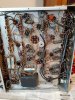
Hi, newbie here. Need help rebuild scott 222a. Where can i find a complete list of capacitors for recap. 4 Top can caps available at Hayseed Hamfest. Thanks
 

Attachments

  • BC2FB38F-2AF4-43CB-AA41-D77F6EA2EC72.jpeg
    BC2FB38F-2AF4-43CB-AA41-D77F6EA2EC72.jpeg
    182.4 KB · Views: 12
Most guys leave the control panel ones alone, as well as the disc and other little molded-looking ones. I think I count 14 of the tubular Imperial caps that all look to have their values clearly marked; I would make a list of and order replacements for those. Would also replace any caps that may be attached to/across the power cord where it comes into the unit with modern X1/Y2 safety caps, and consider adding a CL-80 thermistor there as well, which will drop the voltage slightly and get you a little closer to what was coming out of the wall in the late 1950’s.
 
Most guys leave the control panel ones alone, as well as the disc and other little molded-looking ones. I think I count 14 of the tubular Imperial caps that all look to have their values clearly marked; I would make a list of and order replacements for those. Would also replace any caps that may be attached to/across the power cord where it comes into the unit with modern X1/Y2 safety caps, and consider adding a CL-80 thermistor there as well, which will drop the voltage slightly and get you a little closer to what was coming out of the wall in the late 1950’s.
Thank you very much! Where would you recommend i order the parts? First time to recap. Trying to learn as much as ican thanks
 
I've mostly used mouser and some folks use digikey. Both are great and will likely have what you need. I've also found a local electronics shop with decent supply of parts when I forget something and don't want to pay 10 times the part cost in shipping.

-Steve

**Is that your bug in your avatar? great color!
 
Besides those two, you could look at tubesandmore.com , justradios.com , parts-express.com , arrow.com , Newark.com . . . I would go with whichever one that can supply all the ones you need in one shipment. Search for film capacitors, metallized polyester or polypropylene. Be aware that modern ones rated at 630 volts are likely to have bodies no larger than the vintage 400 volt ones, so if your supplier is out of stock on a value in the 400 volt line, you can substitute a 630 volt rated one without having a fitment issue. Also be aware that you may need to substitute caps made in modern standard values such as .047 or .022 for vintage values such as .05 or .02.
 
I've mostly used mouser and some folks use digikey. Both are great and will likely have what you need. I've also found a local electronics shop with decent supply of parts when I forget something and don't want to pay 10 times the part cost in shipping.

-Steve

**Is that your bug in your avatar? great color!
No ,Wish it was. Found pic on the web. Thanks
 
Besides those two, you could look at tubesandmore.com , justradios.com , parts-express.com , arrow.com , Newark.com . . . I would go with whichever one that can supply all the ones you need in one shipment. Search for film capacitors, metallized polyester or polypropylene. Be aware that modern ones rated at 630 volts are likely to have bodies no larger than the vintage 400 volt ones, so if your supplier is out of stock on a value in the 400 volt line, you can substitute a 630 volt rated one without having a fitment issue. Also be aware that you may need to substitute caps made in modern standard values such as .047 or .022 for vintage values such as .05 or .02.
Thank you
 
Besides those two, you could look at tubesandmore.com , justradios.com , parts-express.com , arrow.com , Newark.com . . . I would go with whichever one that can supply all the ones you need in one shipment. Search for film capacitors, metallized polyester or polypropylene. Be aware that modern ones rated at 630 volts are likely to have bodies no larger than the vintage 400 volt ones, so if your supplier is out of stock on a value in the 400 volt line, you can substitute a 630 volt rated one without having a fitment issue. Also be aware that you may need to substitute caps made in modern standard values such as .047 or .022 for vintage values such as .05 or .02.
Sorry newbie here .047 or .022 modern standard value capacitors substitute. 05 or .02?
 
The old caps were slightly different values. 0.05 microfarad would be replaced with an 0.047 now. Symbols also changed. Used to be mfd but its now uf with the funny u I can't make on my phone. Greek letter mu. Mmfd is micro microfarad but now we use picrofarad or pf. Same thing different decades.

Might also see a modern cap marked 473. That's 47 and 3 zeros in picrofarad so 47000. Becomes 47 nanofarad or 0.047 microfarad.
 
The old caps were slightly different values. 0.05 microfarad would be replaced with an 0.047 now. Symbols also changed. Used to be mfd but its now uf with the funny u I can't make on my phone. Greek letter mu. Mmfd is micro microfarad but now we use picrofarad or pf. Same thing different decades.

Might also see a modern cap marked 473. That's 47 and 3 zeros in picrofarad so 47000. Becomes 47 nanofarad or 0.047 microfarad.
Thank you very much! i have a lot of things to learn. Thanks again for your valuable advice. Downloaded the schematic learning little by little how to understand it. Symbols and other stuffs. Fun hobby!
 
There are also some old schematic conventions that may or may not be spelled out, its one of those assumed knowledge things.
Typically, values in whole numbers will be picofarad unless otherwise noted
values in decimal are microfarad
resistors are 1/2 watt unless otherwise noted
voltages are 15% or so tolerance
DC voltages normally read to chassis ground, and originally most were taken with a high impedance vacuum tube voltmeter (VTVM). A modern digital is a functionally equivalent device.

SAMS schematics are pretty good about having notations on them with all that spelled out, most of the manufacturer schematics skip it.

Old part tolerances tend to be fairly wide too, electrolytic caps might be -20 / +80%, paper caps are typically 20%, most of the resistors are 10%. Modern parts are much tighter, and using a tighter tolerance part to replace an old one won't bother anything.

 
Thank you very much! i have a lot of things to learn. Thanks again for your valuable advice. Downloaded the schematic learning little by little how to understand it. Symbols and other stuffs. Fun hobby!

If you don't have any experience working with 400V to 500V circuits, I'd suggest you search this forum for threads about safety tips before venturing inside the chassis.
 
There are also some old schematic conventions that may or may not be spelled out, its one of those assumed knowledge things.
Typically, values in whole numbers will be picofarad unless otherwise noted
values in decimal are microfarad
resistors are 1/2 watt unless otherwise noted
voltages are 15% or so tolerance
DC voltages normally read to chassis ground, and originally most were taken with a high impedance vacuum tube voltmeter (VTVM). A modern digital is a functionally equivalent device.

SAMS schematics are pretty good about having notations on them with all that spelled out, most of the manufacturer schematics skip it.

Old part tolerances tend to be fairly wide too, electrolytic caps might be -20 / +80%, paper caps are typically 20%, most of the resistors are 10%. Modern parts are much tighter, and using a tighter tolerance part to replace an old one won't bother anything.
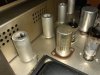
Thank you. im in the mid 50's better late than never to learn. Thanks for sharing your knowledge and experience. Here's a photo of one of the can caps. 1950's
 
If you don't have any experience working with 400V to 500V circuits, I'd suggest you search this forum for threads about safety tips before venturing inside the chassis.
Yes, thank you for your advice. im i the process of chosing the right tools, various equipments like variacs. Reading threads and videos.
 

Attachments

  • 20220315_234932.jpg
    20220315_234932.jpg
    87.2 KB · Views: 9
Back
Top Bottom