Hello Everybody!
Exxtreeemely long time lurker here
Very quickly, let me introduce introduce myself.
I've been lurking on here for years, and I've gleaned so much valuable information from you guys and gals!
I just want to say thank you for the absolute treasure trove of valuable information that this community has provided for me.
You've all helped me truly understand audio.
Very much, thank you for this.
Okay... on to my question.
I found a great deal on a Hafler DH-220 that the owner said was modified by Musical Concepts.
As I was loading up the amp, the owner said.. "Hey don't forget the external Power Supply!"
(I had no idea Musical Concepts even offered this mod).
Of course the second I got home I had to open it up and see what was inside.
I need some help trying to figure out what's actually going on here. If I plug this thing in, is it going to send sparks shooting out of every outlet in my house??
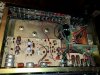
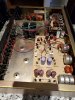
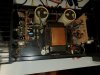
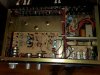
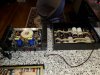
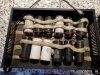
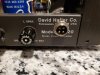
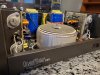
When I opened up this alleged "external power supply" it just turned out to be what looks like a giant bank of recycled filter caps that connects through an extra jack that was installed on the back of the amp
Even if all of these capacitors are good, is this an advantageous mod?
I've never seen anything like this before.
I would think the in-rush current would be enough to blow things up (let alone trip my breakers).
Honestly though, I really don't have a clue.
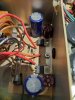
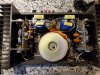
The actual amp does appear to have upgraded caps and a toroidal power transformer.
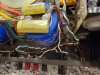
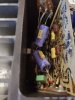
But there also seems to be extra yellow caps everywhere.
I'm still growing my understanding of amplifier design.
But from what you can see, does this look good or bad? Are those yellow caps considered "bypass caps"?
What is the actual benefit of doing this?
I also have the corresponding DH-101 Preamp (which appears to have capacitor mods as well).
I still own my completely "stock" DH-200 and DH-101. I'll include pictures of both.
I didn't have an opportunity to listen it before the purchase (the owner did mention that everything was fully functional though).
Do you think these mods will offer any sonic improvements, or changes I should be listening for?
Thank you for reading my very long first post.
Any input/opinions are appreciated.
Thanx in advance everyone
Exxtreeemely long time lurker here
Very quickly, let me introduce introduce myself.
I've been lurking on here for years, and I've gleaned so much valuable information from you guys and gals!
I just want to say thank you for the absolute treasure trove of valuable information that this community has provided for me.
You've all helped me truly understand audio.
Very much, thank you for this.
Okay... on to my question.
I found a great deal on a Hafler DH-220 that the owner said was modified by Musical Concepts.
As I was loading up the amp, the owner said.. "Hey don't forget the external Power Supply!"
(I had no idea Musical Concepts even offered this mod).
Of course the second I got home I had to open it up and see what was inside.
I need some help trying to figure out what's actually going on here. If I plug this thing in, is it going to send sparks shooting out of every outlet in my house??
When I opened up this alleged "external power supply" it just turned out to be what looks like a giant bank of recycled filter caps that connects through an extra jack that was installed on the back of the amp
Even if all of these capacitors are good, is this an advantageous mod?
I've never seen anything like this before.
I would think the in-rush current would be enough to blow things up (let alone trip my breakers).
Honestly though, I really don't have a clue.
The actual amp does appear to have upgraded caps and a toroidal power transformer.
But there also seems to be extra yellow caps everywhere.
I'm still growing my understanding of amplifier design.
But from what you can see, does this look good or bad? Are those yellow caps considered "bypass caps"?
What is the actual benefit of doing this?
I also have the corresponding DH-101 Preamp (which appears to have capacitor mods as well).
I still own my completely "stock" DH-200 and DH-101. I'll include pictures of both.
I didn't have an opportunity to listen it before the purchase (the owner did mention that everything was fully functional though).
Do you think these mods will offer any sonic improvements, or changes I should be listening for?
Thank you for reading my very long first post.
Any input/opinions are appreciated.
Thanx in advance everyone
Attachments
-
 20210729_195028.jpg168.6 KB · Views: 114
 -
 20210729_194700.jpg149.3 KB · Views: 110
 -
 20210729_195001.jpg149.4 KB · Views: 106
 -
 20210729_194637.jpg107.8 KB · Views: 110
 -
 20210729_194621.jpg101.3 KB · Views: 98
 -
 20210729_194742.jpg113.7 KB · Views: 104
 -
 20210729_194322.jpg167.4 KB · Views: 104
 -
 20210729_194455.jpg86.3 KB · Views: 98
 -
 20210729_194423.jpg101.2 KB · Views: 100
 -
 20210729_194517.jpg143.1 KB · Views: 109