• Please note that Audiokarma will be offline briefly for updates early on Monday morning, September 28th.

Hanging Open Baffle Speaker

Lou F Quincy

Super Member
I can't seem to find very much information on the web about Open Baffle speakers being hung from the ceiling and was wondering if anybody here has any experience with this practice. My space is limited, and have too much cool stuff (crap) to place another pair of speakers, and their wires, on the floor.
Mr. Linkwitz mentions the option briefly but I didn't see any definitive explanation beyond placing driver at ear level and recommended spacing from walls, which I'll have to fudge due to narrow room featuring 7 foot flat ceiling, 5 foot kneewall and quartered sloping ceiling. It's sort of a long, chamfered box.

A pair of 3 1/2" Dayton full range drivers will be used for a twin mono Hoffman tube amp (12 watts each) setup and/or Sony TC500 tube reel to reel.

Thanks, Lou Fred Quincy
 
Last edited:
Register to hide this ad
Perhaps I should move this question to the theoretical placement of this hanging open baffle.
dog-eared fence (2)_LI.jpg
Long, dog-eared room, roughly 10'w X 20'L . (I am no DaVinci , obviously)

Since more bass is developed by getting nearer to floors, would the inverse, i.e. ceiling/wall do the same?
I suspect with this image I'll have to place some deadening fabric along the vicinity.
If I move them inward, as I suspect they should be, it gets placement closer to general recommendations I've found.
Where would you place the driver within the baffle?
Should the baffle have a modified shape?

I'm pretty sure when I do this i'm going to make it a mobile attachment so I can play with variations. Science !
 
So when I think about this, I imagine that hanging open baffle speakers will suffer by the cone movement making the baffle sway front to back, canceling out lower frequency waves, at least partially. This would happen with boxes, too, but to a much lesser extent. Am I just theorizing or would this be a thing?
 
Not an acoustical engineer, but if I were to imagine the ideal den (man cave), which has a killer hifi, in addition to a bunch of other toys, this room would be a good start.
 
I am sorry to report that I never built this setup. The responses I got from my original post... 3+ years ago... kinda persuaded me not to pursue it as I figured it must not be even considered as a worthy endeavor.
It still intrigues me though and wouldn't require much effort.
I ended up being very satisfied with a Nikko Alpha III mosfet firing upgraded crossover JBL L100's with the twin mono Hoffman tube amp firing Design Acoustics PS10's. (A tri amp?)
If I do an Open Baffle I'll be sure to give the results.
(Been working out of town for awhile... away from my hobby stuff.)
 
I've experimented with hanging OB speakers in a closet which performed far better than box speakers in the same closet. If they worked hanging in a closet an open area should be even better. The only reason I tried the closet set up was because the wife so ordered that all gear in that room must be out of sight.

P1010003 2.jpeg
 
Both above layouts interesting. After I mount a pair of sealed speakers overhead, between open ceiling joists, I'll be thinking of temporarily converting them to OB to see what happens.
 
There seem to be different approaches to mounting a speaker to a board, whether it's a large board, small board, in a box, etc., and pluses and minuses.

If one assumes that a dynamic speaker is a generator that moves the air, while the vibrating part is mounted to a non-vibrating part (ideally). In a conical diaphragm speaker, the speaker basket is assumed rigid while the cone is moved relative to that. When the driver is mounted to a board, the board adds to the mass, but also could vibrate in response to the moving mass of the cone.

So one approach is to decouple the basket from the board and use the inertia of the magnet as the non-moving part assumption. With a hanging open baffle, there is little board mass, and it's essentially a driver hanging in mid-air. The magnet will have to be massive to have enough inertia to keep still when pushing the cone. If not, the open baffle is essentially a cone's sound being inter-modulated by the dynamic resonance of the magnet-cone-suspension system.
 
There seem to be different approaches to mounting a speaker to a board, whether it's a large board, small board, in a box, etc., and pluses and minuses.

If one assumes that a dynamic speaker is a generator that moves the air, while the vibrating part is mounted to a non-vibrating part (ideally). In a conical diaphragm speaker, the speaker basket is assumed rigid while the cone is moved relative to that. When the driver is mounted to a board, the board adds to the mass, but also could vibrate in response to the moving mass of the cone.

So one approach is to decouple the basket from the board and use the inertia of the magnet as the non-moving part assumption. With a hanging open baffle, there is little board mass, and it's essentially a driver hanging in mid-air. The magnet will have to be massive to have enough inertia to keep still when pushing the cone. If not, the open baffle is essentially a cone's sound being inter-modulated by the dynamic resonance of the magnet-cone-suspension system.

Drivers designed for open baffle use which move lots of air in free space usually have most or all of the following characteristics: wide band, above .7 Qts, looser suspension, cones of lightweight material, high efficiency and smaller motors. A proper OB driver should not vibrate the baffle and if there's resonance it's not audible unless played at extreme SPL's. A conventional driver with a tight suspension depends on air in the box to act as a spring and consequently is a poor choice for open baffles.
 
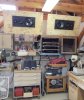
I have a hanging OB experiment ongoing, initially mentioned in a sister thread, "Open Baffle Epiphany," post #4882. I'll move future updates to my stuff to this thread.My setup is in a crowded workshop corner, hung from timber ceiling joists open to the sloping roof. Far from ideal.

Update to the photo below: the 4' x 8' open space above and behind the speakers has been closed by 7/16"x4'x8' plywood simply laid on top. The Sony 3-way speakers (with backs cut off), and their dirty scrap ¼" ply OB's, will soon be replaced by two ¾"x2'x3' pine panels and a pair of Wild Burro Betsy's. BTW, when that plywood sheet was placed on top of the joists, the sound improved dramatically, maybe even "epiphany" class. Before I cut into the nice new pine panels, I'll mount the Betsy's on like-size cardboard OBs to experiment with placement. I'm also going to try a couple of cardboard wings, maybe 6"x2', on the far left and far right ends of the OBs
 

Attachments

  • DSCN4212.jpeg
    DSCN4212.jpeg
    134.6 KB · Views: 27
Last edited:
Drivers designed for open baffle use which move lots of air in free space usually have most or all of the following characteristics: wide band, above .7 Qts, looser suspension, cones of lightweight material, high efficiency and smaller motors. A proper OB driver should not vibrate the baffle and if there's resonance it's not audible unless played at extreme SPL's. A conventional driver with a tight suspension depends on air in the box to act as a spring and consequently is a poor choice for open baffles.
I was trying to indicate that any dynamic speaker tries to make the voice coil and cone assembly the only moving part, while the rest of the driver (basket, magnet) and enclosure does not move. In an open baffle speaker, a moving cone generates an equal and opposite force on the baffle (what little there is of one). When the cone moves forward, the magnet/baffle/basket moves backward, if the driver is hanging from a ceiling.

As for the resonance, it depends on the magnitude of the peak resonance and frequency where it occurs for audibility. My point was not resonance audibility, but that a mechanical resonance exists, and therefore question whether the hanging open-baffle system has a larger absolute motion of the magnet/baffle/basket than a conventional speaker with a more rigidly held basket/baffle/magnet, say in an enclosure.
 
I was trying to indicate that any dynamic speaker tries to make the voice coil and cone assembly the only moving part, while the rest of the driver (basket, magnet) and enclosure does not move. In an open baffle speaker, a moving cone generates an equal and opposite force on the baffle (what little there is of one). When the cone moves forward, the magnet/baffle/basket moves backward, if the driver is hanging from a ceiling.

As for the resonance, it depends on the magnitude of the peak resonance and frequency where it occurs for audibility. My point was not resonance audibility, but that a mechanical resonance exists, and therefore question whether the hanging open-baffle system has a larger absolute motion of the magnet/baffle/basket than a conventional speaker with a more rigidly held basket/baffle/magnet, say in an enclosure.

It's easy to over think open baffles and just as easy to experiment with building a pair.
 
Back
Top Bottom