• The move to the new server is done. There are some software and database maintenance updates in process. This has us passing the hat around to help out. We appreciate any donations. Seriously, even a dollar helps. The payment page may be found here - https://www.audiokarma.org/support.html

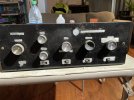
Harman Kardon A30k. Ihave no idea where to start! Actually I do have an idea, this post is it!

Tonedeftup

New Member
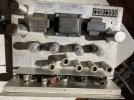
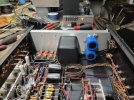
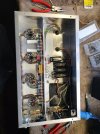
Hey there Community, I have been stalking the forums here for some time. Just made my acct and this is my first post. I just acquired this hk tube amp. It was sitting in a garage cupboard for an indefinite amount of time , likely years, maybe decades. Now what do I do? I know very little about electronics, but have a back ground in high voltage construction. I have a far better than average understanding of electricity, capacitors, transformers, load, resistance, voltage and watts. Classroom time and practical, but larger in scale, think substations and power poles. I definitely do not have a journeyman electricians understanding, but could have a conversation with one and keep up. I’m guessing some you tube videos and some reading is where I should start?! Any guidance y’all could bestow on me is greatly appreciated.
Cheers,
Cyrus
PS, is this thing worth diving into? for the knowledge if nothing else?
 

Attachments

  • IMG_3222.jpeg
    IMG_3222.jpeg
    123.4 KB · Views: 69
  • IMG_3224.jpeg
    IMG_3224.jpeg
    139.5 KB · Views: 68
  • IMG_3228.jpeg
    IMG_3228.jpeg
    207.1 KB · Views: 71
Register to hide this ad
Recap it before ever powering up. Or at least power up using a dim bulb tester.
 
It's thew
What’s a sticky?

They're the major threads at the beginning of the forum that are frequently referenced. They have a little push-pin symbol next to them. There's one called "Vintage Tube Gear Care" that's a good place to start.

If you search for the amp model on AK, you'll find a numbert of restoration threads with good advice.

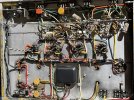
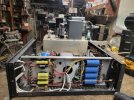
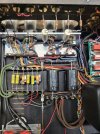
In this case, that's a nice find, despite the butchering of the face plate. These are very desireable little integrated amps and sound lovely. You'll want to find a schematic online, which is not hard to do. The three tall electrolytic can capacitors will need to be replaced, they're going to be dried out and could easily fail. The one that is covered with paper is probably floating a couple hundred votes above ground and will need to be replaced with a similarly insulated can. Alternatively, you can disconnect the existing cans and substitute modern, compact radial caps on a tag strip. It looks like there's plenty of room to do that.

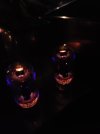
It's also a good idea to replace all the white, wax-coated coupling capacitors underneath. Resistors should be checked with an ohmmeter for drift and replaced if necessary. Clean all switches with DeOxit. Be careful with that orange, rectangular, wafer-like thing in the upper left corner of the underneath photo, it's a compound unit of caps and resistors and it's difficult to replace. Test the tubes and replace the worn ones. Apart from the stupid paint job, it should clean up nicely.
 
Is the faceplate just spray painted with crappy masking where the labels are? If so you might be able to re-mask that and shoot it with some Brakleen. I've had pretty good (or bad, depending on the goal) results with spray paint melting away when exposed to that.
 
That unit is definitely worth diving into in order to learn the ins and outs of tube amplifier repair.
It's really actually perfect for that, because it's already cosmetically challenged, you can go nuts on it. Make your mistakes, learn how to get them to play music again and get the confidence that comes with knowing how to fix things. My first build was an old bogen in about the same shape, got it about 10 or 12 years ago at a flea market. It was in really similar condition and a really similar amplifier in terms of topology and power.
Mine came without tubes...
It served it's purpose which was to develop my confidence. I've moved on from that amplifier, I still have it, but the satisfaction of fixing it got me a bit of an addiction started, and I've been climbing the tube audio food chain ever since, and these days I do a lot of my own custom work. Here are some photos of that.
One of my custom RIAA preamps and the others are part of a set of 4x monoblocks.
All scratchbuilt in my garage.

20231108_061955.jpg20231108_061949.jpg20231108_061942.jpg20231108_061936.jpg20231108_061932.jpg20231108_061925.jpg20231113_070155.jpg20231126_173412.jpg20231125_153435.jpg
 
Whoever built the kit did an excellent job, better than my factory-built A300.

If you Google "Harman Kardon A300, Audiokarma" you will find lots of good links.
Or substitute "A30K"

Should be enough information there to get your amp going.

I have better luck with Google than the AK search function.

Just my opinion.

As mentioned, it is imperative that you at least replace the coupling caps.
Whoever restored mine replaced the filter caps but left the original coupling caps (I think that they were black beauties) to "retain that sound".
"That sound" eventually took out an output tube and luckily, not an output transformer.

While I was in there, I obviously replaced the coupling caps but replaced any out of spec resistors, too.

As also suggested, good idea to replace the filter caps.
Other members more knowledgeable than me can address any questions not covered in the links.

Best of luck with your find!
 
Is the faceplate just spray painted with crappy masking where the labels are? If so you might be able to re-mask that and shoot it with some Brakleen. I've had pretty good (or bad, depending on the goal) results with spray paint melting away when exposed to that.
No sir, it appears as though we thought it would look nice to scrape it with a razor blade! LoL
 
Back
Top Bottom