• The move to the new server is done. There are some software and database maintenance updates in process. This has us passing the hat around to help out. We appreciate any donations. Seriously, even a dollar helps. The payment page may be found here - https://www.audiokarma.org/support.html

Harman Kardon Citation V Performance

TriodeLuvr

So many electrons, so little time!
Subscriber
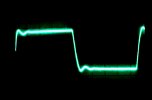
I recently decided to part ways with the wonderful Citation V that I rebuilt not long ago. It's a superb amplifier, but my audio system is slowly evolving with amplification equipment of my own design and construction. The Citation was on the bench to verify performance, and I am truly impressed. For those of you who are into this sort of thing, the two photos below show the amplifier's 10 kHz square wave performance with and without the NFB loop. Feedback is 19.5 dB. These plots are a testament to the extremely high quality of the output transformers HK used in these amplifiers. The ringing shown without feedback occurs at a frequency of 235 kHz. This extremely high resonant frequency results in stabilization components (step network and phase advance capacitor) that are much less invasive than in lesser quality amplifiers. This is how HK achieved the amplifier's incredible 1W frequency response (-1 dB @ 80kHz). It's really a marvel of engineering, and all this was done 60 years ago!

HK Citation V wo NFB.JPG


HK Citation V w NFB.JPG

Jack
 
Register to hide this ad
That is interesting Jack. I took the opposite approach...I designed/built many home brew amps earlier on in my tube amplification journey, and now I'm to the point where I kind of want some good examples of the best the industry had to offer in the vintage era spanning about 1950 to 1968.

I started with a Heath W5-M, which I am still in the process of refurbishing. But I'd like to get a decent example of an early Fisher, perhaps something from their President line, and I was looking at a Citation V last night on the auction site. Vintage McIntosh is out of my price range, so a Citation and an MC275 or the like will have to wait.

Anyway, good luck with your journey! I sure have enjoyed your posts over the years.
 
Thanks @kward! In my case, most of my PP amps have used power transformers and OPTs salvaged from vintage hi-fi gear. Because of this, they perform really well, although not at the power level of the Cit V. Right now I'm listening to my version of an HK A700. I also still have a 6V6 SEP at about 4W/ch that I use only for headphones, and two 211 A2 monoblocks. Honestly, I have more than enough amplifiers now, and that doesn't include future builds I've already acquired the parts to build or the many phono preamps, line stages and other fun small-signal projects I want to pursue. Thanks for your comments and good luck building out your system!

Jack
 
Hi TriodL , did you do a post on HK Cit5 rebuild?. I would be very interested in following what you did as I have a still stock unit awaiting some inspirational motivation. cheers.
 
Amplifiers and cars...both are there to be used, but it is quite entertaining to go building/restoring new ones.

With using vintage amps as the starting point, selecting ones like the CIT V gives you fine iron to build around. Stuff like a Scott 296 or a Heathkit W6, and of course the Citation II are all good. And the 16458 OPT in the W5, or the 32007 in the Eico HF50 and...and the list continues with the top-shelf DIY stuff like the 8000-series of OPT from Stancor, or the 20-20 and 20-20Plus from Peerless, and...

Good power supplies are relatively straightforward as long as we're up to carrying them. Mono amps are the order of the day, likely with divorced power supply chassis...

Douglas
 
Hi TriodL , did you do a post on HK Cit5 rebuild?. I would be very interested in following what you did as I have a still stock unit awaiting some inspirational motivation. cheers.
I should be photographing the interior of the amplifier later today. I'll post photos here and also describe the work.

Jack
 
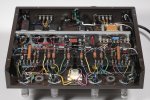
Here’s a summary of the work I performed on the Citation V, also a few photos.

1. All the internal wiring including the input coax was sticky and “greening.” This was the result of the amplifier being made in an era in which a lot of PVC insulated wire was manufactured with a defective plasticiser. I stripped it all out and replaced it with new high quality wire from AES.

2. I replaced all the tube sockets with exact-fit NOS. This made the wiring job somewhat easier, because I didn’t have to remove the wires from the sockets. I just removed the sockets with the wires attached and tossed it all in the trash.

3. I installed a 3-wire line cord for safety. The green earth ground wire is soldered to the chassis at the rear.

4. The 3.3Ω output tube cathode resistors had all drifted off value. I replaced them with 1% parts.

5. I installed Jim McShane’s power supply kit, including the optional screen choke.

6. I added a short ground bus on the power supply bracket to act as a star ground. I insulated this from the chassis to eliminate the possibility of creating a ground loop with other equipment. No grounds are connected to the chassis except the green AC earth wire.

7. The plastic cover on the rear of the Balance meter was missing. I made measurements and cut a new one from .020” FR4 using a CNC mill.

8. I replaced the aging NFB phase advance caps with 68pF silver mica, and I replaced the 220pF caps in the step networks with 240pF polystyrene.

9. I installed a 270Ω stopper at each output tube screen.

10. I replaced all the coupling caps with new parts that I had on hand (Jim McShane also sells these in a kit). I increased the value of the screen bypass caps at V1 and V5 from 0.47uf to 1uF (suggested by Jim McShane).

11. A previous owner had removed the 1Ω filament resistors and terminal strips at V1 and V5. I installed original type terminal strips and new resistors.

12. The Citation V has a DC balance adjustment, but no adjustment for overall bias current. I selected a value for R50 in the power supply to set the output tubes at approximately 44mA to 45mA each. B+ in this amplifier is approximately +480V, so the tubes idle at roughly 22W dissipation, including screens. Each screen draws about 1.2mA at idle based on the voltage measured across the stoppers.

13. I installed NOS driver tubes and a matched quad of 6P3S-E outputs. After DC balance was set at both channels, I adjusted AC balance using a spectrum analyzer. The Citation V also has a procedure in the owner’s manual for accomplishing this without the need for special equipment.

I think that’s about it. It’s a truly excellent amplifier, and I consider it one of the best ever made. Hope this information is helpful in your work.

Jack

IMG_2337.jpg
IMG_2331.jpg
 
Last edited:
Audio quality is excellent. It's very detailed and open, and it delivers massive low-end punch when it's called for. You just can't lose with transformers like these and the huge power supply caps provided by Jim McShane.

Jack
 
Audio quality is excellent. It's very detailed and open, and it delivers massive low-end punch when it's called for. You just can't lose with transformers like these and the huge power supply caps provided by Jim McShane.

Jack
Is Jim still supporting Citation amps?
 
I agree on the V, I actually prefer it over the II. The II is more impressive looking though.
Same here, but then I'm not a fan of most UL amps. The Dynaco ST-35 is maybe the only exception. I performed factory authorized service for Dynaco in the '70s and '80s, and I've always liked the sound of that unit. It's just bad luck that I don't own one.

Jack
 
Good looking amp Jack. Nice work.

Similar to Jack, I have designed solid state amps and built replica tube amps, such as the Eico HF-87 and Wiliamson UL amps and built SE amps using 2A3, 300B and 211 to see what all the glory was with those tubes.

My metric for the HF-87 and Williamson UL amps are a comparison to solid state amps. I have a fondness for old Phase Linear amps mainly the 400/700 models. I convert the output stage to full complementary and I have designed a new driver circuit that is more of a modern design (higher slew rate, more bandwidth, etc) than the early 70's design.

With the exception of some low bass detail, mainly due to output impedance/damping factor, the HF87 and Williamson UL amps sound just a good as their solid state counter parts. I also have an Adcom GFA-555 for another reference as well as some AB International 400/600 amp models.

Fun stuff.
 
the work looks fantastic—tight, tidy. what a labor to strip this down to the studs, so to speak. its quite beautiful.
Thanks! I bought this on the big auction site and put it on the shelf for a couple years before starting the work. Even though it was sold as unrestored, I hadn't anticipated the need to strip everything out. That was a lot of extra work, and I'm just glad I didn't buy one of those overpriced "fully restored" Citations that still need this done.

Here's one quote from an online source about all this (I've posted this before, here on AK). This is why it's so important to remove all the defective wiring:

"... between 1965 to 1971, the company that manufactured and supplied cables ... were utilising di-isoctyl phthalate as a plasticiser. In the long-term di-isoctyl phthalate breaks down releasing hydrochloric acid from the PVC insulation. This acid attacks the copper conductor to form copper chloride (the blue green verdigris). ... Further, the hydrochoric acid fumes will eat into and stain the steel chassis, ... corrode and damage ... potentiometers and other nearby metalwork, such as the aluminium housing of an electrolytic capacitor. The acid also catalyses further degradation of the PVC insulation. This releases even more fumes until the whole process runs away with itself creating a great deal of unsightly collateral damage, some of which is effectively irreparable because it's so prohibitively expensive to put right. "

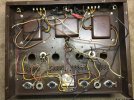
Below is a cell phone photo of the chassis that I took during the work. The new 9-pin sockets have been installed, and the remaining wiring is about to be removed. Note the piece of tape over the back of the meter to keep dust out. LOL.

Jack

Citation V gutted sm.JPG
 
You are running the 6p3s-e tubes at 45 mA and 480v b+? Sounds on the high end for the max dissipation spec but ive been gathering evidence that they can be run higher than that safely. Mine are currently around 35-38 mA @ 475v plate to cathode on my citation v.
 
You are running the 6p3s-e tubes at 45 mA and 480v b+? Sounds on the high end for the max dissipation spec but ive been gathering evidence that they can be run higher than that safely. Mine are currently around 35-38 mA @ 475v plate to cathode on my citation v.
The 6P3S-E can run continuously at 25W dissipation. HV in the Cit V varies from about 470V to 480V on the line voltage in my area, so 45mA is about 22W total dissipation (anodes plus screens). The tubes have been trouble free under these conditions. Nothing wrong with a somewhat colder bias if you're more comfortable with that.

Jack
 
Excellent, i am going to experiment with raising the bias. I just need to swap in a new pot. The current one installed by a previous tech is a ticking time bomb. Breathe on it and the bias changes drastically. This is a truly wonderful amp though with the popular updates and refurbishment. Its very transparent with extended and natural high frequency response that’s rare in the tube world. Transparent in this case doesn’t mean sterile; there’s plenty of tube magic to be found.

Thankfully i don’t have the wire problem in my unit yet but ill agree, changing the tube sockets are a must. Either they just happen to get worn out commonly or they weren’t the highest quality parts in the kit.
You might want to double-check the wiring when you open it up. Even if it isn't visibly greening at the ends, it might be sticky. that's the other symptom that it's decomposing. I even had to replace the shielded cable connected to the input jacks because of this. I'll add that I have several other HK amps and tuners from that era with this same issue.

Lucky you, having a bias pot! I have to change a resistor in the bias supply to set it. Not really a problem considering the output tubes will probably outlive me, but it would have been convenient. :)

Jack
 
Back
Top Bottom