• The move to the new server is done. There are some software and database maintenance updates in process. This has us passing the hat around to help out. We appreciate any donations. Seriously, even a dollar helps. The payment page may be found here - https://www.audiokarma.org/support.html

Harman/Kardon HK6500 - hum, jumpy DC offset in Lch

The "proper" leakage test is to connect a 1500 Ω resistor and 0.15 µF capacitor in parallel. Connect that between the chassis and a known good ground. All other connections to the amplifier are to be disconnected except the line cord. The test is both orientations of the line cord (if not polarized) and power switch both on and off. Voltage across the RC combination is to be less than 0.35 V. If higher, there is excessive leakage. Without a 3 wire grounded cord, there will always be some leakage to the chassis. There will be capacitive coupling between the transformer primary and chassis.

The ground distribution is proper design practice. There is a hierarchy of ground connections, starting with the main filter capacitors and working out. The signal ground is last in the chain. There is to be only ONE connection to the chassis. If the line cord is also connected to the chassis, there is a way of doing that which isolates the internal ground from the safety ground. The link to proper grounding of a power amp is in post #7. This generally agrees with info from Douglas Self and Bob Cordell in their power amplifier books.
I've gone through that presentation. So i could try connecting the chassis to mains earth? They also say only 1 connection to chassis, the phono board in my amp has 2 and then there is the main one coming from the amp itself.
 
Are the phono board chassis connections simply RF suppression capacitors from the ground side of the input jacks or are they actually part of the circuit? Also, are there ground lifting resistors (less than 10 Ω) to those connections?
 
Are the phono board chassis connections simply RF suppression capacitors from the ground side of the input jacks or are they actually part of the circuit? Also, are there ground lifting resistors (less than 10 Ω) to those connections?
Looks like RF supression caps to me.
One is 10nF, second one is 22nF
No ground lifting Rs as far as i can see.
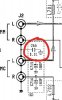
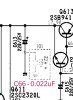
Screenshot_20190221-073419__01.jpg Screenshot_20190221-073602__01.jpg
 
Sooo, i tried something, without the source on my barebones config, if i touch the amplifier chassis the hum gets quieter. What does that mean?
 
Interesting. Usually, hum would get louder in this situation when you touch the chassis because you are an antenna picking up hum from everything around you. Nothing to lose by connecting a wire from chassis ground to earth ground and testing.
 
Interesting. Usually, hum would get louder in this situation when you touch the chassis because you are an antenna picking up hum from everything around you. Nothing to lose by connecting a wire from chassis ground to earth ground and testing.
Without source, the hum is reduced by connecting the chassis to mains earth. With source, when most of the hum is reduced already, connecting to mains earth introduces noise that is kinda similiar to 56K modem dialing.
 
As Dave Letterman once said, after a really lame joke, "It's official folks. We are out of ideas."
I gave it some more thought and research, turns out that even modern film caps have outside foil which should be connected to ground otherwise the cap can pick up hum and interference. I will pull out the ones i put there and mark the outer foils so i can install them for lowest noise.
The other thing is that i'm running my DAC from USB, the ground pin of USB is connected to mains earth inside the computer.
Maybe thats why the amp is already grounded when i have my source connected and extra lead to earth doesnt help/makes it worse.
 
I have not seen outside foil marked on a capacitor in 50 years. Outer foil, if marked, should go to the side with lowest impedance to ground. This is not necessarily the lowest DC voltage. For example, in tube units, the low impedance will be the plate of the previous tube rather than the grid of the next tube.

Another thing to try (maybe we are not quite out of ideas yet) is to disconnect the DAC/USB because we really don't know what the grounding situation is inside the computer.
 
The Idling current is 40mV, the idling current circuits were my previous headeache. 2 resistors that affect the adjustment range, R457 and R455, came reversed from factory. The 220 ohm one was in the place of 120 and vice versa. I put them according to the schematic and the idling current is still adjustable well. I will try to put them back to factory condition, i have not measured the temperatures in that state. Mostly the Rch idling was completely devastated but i managed to fix that and have no heating or DC issues there.
The hum is audible like 10cm (4in) from the speakers when its "loud". Barely audible from absolute point blank (pressing my ear against the grill) when it's "quiet".
Am not familiar of the sensitivity, theyre some vintage speakers.
The offset responds to the trimmer, but jumps up higher after some time anyway.

Hi Dave_k,
i have the same problem the R455 , R456 came reversed from factory with R457,R458. Do you swap them or just replace? I love this amp , appreciate any help!
 
If the resistors look OEM the I wouldn't be swapping them around. Service manuals are full of errors, also SM's are rarely updated
for late/in production changes
 
Hi Dave_k,
i have the same problem the R455 , R456 came reversed from factory with R457,R458. Do you swap them or just replace?Leave them be I love this amp , appreciate any help!
No.....Leave them as is. It is a typo in the schematic.
 
I have the german amp too. I checked every resistor and all of them are ok like in the SM. Its the same in the drawing.
@dave_k have you switch your amp to 240V? If not maybe thats the problem. Because in the 90s the germans had 220V and switch later to 240V.
 

Attachments

  • service .jpg
    service .jpg
    105.1 KB · Views: 4
There are resistors near the VR401 pot, R421 (1.8K) , R419 (33K) and VR402 pot R422 (1.8K) , R420 (33K) After change them, it runs like a charm. So now its time to sleep:boring:
 
Back
Top Bottom