• The move to the new server is done. There are some software and database maintenance updates in process. This has us passing the hat around to help out. We appreciate any donations. Seriously, even a dollar helps. The payment page may be found here - https://www.audiokarma.org/support.html

Harman Kardon HK930 simple and easy fuse question.

jellyfish182

New Member
I was going to replace the fuses in my HK930, there are a total of 3 and they are all rated at 3amp 250v. Are they all fast blow fuses? I read on a 330c post that the speaker fuses are always fast blow, I was just unsure in the AC line.

I have a few bucks to blow and wanted to hear for myself if using hi fi tuning fuses does ANYTHING to the sound. Just want to order the right ones. Thanks!
 
Register to hide this ad
Please save your money and don't buy "hifi" fuses. That really has got to be the most ridi ulous gimmicks I have ever seen.

*expects someone to come along and tell us how his gold plated fuses made his soundstage so much wider*
 
You are sure to get some various opinions on the subject. As with many things in the hobby, there is much conjecture regarding the effectiveness of such an "upgrade".

While I do believe in quality interconnects, power cables and speaker wire, there is a limit, at least in my own mind, of just how much of an improvement is gained. Beyond a certain level of required investment the would have to be some serious scientific proof and sadly, more times than not, there just isn't any.

I'm sure fuses will fall somewhere in that category. If the additional investment can be justified by a demonstrable improvement in quality of materials or construction, then they may be worth considering. If you expect to suddenly hear angels dancing on the head of a pin, you will likely be disappointed.

In the end, as long as the fuse blows before the device it is protecting burns down the house, you got your money's worth.
 
IF hifi fuses make a difference, a recap/restoration, higher quality cables, etc would be needed first, or any improvement would be destroyed.

If there is a difference to be heard, it would be in very very high end gear where every other source of potential degradation had been dealt with too. Not in a mid-fi unit.
 
You are sure to get some various opinions on the subject. As with many things in the hobby, there is much conjecture regarding the effectiveness of such an "upgrade".

Opinions are irrelevant, as this field is 100% based on science. The science is not in favour of audiophool opinions, which renders them invalid, incorrect and a waste of everyone's time and sanity.
 
Let's dial it down a notch, k? The OP says that he has a couple of extra bucks laying around and wants to hear for himself. The question is simply what the correct fuse rating is for his needs. Thread craps will not be tolerated.
 
I believe all the fuses are fast blow.

The worst that will happen if you use fast blow instead of slow blow is it will blow too fast. Not a big deal.
 
Just remember the chain is only as strong as its weakest link. I'd recommend addressing larger losses first. Don't try to get the last 1% before you have the last 40%.
 
Last edited:
Fuses are overrated.

The only thing I ever heard about fuses making a difference in the sound was from Heathkit I believe, though other manufacturers (are they really ? lol) might have agreed, is odd order distortion caused by the fuse element heating up on bass notes and increasing in resistance.

Heath decided to fix this by putting the fuses inside the feedback loop. The efficacy of that is debatable.

You need figures out the ass to know how much this matters. First of all the thermal mass of the fuse element. And then its temperature to resistance coefficient. Then you get to figure out if the fuse is causing 0.001 or 0.0015% distortion, and at what power level.

And then you get to compare that to the distortion in the woofer, and how much IM might be caused by this effect. I think unless you got some really high end speakers like Quad ESLs or something, you are going to have a damn hard time hearing any difference, especially on most material.

The whole premise of a fuse introducing distortion is based on its heating and cooling during the audio cycle at low frequency. At high frequency, even the small fuses have too much thermal mass to have any real effect. At low frequency, because of the thermal mass, it is going to cause phase shift as well as odd order distortion, and that might actually be more hearable than the distortion. All depends on what you're listening to. And your ears and speakers of course.

Tellyawhat, the odds against any amp shorting out and blowing your woofers at any given moment are so astronomical, jump them. I don't mean permanently, but if you want a side by side comparison take a toggle switch and wire it across the fuses. See if you can hear a difference with the switch on or off. Keep the wires short. this should satisfy your curiosity better than buying fuses, changing them and then turning the thing back on and all that.

Another thing you could do is take the original fuses and a calibrated power supply and see just how much the resistance changes with DC current. This will give you a maximum factor. However, you'll probably blow the fuse about the time you get any useful reading.

And that will tell you this much - by the time that fuse makes any distortion, your woofer is going to be making alot more unless you got four figures into speakers. But don't let me discourage you from experimenting, I am just telling it like it is. If you prove me wrong then I shall have learned something.

 
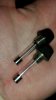
Thanks for the feedback. So we would imagine the fuses are fast-blow in the HK930 in the speaker and ac line? I asked somebody local and he thought they should be fast blow too. I showed him what was in there and they appear to be slow blow? (See picture) They are the type with plastic core with fine copper wire wound around it. So regardless if I buy the hifi ones or not, they should be of a different type than what was in there, correct?

I appreciate all your help! I didn't mean to start a war or anything-just thought it would be fun to try a cheap-ish tweak and see what happens.
 

Attachments

  • fuse0.jpg
    fuse0.jpg
    34.7 KB · Views: 13
Theoretically a slow blow should introduce less distortion. It is your woofers you risk by upping it to slow blow or even a higher value. I gather that you wanted to just A/B compare with and without the (regular) fuses. If you actually detect a difference, there are ways to reduce that distortion without eliminating the fuses and thus your protection. One would be to put a very large capacitance across each fuse, and we are talking to do it right that means like 10,000 uF, bipolar and rated for the supply voltages of the amp. That means 4-20,000 uF at probably 50 volts.

I believe that you are not going to hear a significant difference, but it is a nice little experiment. What I have read on fuses causing distortion says that it is only measurable with the most sensitive equipment and under grueling conditions, like near full power at very low frequency. That of course assumes that the fuse element heats up enough to come near the resistance of your speaker wires at least.
 
Thanks for everyone's input. I just have one more question about this receiver. I need to replace the volume pot on this unit as well, but there are so many options when I look online; I'm afraid of ordering the wrong one. I have a schematic and under controls it says: Part # 22028121 Reference # VR501 The description is: VR, Volume, 100k. Also, what brand should I be buying? Any links or recommendations would be helpful. I've never had to order parts before.
 
Back
Top Bottom