• The move to the new server is done. There are some software and database maintenance updates in process. This has us passing the hat around to help out. We appreciate any donations. Seriously, even a dollar helps. The payment page may be found here - https://www.audiokarma.org/support.html

HeathKit Amplifier AA-1800

BJJB Jr.

Active Member
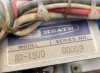
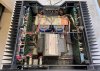
Inherited this original owner set of HeathKit electronics. Includes a AA-1800, AP-1800, AD-1706, AD-1703, and AD-1701. Initially during testing, had sound thru both channels, but I think the right channel pot may have caused the 5A fuses to blow on the bottom right rear circuit board. After cleaning and testing the pots, I put new fuses in, and they both blew on power up without anything connected. For a kit amp it looks to be complicated to get to the top of the circuit board for a looksee. Any help would be appreciated before I make any mistakes looking for what I can't find. All the boards and components look fine without any obvious signs of burns or chars. Dad says the unit has never been touched internally since the 1982 service tag, and everything inside certainly looks that way. I have the ability to re-cap or do some basic testing, but I don't want to get caught up in any output transistor drama if it comes to that. I have a multimeter, capacitance tester, and transistor tester. I only have the manual for the pre-amp, and nothing else at this point. Any input would be appreciated to help me decide if this project is in my best interest.main.jpgmain back.jpgAA1800bottom.jpgAA1800decal.jpgAA1800top.jpgservice decal.jpg
 
Register to hide this ad
My first guess is probably not caps as the main culprit...

Beyond that it's hard to say. You might consider carefully, disconnecting the power supply from the boards to see if on the (IMO) slim possibility it is something in the power supply. It's not completely unheard of. It was a bad rectifier bridge causing the main fuse to blow in a Yamaha amp I picked up at scrap metal prices. $5 and a little time it's still being used today.

Just be sure you don't get bit by a charged up cap...
 
There are 7 fuses that I see, a single main power fuse is good, 4 fuses on the left channel board good, 4 fuses on the right channel board, 2 good (top), and 2 blown (bottom. I may have to pull both boards and do a comparison, as they look to be the same board, just flipped upside down and mounted on each side.
 
Took the amp in to a repair shop. They stated that both of the pre-amp sections need repair, and some of the output transistors were leaking. Repair estimate is $440. Anyone care to comment on whether its worth to repair, or maybe keep system and use alternate amp? Or any suggestions on a qualified repair person in the so. cal area.
Thank you.
 
Depends how you look at it I guess. $440 is lot of money to fix but you can't buy a new big iron amp like that for $400. You may even have a hard time finding a used but working big iron power amp for that kind of money, unless you're not opposed to a pro audio type of amp.

A lot of what you can find and at what price is contingent on where you live and how much time you have to spend looking.
 
Last edited:
There's two ways to look at it:
Strictly from a dollars standpoint it's not worth it, a working AA-1800 is only worth $4-500 so you're basically paying the full value of the amp for the repairs.
However, it is your dad's amp, so it could very well have additional value to you.

If you have any interest in learning to troubleshoot electronics, I'd hang on to it. Heathkit amps are not all that complex and they can be solid performers. Schematics can be a bit tough (Heathkit was pretty litigious about people posting schematics for a while, looks like you can get one from vintagemanuals.com for $36 though) and they have a nasty habit of using Heathkit part numbers instead of real part numbers in their documentation, but these are minor challenges.
 
I'm jealous. Growing up I built a couple Heathkit projects. I never knew they put out anything that big.
But, then again by the time they built it, I was out of college.
 
The value of a complete working amp may not be that high but this thing (as most Heathkit products) is built like a tank and you will not be able to find anything else similar for any lower price. It's unfortunate that you have to hand it off for repair because they need to charge a lot to cover their time.
 
Heathkit's were made to be built by non-specialists. If you are comfortable replacing caps, you are not far out of reach of the skill level needed. I'd buy a copy of the builders manual and take a look at the calibration and troubleshooting sections. See what equipment it needs. Calibrating an amp is pretty straightforward, not requiring much more than a volt/amp meter. (Although I've learned there are some translation issues to modern digital meters.) These tend to be modular builds that allow isolating sections. If you're up for a project, it's worth a shot.

If it were a family piece, I'd put $440 into it if I had it and wanted an amp. This is to repair both preamp and amp? That seems like a fair price. (The amp may go for $4-500 but that whole stack is worth more.)

I'm not sure what "leaking" outputs would do. Those are easy to replace though.

I write as someone whose experience level includes building a Heathkit power supply with my grandfather in 6th grade, recapping and repairing a Scott receiver, and building an amp around one of Rod Elliot's circuit boards. So, I'm not a pro by any measure.
 
Last edited:
Hi:
Please let me know where you live and I will come and pick up this defective equipment for recycle , ASAP so you would not be affected by it. This equip can really make you sick with worry! I am in Mt Pleasant SC.
I think that when you cleaned the pots you may have disturbed the settings and the bias on the transistors may be wrong causing higher than normal current draw. You would need a manual for instruction to reset these pots. I would replace these pots because they can come apart and damage other components.
Replace the phono cables that go from the input pots , replace these pots and the RCA jacks too , these cables can go bad at the plug and the connection may be dirty at the jack. Just take a good quality phono cable and cut it in half to length , that is what Heathkit did , and replace this cable to each board.
If you ever have to ship this amp Heathkit recommends that you remove the power transformer from the wire cage , this is not strong enough to hold this HEAVY trans. The wires unplug for this reason.
I bought and built this when it first came out , still in service and sounds great.
AP 1800 , AA1800 , AJ 1600 , AD 1701 and the rack for installation.
Ed Lipman
 
Thank you so far for the responses. So the repairman stated that each board of the aa-1800 has its own pre-amp and then the output stage transistors. I understand that the rear pots only serve as an input signal volume control, so I asked him if I could bypass the pots and run my audio straight to each board and control volume strictly with the real pre-amp. He said NO, you will blow the amp. Is this correct? I can do all the solder work and replace all the caps, but i can't find the aa-1800 schematic for all the specs. It looks like in order to begin the recap, I will have to unsolder all of the output transistors to get to the top side of the boards, or struggle with installing components through a 1" gap? I have multimeter, cap tester, and a transistor / circuit tester.
bj
 
I don't understand that. The ap-1800 is the preamp. Each amp board in the aa-1800 would have both driver and output stage transistors. But together they make up the amp circuit. That and the "leaky outputs" line raises my suspicions about the shop.

I can't speak to the pots. Are they a problem? Then replacing them wouldn't be too difficult.
If they are input balancing pots, they aren't going to be blowing fuses. That's the issue that needs to be traced and fixed first before any cap replacements.

I've never worked on one of these, but your description of what's required seems unduly complex for what was designed as a kit. Do you have the assembly manual yet? I wouldn't proceed without one. That will also have a troubleshooting section because they didn't always work when a hobbiest assembled them ;-(.
 
I took the amp to another repair place. It is being looked out now. Early estimate is blown output transistor. Repair states transistors of this age can go bad and short. Have to replace all 8 with matching gains. Good thing is the transistors are still made by Motorola.
be a couple of months.
 
A little off subject here, but I really like the way the speaker posts are laid out on yours. I have a smaller version (can't remember the number...1200?,1600?) But the face looks just like yours. It is out in my container/shop and raining now, so I can't easily go look. :) But my posts are too close together to be convenient. Mine has worked fine for years.
 
Zygmo,

You probably have the Heathkit AA-1600, a smaller version of the AA-1800, rated at 125 watts per channel, instead of the 250 watt rating of the AA-1800, Another excellent amp from Heathkit with similar design excellent design objectives, just less power output.
 
Good day. I see this is an old post but here's my two cents.
I would recommend changing the input level controls from the original CTS brand to Allen Bradley Type "J". I too suffered from blowing fuses until I performed this simple swap out.
Also, here's the schematic that I redrew and have highlighted some stuff that may help with T/S.
Chris
 

Attachments

What a cool stack!!
My opinion is that it is worth the money to get it working again if only for the cool-factor.
 
Thank you HVAC for the tip, I have always thought those little pots were an issue. Do you know the value of the pots in ohms? Oh, and thank you for the schematic.

Update - I eventually got the repaired 1800 back from a shop in San Diego. $400 later and repaired. As explained to me, it sounds like this amplifier is rated at 500 watts, not sure if that is per channel. The tech stated that the OUTPUT of the unit is always 500 watts, but that the INPUT potentiometers control the volume, in addition to the Pre-Amp. He said that when the unit was in the ON position, one of the channels had the Positive and Negative wires contact each other which created a direct short and blew all the transistors on one side. The repair apparently is very complicated and time consuming. The unit however is back to sounding great. As HVAC stated above, I will be swapping out those pots for added future security. Still do not know why fuses did not blow in time to protect the transistors though. Hmmph.
 
The AA-1800 is rated at 250 watts per channel. The AA-1600 is rated at 125 watts per channel. I just put my "cool stack" photo somewhere on this site. I thought it would show up here but I guess I need to read the directions on how to do that. Just pulled the entire stack down and am going through each piece and checking operation. So far OK except FM tuner distortion in one channel. May be recap time for that one. Probably going to recap the power amplifier before even powering up. Stack has been sitting unused for years.
 
Back
Top Bottom